• Fri frakt över 249 kr
  • •
  • Snabba leveranser
  • •
  • Billiga böcker
Kundservice

Du är på sajten för privatpersoner.

Företag, bibliotek eller offentlig verksamhet?

Du handlar på classic.bokus.com, där alla dina funktioner finns intakta.
Till classic.bokus.com
Bokus logotyp. Gå till startsidan.
  • Erbjudanden
  • Nyheter
  • Student
  • Topplistor
  • Barn & ungdom
  • Bokus Play
  • E-böcker
  • Pocketböcker
  • Spel & pussel

10% rabatt på allt med kod: NYSTART10 →

Sidfot

Mina sidor

    Hjälp

    • Kundservice
    • Vanliga frågor och svar
    • Frakt och leverans
    • Retur vid ångerrätt
    • Reklamera vara
    • Betalning
    • Köpvillkor
    • Allmänna villkor
    • Information om webbplatsens tillgänglighet

    Om Bokus

    • Om oss
    • Pressrum
    • För studenter
    • För företag
    • För bibliotek och offentlig verksamhet
    • För leverantörer
    • Hållbarhet

    Populärt

    • Aktuella erbjudanden
    • Presentkort
    • Studentlitteratur
    • Nya böcker
    • Topplistor
    • Signerade böcker
    • Engelska böcker

    Inspiration

    • Boktips
    • BookTok
    • Populära bokserier
    • Barnbokskaraktärer
    • Populära författare
    Logotyp för Bokus
    Följ oss på Facebook (extern länk)Följ oss på Instagram (extern länk)Följ oss på YouTube (extern länk)Följ oss på TikTok (extern länk)
    bokus @ CookiesAnpassa cookiesIntegritetspolicyKöpvillkor
    Till Citymail hemsida (extern länk)Till Budbee hemsida (extern länk)Till Postnord hemsida (extern länk)Till Schenker hemsida (extern länk)Till Early Bird hemsida (extern länk)Till Walleys hemsida (extern länk)
    1. Samhälle och politik
    2. Social välfärd och brottslighet
    3. Brottslighet och kriminologi

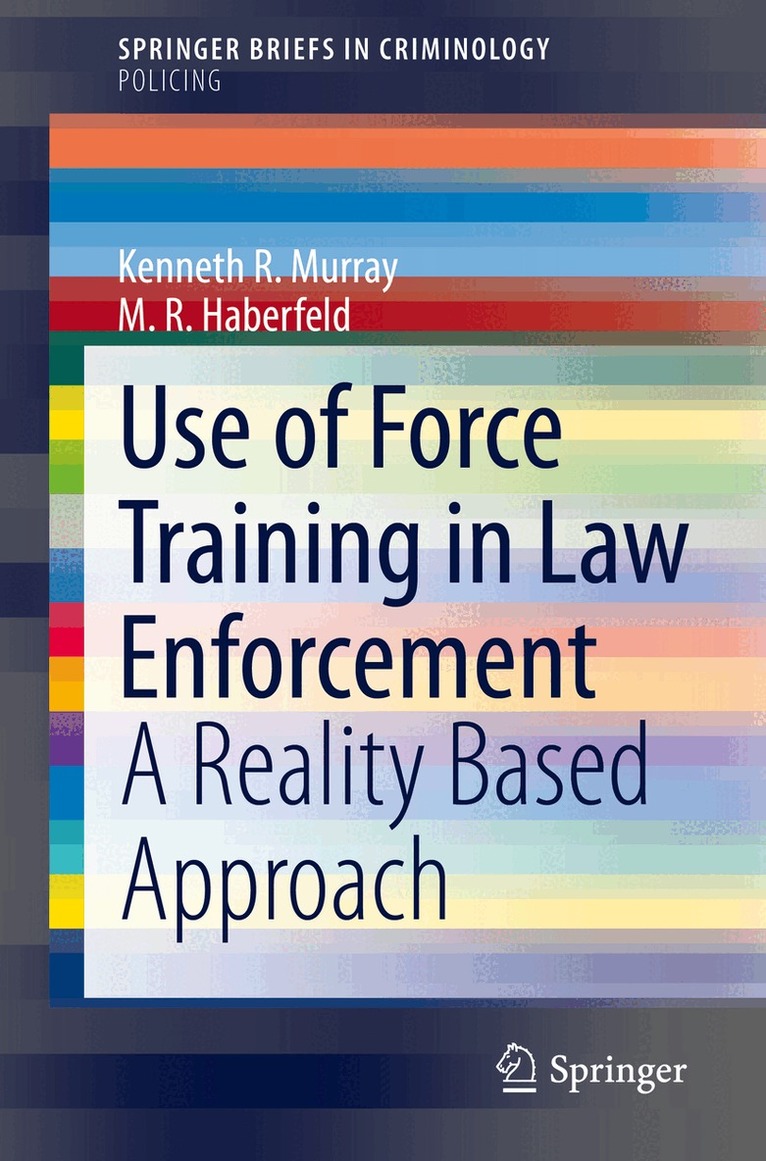
    Use of Force Training in Law Enforcement

    A Reality Based Approach

    AvKenneth R. Murray,M. R. Haberfeld

    Häftad, Engelska, 2020

    Del i serien SpringerBriefs in Criminology

    441 kr

    Beställningsvara. Skickas inom 5-8 vardagar. Fri frakt över 249 kr.

    Beskrivning

    This Brief describes a reality based approach to use-of-force training in law enforcement, an area of growing importance. It explains what scenario-based training is, how it works to improve police-community relations, and provides a guide for how the training can be implemented. This brief will be of value to researchers working to understand the negative impact of use of force on police-community relations, and interested in alternative approaches that integrate academic research with tactical experience.The traditional use-of-force training paradigm is based on relatively brief training sessions with high student-to-instructor ratios. In scenario-based training, officers listen to social science-based lectures, develop a set of scenarios to be tested in a training environment, and conclude with a debriefing session that brings together the theoretical with the practical, including the consequences of the shooting from the tactical, emotional, psychological, social, and economic angles. This work will be of interest to researchers in criminology, criminal justice, sociology, psychology and related fields, policy-makers, particularly with interest in police legitimacy and police-community relations, as well as practitioners in police organization and training.

    Produktinformation

    • Utgivningsdatum:2020-12-09
    • Mått:155 x 235 x 10 mm
    • Vikt:206 g
    • Format:Häftad
    • Språk:Engelska
    • Serie:SpringerBriefs in Criminology
    • Antal sidor:109
    • Förlag:Springer Nature Switzerland AG
    • ISBN:9783030598785

    Utforska kategorier

    • Brottslighet och kriminologi inom Samhälle och politik

    Mer om författaren

    M.R. Haberfeld is a Professor and Chair of the Department of Law, Police Science and Criminal Justice Administration at John Jay College of Criminal Justice in New York City. She was born in Poland and immigrated to Israel as a teenager. She served in the Israel Defense Forces in a counter-terrorist unit and left the army at the rank of a sergeant. Prior to coming to John Jay she served in the Israel National Police and left the force at the rank of lieutenant. She also worked as a special consultant for the U.S. Drug Enforcement Administration in the New York Field Office. She has conducted research in the areas of public and private law enforcement, integrity, and white-collar crime in the United States, Eastern and Western Europe and Israel. In addition to her research, she has also provided leadership training to a number of police agencies. Since 2001 she has been involved in developing, coordinating and teaching in a special educational program at John Jay for the New York City Police Department. Kenneth Murray is the Director of Training for the Armiger Police Training Institute (www.armiger.net) located in the greater Orlando area of Florida. Born in Winnipeg, Canada, he has spent the past twenty years as a police and military trainer, specializing in the field of Reality Based Training. Topics covered in his instructor classes include both the governing principles for effective training as well as the safe use of the broad spectrum of available and emerging technologies designed to improve realism in training for dangerous encounters. He is a member of the advisory board of the Police Policy Studies Council and the Force Science Research Center.

    Innehållsförteckning

    • Introduction: Perceptions based on our past experiences sometimes take us in the wrong direction.-   Introducing the Scenario-Based Training: blending psychology, philosophy and technology.- When all expectations go wrong - Talk, Fight, Shoot or Leave?- Addressing   the “Unconsciously incompetent” mode through scenario-based training.- Changing behavior : scenario-based training versus the impact of theoretical knowledge.-S uspension of judgment   and time out for safety.-   Victim, witness, perpetrator – the psychological and physiological impacts on police officers.- Scenario-Based Training and delivery of the “Unconscious competence." The implementation phase, the u nleashed competence or "the OODA loop” – Observe, Orient, Decide, Act.- Conclusions and recommendations for the future. ​