• Fri frakt över 249 kr
  • •
  • Snabba leveranser
  • •
  • Billiga böcker
Kundservice

Du är på sajten för privatpersoner.

Företag, bibliotek eller offentlig verksamhet?

Du handlar på classic.bokus.com, där alla dina funktioner finns intakta.
Till classic.bokus.com
Bokus logotyp. Gå till startsidan.
  • Erbjudanden
  • Nyheter
  • Student
  • Topplistor
  • Barn & ungdom
  • Bokus Play
  • E-böcker
  • Pocketböcker
  • Spel & pussel

10% rabatt på allt med kod NYSTART10 →

Sidfot

Mina sidor

    Hjälp

    • Kundservice
    • Vanliga frågor och svar
    • Frakt och leverans
    • Retur vid ångerrätt
    • Reklamera vara
    • Betalning
    • Köpvillkor
    • Allmänna villkor
    • Information om webbplatsens tillgänglighet

    Om Bokus

    • Om oss
    • Pressrum
    • För studenter
    • För företag
    • För bibliotek och offentlig verksamhet
    • För leverantörer
    • Hållbarhet

    Populärt

    • Aktuella erbjudanden
    • Presentkort
    • Studentlitteratur
    • Nya böcker
    • Topplistor
    • Signerade böcker
    • Engelska böcker

    Inspiration

    • Boktips
    • BookTok
    • Populära bokserier
    • Barnbokskaraktärer
    • Populära författare
    Logotyp för Bokus
    Följ oss på Facebook (extern länk)Följ oss på Instagram (extern länk)Följ oss på YouTube (extern länk)Följ oss på TikTok (extern länk)
    bokus @ CookiesAnpassa cookiesIntegritetspolicyKöpvillkor
    Till Citymail hemsida (extern länk)Till Budbee hemsida (extern länk)Till Postnord hemsida (extern länk)Till Schenker hemsida (extern länk)Till Early Bird hemsida (extern länk)Till Walleys hemsida (extern länk)
    1. Psykologi och pedagogik
    2. Psykologi

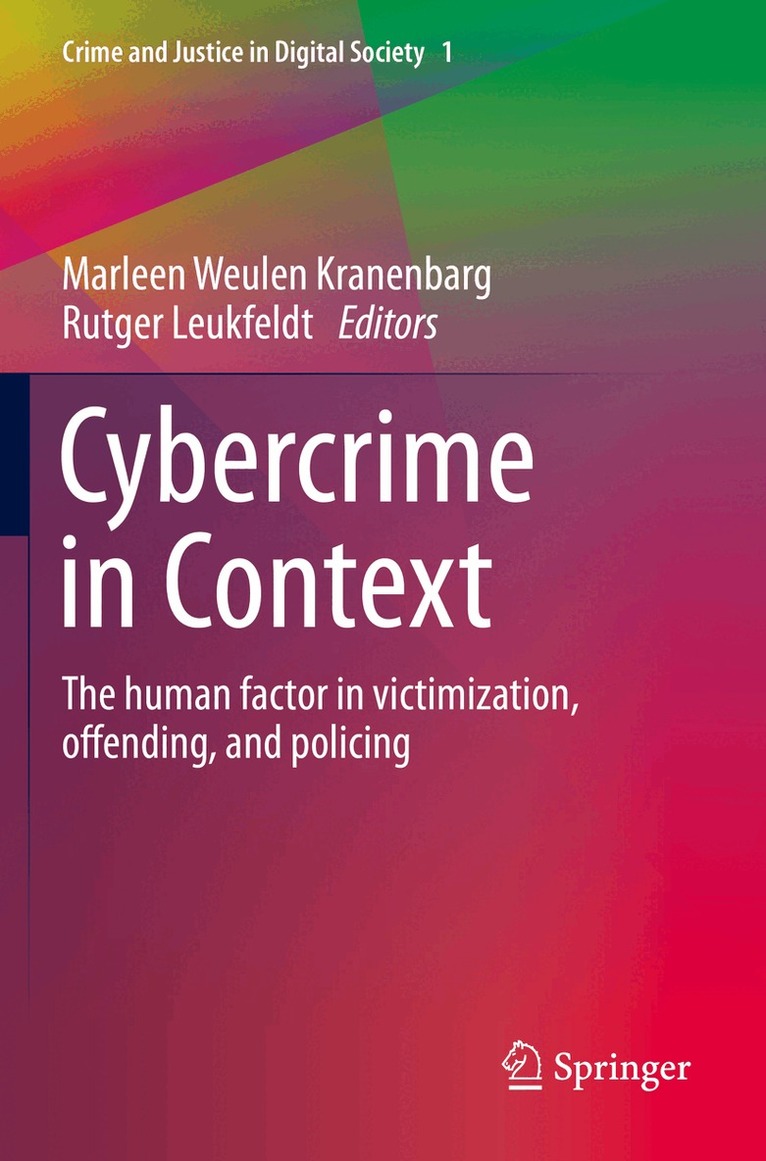
    Cybercrime in Context

    The human factor in victimization, offending, and policing

    AvMarleen Weulen Kranenbarg,Rutger Leukfeldt

    Häftad, Engelska, 2022

    Del i serien Crime and Justice in Digital Society

    1 791 kr

    Beställningsvara. Skickas inom 10-15 vardagar. Fri frakt över 249 kr.

    Beskrivning

    This book is about the human factor in cybercrime: its offenders, victims and parties involved in tackling cybercrime. It takes a diverse international perspective of the response to and prevention of cybercrime by seeking to understand not just the technological, but the human decision-making involved.This edited volume represents the state of the art of research on the human factor in cybercrime, addressing its victims, offenders, and policing. It originated at the Second annual Conference on the Human Factor in Cybercrime, held in The Netherlands in October 2019, bringing together empirical research from a variety of disciplines, and theoretical and methodological approaches.This volume will be of particular interest to researchers and students in cybercrime and the psychology of cybercrime, as well as policy makers and law enforcement interested in prevention and detection.

    Produktinformation

    • Utgivningsdatum:2022-05-04
    • Mått:155 x 235 x 23 mm
    • Vikt:628 g
    • Format:Häftad
    • Språk:Engelska
    • Serie:Crime and Justice in Digital Society
    • Antal sidor:407
    • Förlag:Springer Nature Switzerland AG
    • ISBN:9783030605292

    Utforska kategorier

    • Psykologi inom Psykologi och pedagogik
    • IT-rätt och kommunikationsrätt inom Juridik
    • Brottslighet och kriminologi inom Samhälle och politik

    Mer om författaren

    Dr. Marleen Weulen Kranenbarg is an assistant professor at VU Amsterdam, The Netherlands. Her research mostly focuses on cyber-dependent offenders. In her doctoral dissertation she empirically compared traditional offenders to cyber-offenders on four important domains in criminology: 1. offending over the life-course, 2. personal and situational risk factors for offending and victimization, 3. similarity in deviance in the social network, and 4. motivations related to different offense clusters. She recently started a large-scale longitudinal study into actual vs. perceived cybercriminal behaviour of offline vs. online social ties among youth. Marleen is also a research fellow of the NSCR (Netherlands Institute for the Study of Crime and Law Enforcement), board member of the ESC Cybercrime Working Group, and part of the steering committee of the IIRCC (International Interdisciplinary Research Consortium on Cybercrime).Dr. Rutger Leukfeldt is Senior Researcher and the cybercrime cluster coordinator at the Netherlands Institute for the Study of Crime and Law Enforcement (NSCR) and Academic Director of Centre of Expertise Cybersecurity of the Hague University of Applied Sciences. His work focusses on the human factor in cybercrime and cybersecurity. Recent examples include studies into pathways into cybercrime, organized cybercrime and risk profiles of cybercrime victims. Over de past decade, Rutger worked on various studies for public and private organizations. Furthermore, he received a Marie Curie Individual Fellowship (EU grant for promising researchers) and a Veni grant (Dutch grant for highly promising researchers) to carry out a study into cybercriminal networks. Rutger is currently the chair of the Cybercrime Working Group of the European Society of Criminology (ESC).

    Innehållsförteckning

    • 1. Introduction.- 2. The Annual Conference on the Human Factor in Cybercrime: An analysis of participation in the 2018 and 2019 meetings.- 3. Cyber awareness versus actual online behaviour: a population based survey experiment.- 4. Susceptibility to Malware-Based Phishing and Smishing Attacks: An Experimental examination of the efficacy of thoughtfully reflective decision making and routine activities.- 5. No Gambles with Information Security: The Neuropsychology of a Ransomware Attack.- 6. Shifting the blame? Investigation of user compliance with digital payment regulations.- 7. The risk of an employee’s cyber misconduct on a Social Media Site: A potential threat factor for your organization’s brand reputation and business endurance.- 8. Situating the effects of cybercrime victimization within the scope public safety: An exploratory study.- 9. Show me the money! Identy fraud financial losses and victims' efforts for reimbursement.- 10. The Impact of CyberCrime: The Victims’ Perspectives.- 11. The Prevention of Financial Cybercrimes: What Do Clients Think?.- 12. Saint or Satan? Moral Development and Dark Triad Influences on Cyber-Criminal Intent.- 13. Cybercrime versus traditional crime: empirical evidence for clusters of offenses and related motivations.- 14. Gender Similarities (and Some Differences) Among Cybercrime Offenders Under Federal Supervision in the United States.- 15. Exploring the Role of Gender in Online Cybercrime Subcultures.- 16. Predicting the popularity of online account credentials advertisements.- 17. Child sexual exploitation communities on the Darkweb: How organized are they?.- 18. The Changing Division of Criminal Labour within the Modern Cybercrime Ecosystem.-19. Infrastructural power: mapping struggles over meaning, crime, and control in the Tor anonymity network.- 20. Law and Human Perspectives to Cybercrime Perpetration in Africa.- 21. Cybercrime reporting behaviors among small and medium-sized enterprises in the Netherlands.– 22. Textmining for cybercrime in registrations of the Dutch police.