Häftad, Engelska, 2022
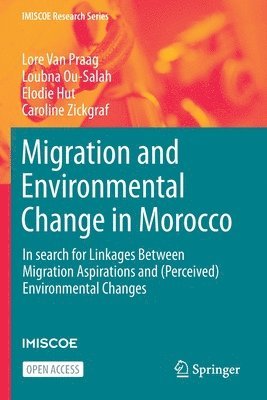
Migration and Environmental Change in Morocco
Av Lore Van Praag, Loubna Ou-Salah, Elodie Hut
442 kr
Beställningsvara. Skickas inom 10-15 vardagar. Fri frakt över 249 kr.
Beskrivning
This open access book studies the migration aspirations and trajectories of people living in two regions in Morocco that are highly affected by environmental change or emigration, namely Tangier and Tinghir, as well as the migration trajectories of immigrants coming from these regions currently living in Belgium. This book departs from the development of a new theoretical framework on the relationship between environmental changes and migration that can be applied to the Moroccan case. Qualitative research conducted in both countries demonstrate how the interplay between migration and environmental factors is not as straightforward as it seems, due to its wider social, political, economic, demographic and environmental context. Findings show how existing cultures of migration, remittances, views on nature and discourses on climate change create distinct abilities, capacities and aspirations to migrate due to environmental changes. The results illustrate how migration and environmental factors evolve gradually and mutually influence each other. In doing so, this book offers new insights in the ways migration can be seen as an adaptation strategy to deal with environmental change in Morocco.
Produktinformation
- Utgivningsdatum: 2022-01-19
- Mått: 156 x 234 x 11 mm
- Vikt: 299 g
- Format: Häftad
- Språk: Engelska
- Antal sidor: 208
- Förlag: Springer
- ISBN: 9783030613921
Utforska kategorier
Betyg & recensioner
0 recensioner
Inga recensioner tillgängliga.