• Fri frakt över 249 kr
  • •
  • Snabba leveranser
  • •
  • Billiga böcker
Kundservice

Du är på sajten för privatpersoner.

Företag, bibliotek eller offentlig verksamhet?

Du handlar på classic.bokus.com, där alla dina funktioner finns intakta.
Till classic.bokus.com
Bokus logotyp. Gå till startsidan.
  • Erbjudanden
  • Student
  • Topplistor
  • Barn & ungdom
  • Bokus Play
  • E-böcker
  • Ljudböcker
  • Pocketböcker
  • Spel och pussel

Pocketfynda! Hundratals böcker för 49 kr/st →

Sidfot

Mina sidor

    Hjälp

    • Kundservice
    • Vanliga frågor och svar
    • Frakt och leverans
    • Retur vid ångerrätt
    • Reklamera vara
    • Betalning
    • Köpvillkor
    • Allmänna villkor
    • Information om webbplatsens tillgänglighet

    Om Bokus

    • Om oss
    • Pressrum
    • För studenter
    • För företag
    • För bibliotek och offentlig verksamhet
    • För leverantörer
    • Hållbarhet

    Populärt

    • Aktuella erbjudanden
    • Presentkort
    • Studentlitteratur
    • Nya böcker
    • Topplistor
    • Signerade böcker
    • Engelska böcker

    Inspiration

    • Boktips
    • BookTok
    • Barnbokskaraktärer
    • Populära författare
    Logotyp för Bokus
    Följ oss på Facebook (extern länk)Följ oss på Instagram (extern länk)Följ oss på YouTube (extern länk)Följ oss på TikTok (extern länk)
    bokus @ CookiesAnpassa cookiesIntegritetspolicyKöpvillkor
    Till Citymail hemsida (extern länk)Till Budbee hemsida (extern länk)Till Postnord hemsida (extern länk)Till Schenker hemsida (extern länk)Till Early Bird hemsida (extern länk)Till Walleys hemsida (extern länk)
    1. Samhälle och politik
    2. Politik och statsskick
    3. Statsvetenskap och politisk teori

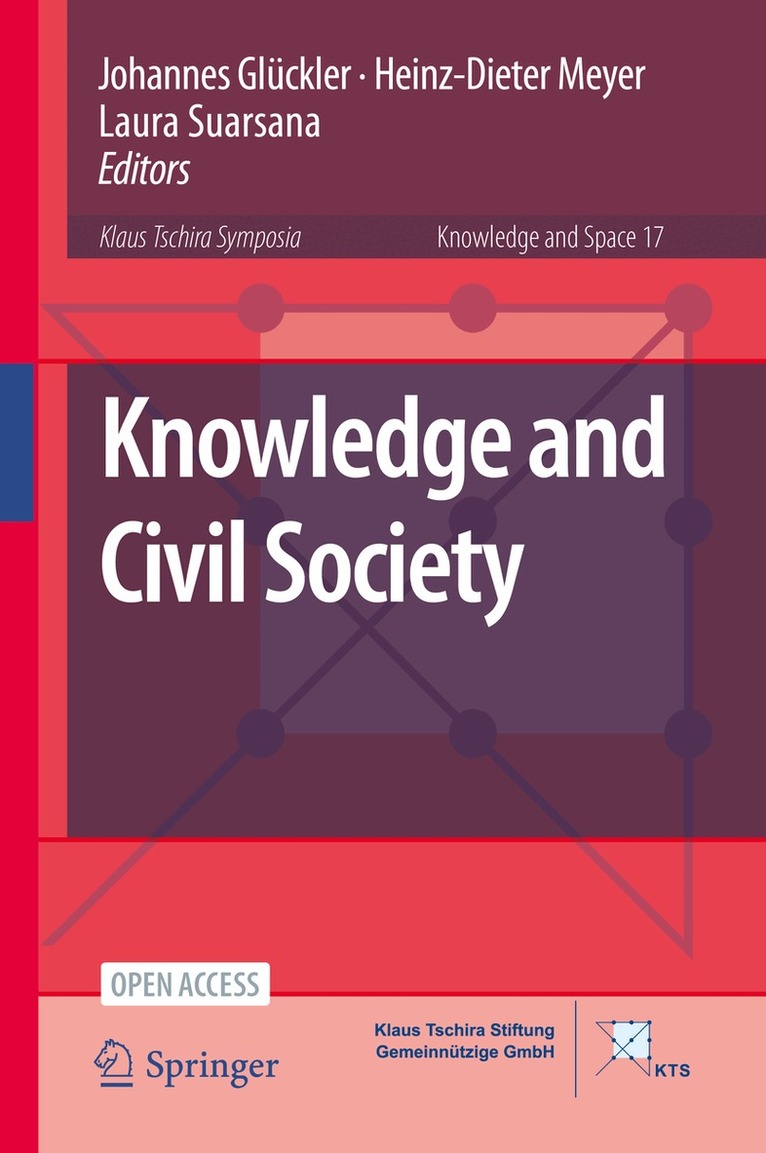
    Knowledge and Civil Society

    AvJohannes Glückler,Heinz-Dieter Meyer

    Inbunden, Engelska, 2021

    Del i serien Knowledge and Space

    229 kr

    Skickas . Fri frakt över 249 kr.

    Beskrivning

    This open access book focuses on the role of civil society in the creation, dissemination, and interpretation of knowledge in geographical contexts. It offers original, interdisciplinary and counterintuitive perspectives on civil society. The book includes reflections on civil and uncivil society, the role of civil society as a change agent, and on civil society perspectives of undone science. Conceptual approaches go beyond the tripartite division of public, private and civic sectors to propose new frameworks of civic networks and philanthropic fields, which take an inclusive view of the connectivity of civic agency across sectors. This includes relational analyses of epistemic power in civic knowledge networks as well as of regional giving and philanthropy. The original empirical case studies examine traditional forms of civic engagement, such as the German landwomen’s associations, as well as novel types of organizations, such as giving circles and time banks in their geographical context. The book also offers insider reflections on doing civil society, such as the cases of the Umbrella Movement in Hong Kong, epistemic activism in the United States, and the #FeesMustFall movement in South Africa.

    Produktinformation

    • Utgivningsdatum:2021-12-09
    • Mått:155 x 235 x 27 mm
    • Vikt:636 g
    • Format:Inbunden
    • Språk:Engelska
    • Serie:Knowledge and Space
    • Antal sidor:316
    • Förlag:Springer Nature Switzerland AG
    • ISBN:9783030711467

    Utforska kategorier

    • Statsvetenskap och politisk teori inom Samhälle och politik
    • Geografi inom Naturvetenskap och teknik

    Mer om författaren

    Johannes Glückler is Professor of Economic and Social Geography and Fellow of the Marsilius Center for Advanced Studies at Heidelberg University, Germany. In his research he follows a relational perspective and builds on theories of social networks and institutions in the study of the geography of knowledge and regional development. He is a founding board member of the German Society for Social Network Research DGNet and co-founder of the M.Sc. Governance of Risks and Resources at the Heidelberg Center for Latin America in Santiago de Chile.Heinz Dieter Meyer is Professor of Education Governance and Policy (MA Sociology, Goettingen University, Germany; PhD Organization Theory, Cornell University, USA. Interests: Theory, Policy, Civil Society; Mindfulness in Education. Authorships: “The Design of the University: German, American, 'World Class'”; Meyer / Benavot: “PISA, Power, Policy” (w/ Benavot); Meyer / Rowan: "The New Institutionalism in Education". Meyer / Boyd: "Education between States, Markets, and Civil Society". Awards: National Endowment of the Humanities (NEH); Harman Fellow, Harvard University.Laura Suarsana is research associate at the University of Bremen, Germany, where she works on regional innovation and regional network governance. Before, she was research associate at the Economic Geography Research Group at the Institute of Geography at Heidelberg University and has been co-editor of several volumes of the Springer books series on Knowledge & Space. Her research focuses on the relation between civil society, innovation and regional development, as well as on the analysis of networks in civil society, philanthropy and corporate social responsibility. She also has experience as a practitioner in regional development, having worked several years for a regional development agency.

    Innehållsförteckning

    • Chapter 1. The Place of Civil Society in the Making of Knowledge.- Part I: (Re-)Thinking Civil Society.- Chapter 2. The Dialectic of Civil and Uncivil Society—Fragility, Fault Lines, and Countervailing Forces.-Chapter 3. Civil Society as an Agent of Change.- Chapter 4. Undone Science and Smart Cities: Civil Society Perspectives on Risk and Emerging Technologies.- Part II: Analyzing Civil Society Organizations.- Chapter 5. Specialists for Crumble Cakes? The German LandFrauen Organizations in Social Innovation and as Educational, Social, and Political Institutions.- Chapter 6. Schools of Democracy? Giving Circles and the Civic and Political Participation of Collaborative Philanthropists.- Chapter 7. Time Banks as Transient Civic Organizations? Exploring the Dynamics of Decline.- Part III: Spaces, Networks and Fields.- Chapter 8. Civil Society as Networks of Issues and Associations: The Case of Food.- Chapter 9. The Geography of Giving in the Philanthropic Field.- Chapter 10. Global Authenticity, Local Authority: Epistemic Power, Discursive Geographies, and the Creation of Civil Society Knowledge Networks.- Part IV: Doing Civil Society.- Chapter 11. Democracy Movement and Alternative Knowledge in Hong Kong.- Chapter 12. Epistemic Activism in the United States: Examining Meetings Across the Silos of Civil Society.- Chapter 13. Seeding a New World: Lessons From the #FeesMustFall Movement for the Advancement of Social Justice.- Chapter 14. Civility, Education, and the Embodied Mind—Three Approaches to a New Sentimental Education.