• Fri frakt över 249 kr
  • •
  • Snabba leveranser
  • •
  • Billiga böcker
Kundservice

Du är på sajten för privatpersoner.

Företag, bibliotek eller offentlig verksamhet?

Du handlar på classic.bokus.com, där alla dina funktioner finns intakta.
Till classic.bokus.com
Bokus logotyp. Gå till startsidan.
  • Erbjudanden
  • Nyheter
  • Student
  • Topplistor
  • Barn & ungdom
  • Bokus Play
  • E-böcker
  • Pocketböcker
  • Spel & pussel

10% rabatt på allt med kod: NYSTART10 →

Sidfot

Mina sidor

    Hjälp

    • Kundservice
    • Vanliga frågor och svar
    • Frakt och leverans
    • Retur vid ångerrätt
    • Reklamera vara
    • Betalning
    • Köpvillkor
    • Allmänna villkor
    • Information om webbplatsens tillgänglighet

    Om Bokus

    • Om oss
    • Pressrum
    • För studenter
    • För företag
    • För bibliotek och offentlig verksamhet
    • För leverantörer
    • Hållbarhet

    Populärt

    • Aktuella erbjudanden
    • Presentkort
    • Studentlitteratur
    • Nya böcker
    • Topplistor
    • Signerade böcker
    • Engelska böcker

    Inspiration

    • Boktips
    • BookTok
    • Populära bokserier
    • Barnbokskaraktärer
    • Populära författare
    Logotyp för Bokus
    Följ oss på Facebook (extern länk)Följ oss på Instagram (extern länk)Följ oss på YouTube (extern länk)Följ oss på TikTok (extern länk)
    bokus @ CookiesAnpassa cookiesIntegritetspolicyKöpvillkor
    Till Citymail hemsida (extern länk)Till Budbee hemsida (extern länk)Till Postnord hemsida (extern länk)Till Schenker hemsida (extern länk)Till Early Bird hemsida (extern länk)Till Walleys hemsida (extern länk)
    1. Psykologi och pedagogik
    2. Pedagogik

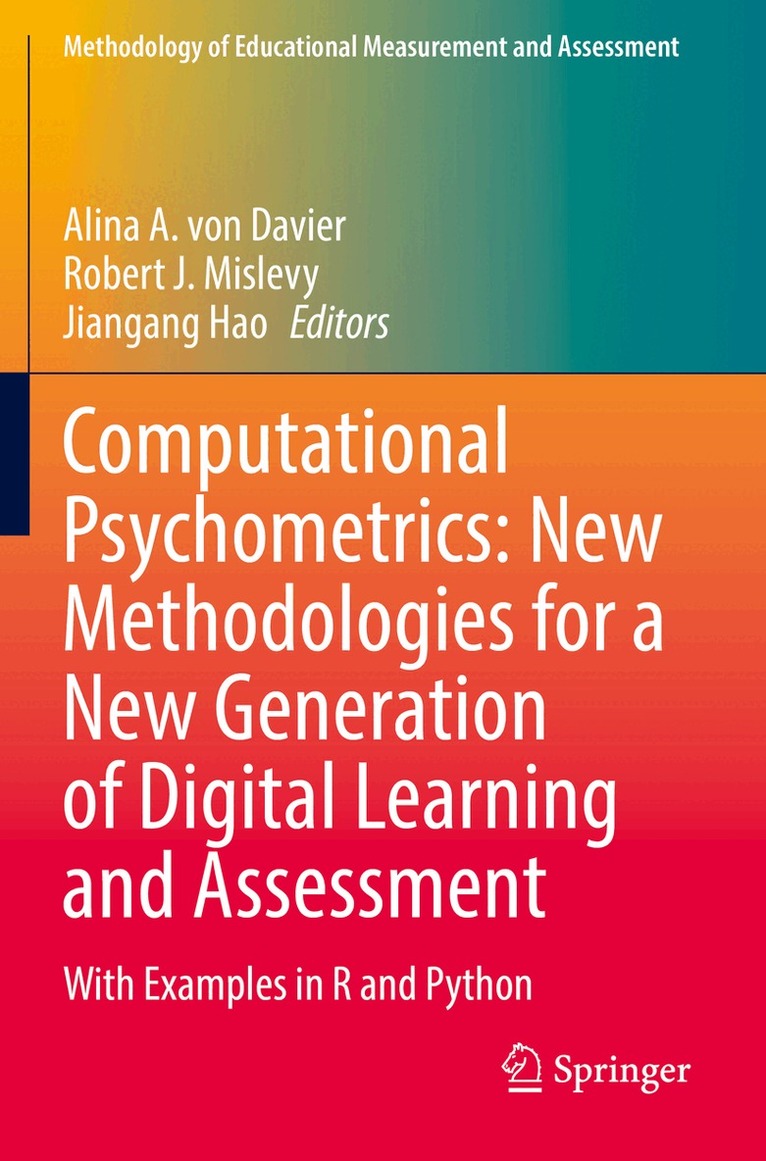
    Computational Psychometrics: New Methodologies for a New Generation of Digital Learning and Assessment

    With Examples in R and Python

    AvAlina A. von Davier,Robert J. Mislevy

    Häftad, Engelska, 2022

    Del i serien Methodology of Educational Measurement and Assessment

    1 685 kr

    Beställningsvara. Skickas inom 10-15 vardagar. Fri frakt över 249 kr.

    Beskrivning

    This book defines and describes a new discipline, named “computational psychometrics,” from the perspective of new methodologies for handling complex data from digital learning and assessment. The editors and the contributing authors discuss how new technology drastically increases the possibilities for the design and administration of learning and assessment systems, and how doing so significantly increases the variety, velocity, and volume of the resulting data. Then they introduce methods and strategies to address the new challenges, ranging from evidence identification and data modeling to the assessment and prediction of learners’ performance in complex settings, as in collaborative tasks, game/simulation-based tasks, and multimodal learning and assessment tasks.Computational psychometrics has thus been defined as a blend of theory-based psychometrics and data-driven approaches from machine learning, artificial intelligence, and data science. All these together provide a better methodological framework for analysing complex data from digital learning and assessments. The term “computational” has been widely adopted by many other areas, as with computational statistics, computational linguistics, and computational economics. In those contexts, “computational” has a meaning similar to the one proposed in this book: a data-driven and algorithm-focused perspective on foundations and theoretical approaches established previously, now extended and, when necessary, reconceived. This interdisciplinarity is already a proven success in many disciplines, from personalized medicine that uses computational statistics to personalized learning that uses, well, computational psychometrics. We expect that this volume will be of interest not just within but beyond the psychometric community.In this volume, experts in psychometrics, machine learning, artificial intelligence, data science and natural language processing illustrate their work, showing how the interdisciplinary expertise of each researcher blends into a coherent methodological framework to deal with complex data from complex virtual interfaces. In the chapters focusing on methodologies, the authors use real data examples to demonstrate how to implement the new methods in practice. The corresponding programming codes in R and Python have been included as snippets in the book and are also available in fuller form in the GitHub code repository that accompanies the book.

    Produktinformation

    • Utgivningsdatum:2022-12-15
    • Mått:155 x 235 x 14 mm
    • Vikt:467 g
    • Format:Häftad
    • Språk:Engelska
    • Serie:Methodology of Educational Measurement and Assessment
    • Antal sidor:262
    • Förlag:Springer Nature Switzerland AG
    • ISBN:9783030743963

    Utforska kategorier

    • Pedagogik inom Psykologi och pedagogik
    • Sociologi inom Samhälle och politik
    • Psykologisk metod inom Psykologi och pedagogik

    Innehållsförteckning

    • 1. Introduction. Computational Psychometrics: Towards a Principled Integration of Data Science and Machine Learning Techniques into Psychometrics (Alina A. von Davier, Robert Mislevy and Jiangang Hao).- Part I. Conceptualization. 2. Next generation learning and assessment: what, why and how (Robert Mislevy).- 3. Computational psychometrics (Alina A. von Davier, Kristen DiCerbo and Josine Verhagen).- 4. Virtual performance-based assessments (Jessica Andrews-Todd, Robert Mislevy, Michelle LaMar and Sebastiaan de Klerk).- 5. Knowledge Inference Models Used in Adaptive Learning (Maria Ofelia Z. San Pedro and Ryan S. Baker).- Part II. Methodology. 6. Concepts and models from Psychometrics (Robert Mislevy and Maria Bolsinova).- 7. Bayesian Inference in Large-Scale Computational Psychometrics (Gunter Maris, Timo Bechger and Maarten Marsman).- 8. Data science perspectives (Jiangang Hao and Robert Mislevy).- 9. Supervised machine learning (Jiangang Hao).- 10. Unsupervised machine learning (Pak Chunk Wong).- 11. AI and deep learning for educational research (Yuchi Huang and Saad M. Khan).- 12. Time series and stochastic processes (Peter Halpin, Lu Ou and Michelle LaMar).- 13. Social network analysis (Mengxiao Zhu).- 14. Text mining and automated scoring (Michael Flor and Jiangang Hao).