• Fri frakt över 249 kr
  • •
  • Snabba leveranser
  • •
  • Billiga böcker
Kundservice

Du är på sajten för privatpersoner.

Företag, bibliotek eller offentlig verksamhet?

Du handlar på classic.bokus.com, där alla dina funktioner finns intakta.
Till classic.bokus.com
Bokus logotyp. Gå till startsidan.
  • Erbjudanden
  • Student
  • Topplistor
  • Barn & ungdom
  • Bokus Play
  • E-böcker
  • Ljudböcker
  • Pocketböcker
  • Spel och pussel

Pocketfynda! Hundratals böcker för 49 kr/st →

Sidfot

Mina sidor

    Hjälp

    • Kundservice
    • Vanliga frågor och svar
    • Frakt och leverans
    • Retur vid ångerrätt
    • Reklamera vara
    • Betalning
    • Köpvillkor
    • Allmänna villkor
    • Information om webbplatsens tillgänglighet

    Om Bokus

    • Om oss
    • Pressrum
    • För studenter
    • För företag
    • För bibliotek och offentlig verksamhet
    • För leverantörer
    • Hållbarhet

    Populärt

    • Aktuella erbjudanden
    • Presentkort
    • Studentlitteratur
    • Nya böcker
    • Topplistor
    • Signerade böcker
    • Engelska böcker

    Inspiration

    • Boktips
    • BookTok
    • Barnbokskaraktärer
    • Populära författare
    Logotyp för Bokus
    Följ oss på Facebook (extern länk)Följ oss på Instagram (extern länk)Följ oss på YouTube (extern länk)Följ oss på TikTok (extern länk)
    bokus @ CookiesAnpassa cookiesIntegritetspolicyKöpvillkor
    Till Citymail hemsida (extern länk)Till Budbee hemsida (extern länk)Till Postnord hemsida (extern länk)Till Schenker hemsida (extern länk)Till Early Bird hemsida (extern länk)Till Walleys hemsida (extern länk)
    1. Data och IT
    2. Systemvetenskap och AI

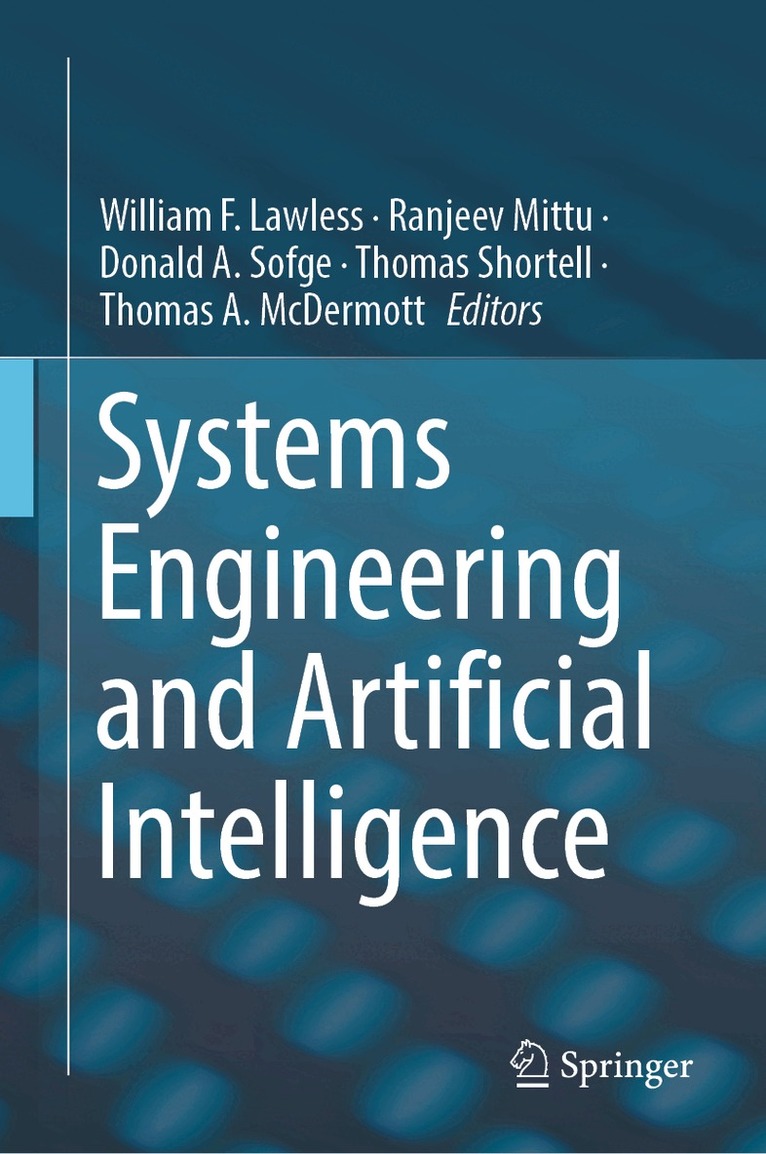
    Systems Engineering and Artificial Intelligence

    AvWilliam F. Lawless,Ranjeev Mittu

    Inbunden, Engelska, 2021

    1 993 kr

    Beställningsvara. Skickas inom 10-15 vardagar. Fri frakt över 249 kr.

    Beskrivning

    This book provides a broad overview of the benefits from a Systems Engineering design philosophy in architecting complex systems composed of artificial intelligence (AI), machine learning (ML) and humans situated in chaotic environments.   The major topics include emergence, verification and validation of systems using AI/ML and human systems integration to develop robust and effective human-machine teams—where the machines may have varying degrees of autonomy due to the sophistication of their embedded AI/ML.  The chapters not only describe what has been learned, but also raise questions that must be answered to further advance the general Science of Autonomy.  The science of how humans and machines operate as a team requires insights from, among others, disciplines such as the social sciences, national and international jurisprudence, ethics and policy, and sociology and psychology. The social sciences inform how context is constructed, how trust is affected when humans and machines depend upon each other and how human-machine teams need a shared language of explanation. National and international jurisprudence determine legal responsibilities of non-trivial human-machine failures, ethical standards shape global policy, and sociology provides a basis for understanding team norms across cultures. Insights from psychology may help us to understand the negative impact on humans if AI/ML based machines begin to outperform their human teammates and consequently diminish their value or importance. This book invites professionals and the curious alike to witness a new frontier open as the Science of Autonomy emerges.

    Produktinformation

    • Utgivningsdatum:2021-11-02
    • Mått:155 x 235 x 40 mm
    • Vikt:1 016 g
    • Format:Inbunden
    • Språk:Engelska
    • Antal sidor:569
    • Upplaga:21001
    • Förlag:Springer Nature Switzerland AG
    • ISBN:9783030772826

    Utforska kategorier

    • Systemvetenskap och AI inom Data och IT
    • Människa – datorinteraktion inom Data och IT
    • Artificiell intelligens inom Data och IT

    Mer om författaren

    William Lawless is Professor of Mathematics and Psychology. Dr. Lawless has published over fifty book chapters and/or journal articles and is featured in more than 120 peer-reviewed conference publications.Ranjeev Mittu is the Branch Head for the Information Management and Decision Architectures Branch within the Information Technology Division at the U.S. Naval Research Laboratory. The research within the branch is focused on visual analytics and augmented reality, immersive simulations, intelligent decision support applications, distributed systems and enterprise and service oriented architectures.Donald A. Sofge is a Computer Scientist with the Naval Research Laboratory, Washington, DC, USA, where he leads the Distributed Autonomous Systems Group. He has extensive expertise in the application of artificial intelligence, machine learning, machine vision (and other forms of artificial perception), planning and control theory to robotic systems.Thomas Shortell is a Systems Engineer at Lockheed Martin. He has been awarded the PhD degree by Drexel University.Tom McDermott is a leader, educator, and innovator in multiple technology fields. He currently serves as Deputy Director of the Systems Engineering Research Center at Stevens Institute of Technology in Hoboken, NJ, as well as a consultant specializing in strategic planning for uncertain environments. He serves as Director of Strategic Integration on the Board of the International Council on Systems Engineering.

    Innehållsförteckning

    • W.F. Lawless, R. Mittu, D.A. Sofge, T. Shortell and T.A. McDermott, Jr.: Introduction to the Subject and the Chapters.- P. Cummings, N. Schurr, A. Naber, Charlie and D. Serfaty: Recognizing Artificial Intelligence: The Key to Unlocking Human AI Teams.- T.A. McDermott, M.R. Blackburn and P.A. Beling: Artificial Intelligence and Future of Systems Engineering.- N.J. Cooke and W.F. Lawless: Effective Human-Artificial Intelligence Teaming.- M. Steinberg: Towards Systems Theoretical Foundations for Human-Autonomy Teams.- J. Llinas, R. Mittu and H. Fouad: Systems Engineering for Artificial Intelligence-based Systems: A Review in Time.- K.E. Schaefer, B. Perelman, J. Rexwinkle, J. Canady, C. Neubauer, N. Waytowich, G. Larkin, K. Cox, M. Geuss, G. Gremillion, J.S. Metcalfe, A. DeCostanza and A. Marathe: Human-Autonomy Teaming for the Tactical Edge: The Importance of Humans in Artificial Intelligence Research and Development.- Stephen Russell, B. Jalaian and I.S. Moskowitz: Re-orienting towardsthe Science of the Artificial: Engineering AI Systems.- M. Sheehan and O. Yakimenko: The Department of Navy’s Digital Transformation with the Digital System Architecture, Strangler Patterns, Machine Learning, and Autonomous Human-Machine Teaming.- M. Mylrea, M. Nielsen, J. John and M. Abbaszade: AI Driven Cyber Physical Industrial Immune System for Defenders of Critical Energy Infrastructure.- I.S. Moskowitz, N.L. Brown and Z. Goldstein: A fractional Brownian Motion Approach to Psychological and Team Diffusion Problems.- P. Deignan: Human-Machine Understanding: The Utility of Causal Models and Counterfactuals.- M. Garcia, T. Goranson and B. Cardier: An Executive for Autonomous Systems, Inspired by Fear Memory Extinction.- E. Santos Jr., C. Nyanhongoa, H. Nguyen, K. Joo Kima, Gr. Hydea: Contextual Evaluation of Human-Machine Team Effectiveness.- S.-H. Chen: Humanity in the Era of Autonomous Human-Machine Teams.- J C. Wood, W F Lawless: Transforming the system of military medical research: An Institutional History of the Department of Defense’s (DoD) First Electronic Institutional Review Board Enterprise IT System.- N. Peters, M. Ugolini and G. Bowers: Collaborative communication and intelligent interruption systems.- N. Shadad, A.U. Kulkarni and S. Alejandro: Shifting Paradigms in Verification and Validation of AI-Enabled Systems: A Systems-Theoretic perspective.- A.D. Cobb, B. Jalaian, N.D. Bastian and S. Russell: Towards Safe Decision-Making via Uncertainty Quantification in Machine Learning.- M. Wollowski, L. Chen, X. Chen, Y. Cui, J. Knierman and X. Liu: Engineering Context from the Ground Up.- N. Hili, A. Albore and J. Baclet: From Informal Sketches to Systems Engineering Models Using AI Plan Recognition.- R.P.  Quandt: An Analogy of Sentence Mood and Use.- M. Akiyoshi, J. Whitton, I. Charnley-Parryc and W.F. Lawless: Effective Decision Rules for Systems of Public Engagement in Radioactive Waste Disposal: Evidence from the United States, the United Kingdom, and Japan.- B. Cardier, A. Nieslen, J. Shull and L. Sanford: Outside the Lines: Visualizing Influence Across Heterogenous Contexts in PTSD.