• Fri frakt över 249 kr
  • •
  • Snabba leveranser
  • •
  • Billiga böcker
Kundservice

Du är på sajten för privatpersoner.

Företag, bibliotek eller offentlig verksamhet?

Du handlar på classic.bokus.com, där alla dina funktioner finns intakta.
Till classic.bokus.com
Bokus logotyp. Gå till startsidan.
  • Erbjudanden
  • Nyheter
  • Student
  • Topplistor
  • Barn & ungdom
  • Bokus Play
  • E-böcker
  • Pocketböcker
  • Spel & pussel

10% rabatt på allt med kod: NYSTART10 →

Sidfot

Mina sidor

    Hjälp

    • Kundservice
    • Vanliga frågor och svar
    • Frakt och leverans
    • Retur vid ångerrätt
    • Reklamera vara
    • Betalning
    • Köpvillkor
    • Allmänna villkor
    • Information om webbplatsens tillgänglighet

    Om Bokus

    • Om oss
    • Pressrum
    • För studenter
    • För företag
    • För bibliotek och offentlig verksamhet
    • För leverantörer
    • Hållbarhet

    Populärt

    • Aktuella erbjudanden
    • Presentkort
    • Studentlitteratur
    • Nya böcker
    • Topplistor
    • Signerade böcker
    • Engelska böcker

    Inspiration

    • Boktips
    • BookTok
    • Populära bokserier
    • Barnbokskaraktärer
    • Populära författare
    Logotyp för Bokus
    Följ oss på Facebook (extern länk)Följ oss på Instagram (extern länk)Följ oss på YouTube (extern länk)Följ oss på TikTok (extern länk)
    bokus @ CookiesAnpassa cookiesIntegritetspolicyKöpvillkor
    Till Citymail hemsida (extern länk)Till Budbee hemsida (extern länk)Till Postnord hemsida (extern länk)Till Schenker hemsida (extern länk)Till Early Bird hemsida (extern länk)Till Walleys hemsida (extern länk)
    1. Ekonomi och Ledarskap
    2. Nationalekonomi

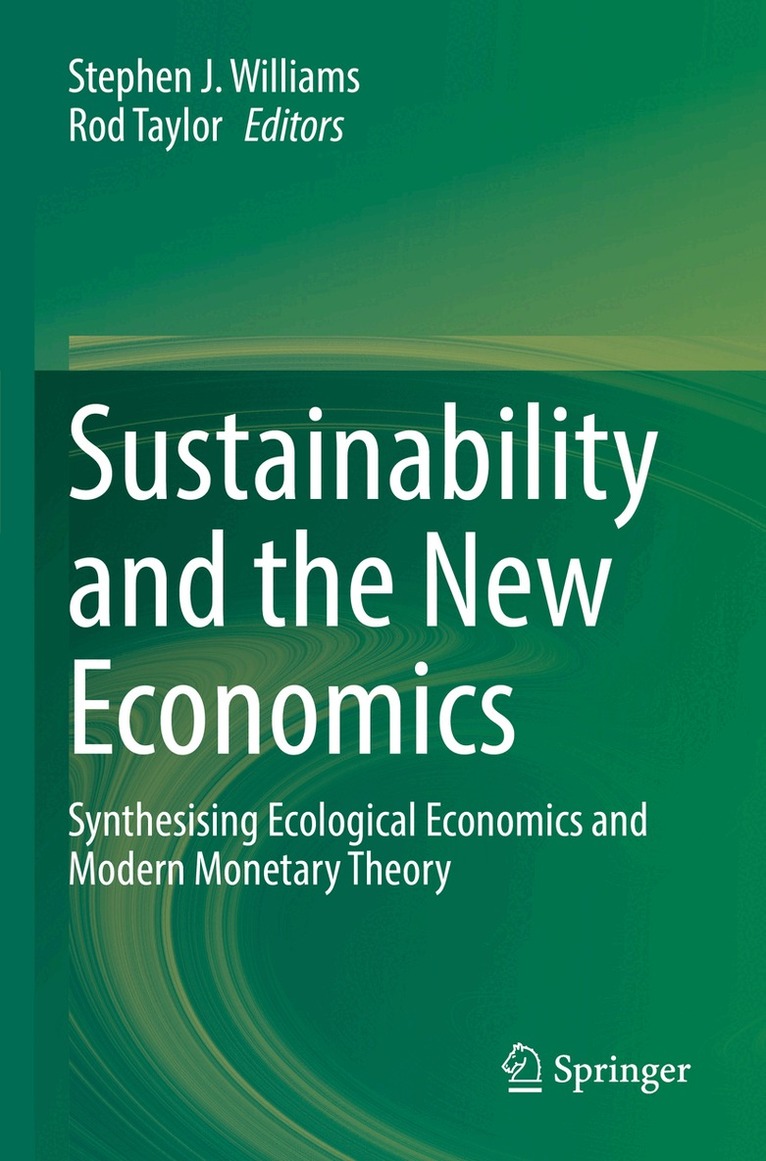
    Sustainability and the New Economics

    Synthesising Ecological Economics and Modern Monetary Theory

    AvStephen J. Williams,Rod Taylor

    Häftad, Engelska, 2022

    1 734 kr

    Beställningsvara. Skickas inom 10-15 vardagar. Fri frakt över 249 kr.

    Beskrivning

    This multidisciplinary book provides new insights and hope for sustainable prosperity given recent developments in economics – but only if swift and strong actions consistent with Earth’s biophysical limits and principles of justice are universally taken.It is one thing to put limits on resource throughput and waste generation to conform with the ecosphere’s biocapacity. It is another thing to efficiently allocate a sustainable rate of resource throughput and ensure it is equitably distributed in the form of final goods and services. While the separate but interdependent decisions regarding throughput, distribution, and allocation are the essence of ecological economics, dealing with them in a world that needs to cure its growth addiction requires a realistic understanding of macroeconomics and the fiscal capacity of currency-issuing central governments. Sustainable prosperity demands that we harness this understanding to carefully regulate the rate of resource throughput and manipulate macroeconomic outcomes to facilitate human flourishing. The book begins by outlining humanity’s current predicament of gross ecological overshoot and laments the half-century of missed opportunities since The Limits to Growth (1972). What was once economic growth has become, in many high-income countries, uneconomic growth (additional costs exceeding additional benefits), which is no longer advancing wellbeing. Meanwhile, low-income nations need a dose of efficient and equitable growth to escape poverty while protecting their environments and the global commons. The book argues for a synthesis of our increasing knowledge of the ecosphere’s limited carrying capacity and the power of governments to harness, transform, and distribute resources for the common good. Central to this synthesis must be a correct understanding of the difference between financial constraints and real resource constraints. While the latter apply to everyone, the former do not apply to currency-issuing central governments, which have much more capacity for corrective action than mainstream thinking perceives. The book joins the growing chorus of authoritative voices calling for a complete overhaul of the dominant economic system. We conclude with policy recommendations based on a new economics that, if implemented, would come close to guaranteeing a sustainable and prosperous future.Upon reading this book, at least one thing should be crystal clear: business as usual is not a viable option.

    Produktinformation

    • Utgivningsdatum:2022-12-11
    • Mått:155 x 235 x undefined mm
    • Format:Häftad
    • Språk:Engelska
    • Antal sidor:344
    • Förlag:Springer Nature Switzerland AG
    • ISBN:9783030787974

    Utforska kategorier

    • Nationalekonomi inom Ekonomi och Ledarskap
    • Energiteknik inom Naturvetenskap och teknik
    • Miljövetenskap och miljöpolitik inom Naturvetenskap och teknik

    Mer om författaren

    Stephen J. Williams is an Australian-based researcher with a background in journalism and law. His primary interest is the relationship between economic systems, social justice and environmental outcomes. His most-recent peer-reviewed writing is: Williams, S. & Alexander, S. ‘MMT, post-growth economics, and avoiding collapse’. In Washington, H. (ed). 2020. Ecological Economics: Solutions for the Future. ANZSEE.Rod Taylor is a Canberra-based science writer and broadcaster, whose latest book is Ten Journeys in a Fragile Planet (Odyssey 2020). He has written a weekly science column for The Canberra Times newspaper for the past 10 years. His background is in IT and business systems.

    Innehållsförteckning

    • Introduction by William Rees.- Ch 1: The great acceleration, planetary boundaries and the Anthropocene, Will Steffen, Ch 2: Assessing natural environments: a summary, David Lindenmayer & Chris Dickman.- Ch 3: Human health and the natural environment, Colin D. Butler.- Ch 4:UN Sustainability Goals, Kerryn Higgs.- Ch. 5: The evolution of neoliberalism, John Quiggin.-  Ch 6: Population growth, Ian Lowe.- Ch 7: Evaluation ‘The Limits to Growth’ 50 Years On, Kerryn Higgs.- Ch 8: The role of the fossil fuel industry, Ian Dunlop.- Ch 9: Economic failures of the IPCC process, Steve Keen.- Ch 10: Introduction to ecological economics, Philip Lawn & Stephen Williams.- Ch 11: Energy systems for sustainable prosperity, Mark Diesendorf .- Ch 12: Climate litigation and human rights, Michael Kirby & Sean Ryan.- Ch 13: What is a green deal without growth, Riccardo Mastini.- Ch 14: Paying a Green New Deal: MMT and the job guarantee, Steven Hall.- Ch 15: The Paradigm Shift, Stephen Williams.- Appendix.