• Fri frakt över 249 kr
  • •
  • Snabba leveranser
  • •
  • Billiga böcker
Kundservice

Du är på sajten för privatpersoner.

Företag, bibliotek eller offentlig verksamhet?

Du handlar på classic.bokus.com, där alla dina funktioner finns intakta.
Till classic.bokus.com
Bokus logotyp. Gå till startsidan.
  • Erbjudanden
  • Student
  • Topplistor
  • Barn & ungdom
  • Bokus Play
  • E-böcker
  • Ljudböcker
  • Pocketböcker
  • Spel och pussel

Pocketfynda! Hundratals böcker för 49 kr/st →

Sidfot

Mina sidor

    Hjälp

    • Kundservice
    • Vanliga frågor och svar
    • Frakt och leverans
    • Retur vid ångerrätt
    • Reklamera vara
    • Betalning
    • Köpvillkor
    • Allmänna villkor
    • Information om webbplatsens tillgänglighet

    Om Bokus

    • Om oss
    • Pressrum
    • För studenter
    • För företag
    • För bibliotek och offentlig verksamhet
    • För leverantörer
    • Hållbarhet

    Populärt

    • Aktuella erbjudanden
    • Presentkort
    • Studentlitteratur
    • Nya böcker
    • Topplistor
    • Signerade böcker
    • Engelska böcker

    Inspiration

    • Boktips
    • BookTok
    • Barnbokskaraktärer
    • Populära författare
    Logotyp för Bokus
    Följ oss på Facebook (extern länk)Följ oss på Instagram (extern länk)Följ oss på YouTube (extern länk)Följ oss på TikTok (extern länk)
    bokus @ CookiesAnpassa cookiesIntegritetspolicyKöpvillkor
    Till Citymail hemsida (extern länk)Till Budbee hemsida (extern länk)Till Postnord hemsida (extern länk)Till Schenker hemsida (extern länk)Till Early Bird hemsida (extern länk)Till Walleys hemsida (extern länk)
    1. Data och IT
    2. Programmeringsböcker
    3. Programvaruutveckling

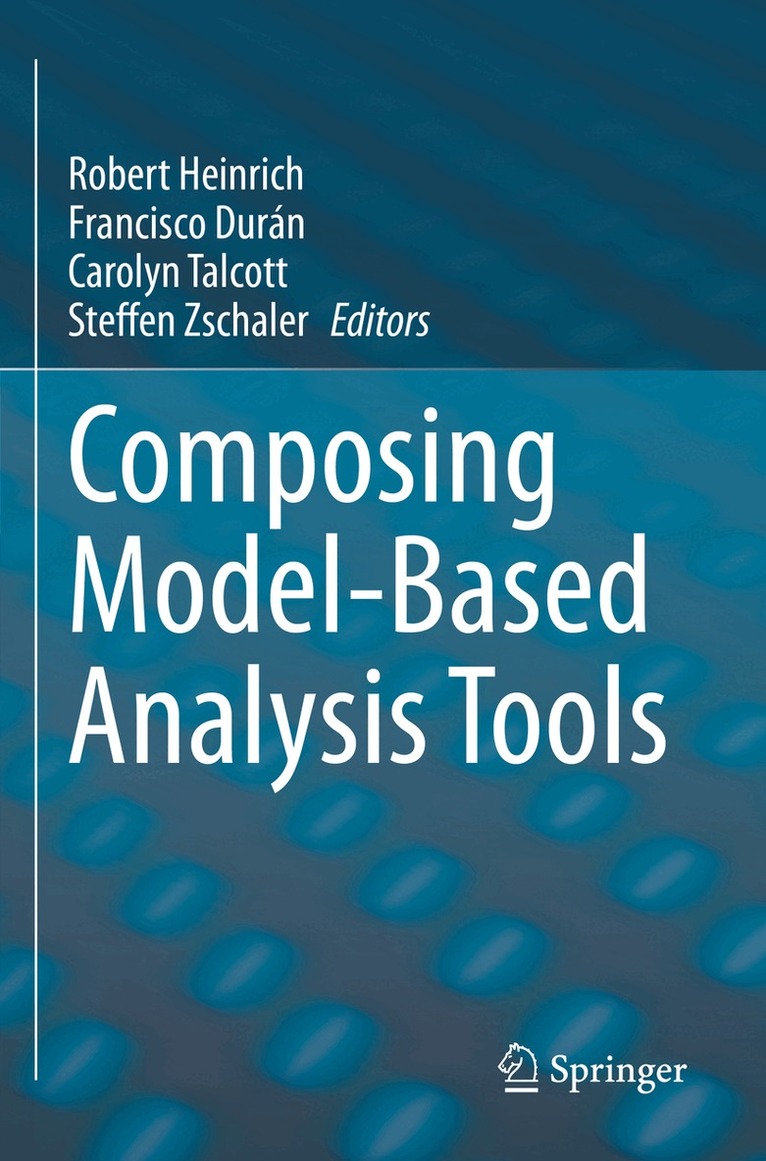
    Composing Model-Based Analysis Tools

    AvRobert Heinrich,Francisco Durán

    Häftad, Engelska, 2022

    1 110 kr

    Beställningsvara. Skickas inom 10-15 vardagar. Fri frakt över 249 kr.

    Beskrivning

    This book presents joint works of members of the software engineering and formal methods communities with representatives from industry, with the goal of establishing the foundations for a common understanding of the needs for more flexibility in model-driven engineering. It is based on the Dagstuhl Seminar 19481 „Composing Model-Based Analysis Tools“, which was held November 24 to 29, 2019, at Schloss Dagstuhl, Germany, where current challenges, their background and concepts to address them were discussed.The book is structured in two parts, and organized around five fundamental core aspects of the subject: (1) the composition of languages, models and analyses; (2) the integration and orchestration of analysis tools; (3) the continual analysis of models; (4) the exploitation of results; and (5) the way to handle uncertainty in model-based developments. After a chapter on foundations and common terminology and a chapter on challenges in the field, one chapter is devoted toeach of the above five core aspects in the first part of the book. These core chapters are accompanied by additional case studies in the second part of the book, in which specific tools and experiences are presented in more detail to illustrate the concepts and ideas previously introduced. The book mainly targets researchers in the fields of software engineering and formal methods as well as software engineers from industry with basic familiarity with quality properties, model-driven engineering and analysis tools. From reading the book, researchers will receive an overview of the state-of-the-art and current challenges, research directions, and recent concepts, while practitioners will be interested to learn about concrete tools and practical applications in the context of case studies.

    Produktinformation

    • Utgivningsdatum:2022-12-04
    • Mått:155 x 235 x 18 mm
    • Vikt:493 g
    • Format:Häftad
    • Språk:Engelska
    • Antal sidor:307
    • Förlag:Springer Nature Switzerland AG
    • ISBN:9783030819170

    Utforska kategorier

    • Programvaruutveckling inom Data och IT

    Mer om författaren

    Robert Heinrich holds the interim professorship (Professurvertretung) for a full professorship in software engineering at Karlsruhe Institute of Technology (KIT). He heads the Quality-driven System Evolution research group at KIT and the mobility lab at Competence Center for Applied Security Technology (KASTEL). His research interests include software engineering and evolution with a special focus on model-based analysis of several quality properties for heterogeneous systems.Francisco Durán is Full Professor at the Department of Computer Science of the University of Málaga, Spain. His main research topics are formal methods in software engineering, with a focus on the analysis of complex systems and their compositionality. Carolyn Talcott is a Program Director and leader of the Symbolic Systems Technology group at SRI International in Menlo Park, CA, USA. Her work, published in more than 130 articles, falls under the general heading of formal reasoning about distributed cyber-physical and biological systems.Steffen Zschaler is a Reader in Software Engineering in the Department of Informatics at King's College London, UK. He also directs MDENet, the expert network for model-driven engineering. His research is in model-driven engineering with a particular focus on the foundations of modularity and the optimization of non-functional properties.

    Innehållsförteckning

    • 1. Introduction.- 2. Foundations.- Part I: Challenges and Concepts.- 3. Overview of Challenges in Composing Model-Based Analysis Tools.- 4. Composition of Languages,Models, and Analyses.- 5. Integration and Orchestration of Analysis Tools.- 6. Continual Model-Based Analysis.- 7. Exploiting Results of Model-Based Analysis Tools.- 8. Living with Uncertainty in Model-Based Development.- Part II: Case Studies.- GTSMorpher: Safely Composing Behavioural Analyses Using Structured Operational Semantics.- 10. Compositional Modelling Languages with Analytics and Construction Infrastructures Based on Object-Oriented Techniques—The MontiCore Approach.- 11. Challenges in the Evolution of Palladio—Refactoring Design Smells in a Historically-Grown Approach to Software Architecture Analysis.- 12. AnATLyzer: Static Analysis of ATL Model Transformations.- 13. Using Afra in Different Domains by Tool Orchestration.- 14. Conclusion.