• Fri frakt över 249 kr
  • •
  • Snabba leveranser
  • •
  • Billiga böcker
Kundservice

Du är på sajten för privatpersoner.

Företag, bibliotek eller offentlig verksamhet?

Du handlar på classic.bokus.com, där alla dina funktioner finns intakta.
Till classic.bokus.com
Bokus logotyp. Gå till startsidan.
  • Erbjudanden
  • Student
  • Topplistor
  • Barn & ungdom
  • Bokus Play
  • E-böcker
  • Ljudböcker
  • Pocketböcker
  • Spel & pussel

Upp till 25% på utvalda nyheter →

Sidfot

Mina sidor

    Hjälp

    • Kundservice
    • Vanliga frågor och svar
    • Frakt och leverans
    • Retur vid ångerrätt
    • Reklamera vara
    • Betalning
    • Köpvillkor
    • Allmänna villkor
    • Information om webbplatsens tillgänglighet

    Om Bokus

    • Om oss
    • Pressrum
    • För studenter
    • För företag
    • För bibliotek och offentlig verksamhet
    • För leverantörer
    • Hållbarhet

    Populärt

    • Aktuella erbjudanden
    • Presentkort
    • Studentlitteratur
    • Nya böcker
    • Topplistor
    • Signerade böcker
    • Engelska böcker

    Inspiration

    • Boktips
    • BookTok
    • Populära bokserier
    • Barnbokskaraktärer
    • Populära författare
    Logotyp för Bokus
    Följ oss på Facebook (extern länk)Följ oss på Instagram (extern länk)Följ oss på YouTube (extern länk)Följ oss på TikTok (extern länk)
    bokus @ CookiesAnpassa cookiesIntegritetspolicyKöpvillkor
    Till Citymail hemsida (extern länk)Till Budbee hemsida (extern länk)Till Postnord hemsida (extern länk)Till Schenker hemsida (extern länk)Till Early Bird hemsida (extern länk)Till Walleys hemsida (extern länk)
    1. Psykologi och pedagogik
    2. Pedagogik
    3. Pedagogisk psykologi

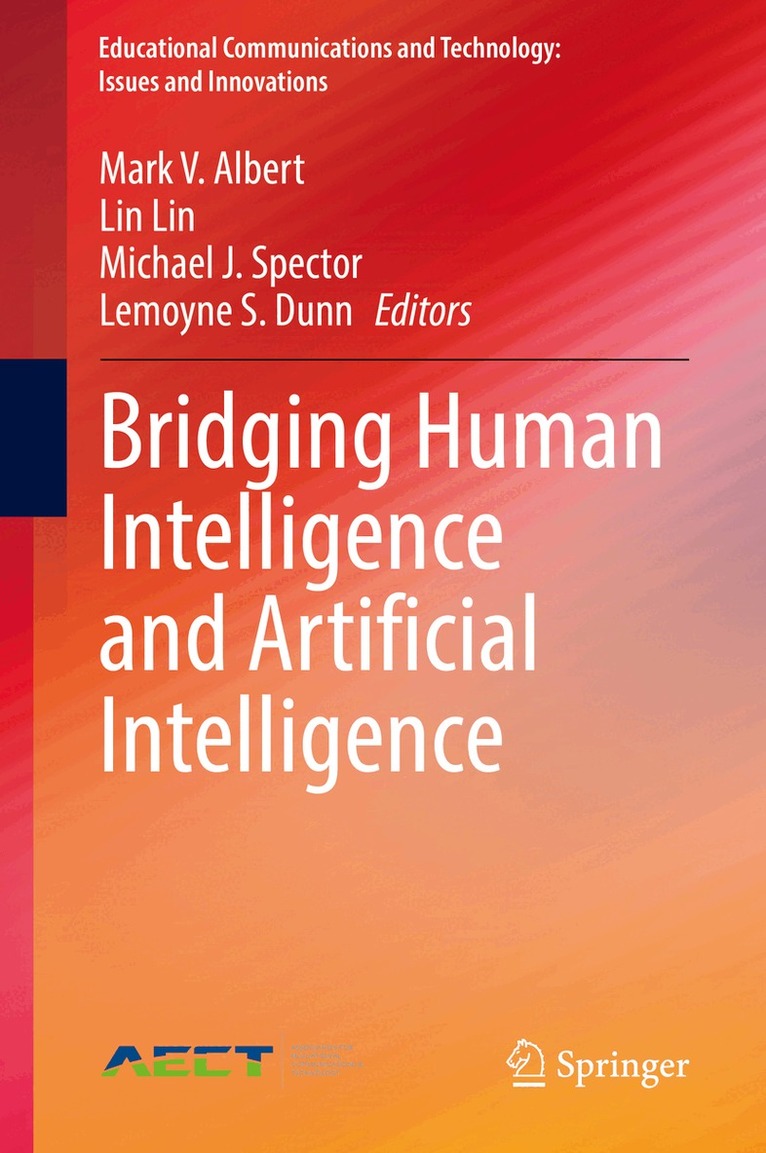
    Bridging Human Intelligence and Artificial Intelligence

    AvMark V. Albert,Lin Lin

    Inbunden, Engelska, 2022

    Del i serien Educational Communications and Technology: Issues and Innovations

    1 790 kr

    Beställningsvara. Skickas inom 10-15 vardagar. Fri frakt över 249 kr.

    Beskrivning

    This edited volume is based on contributions from the TCET-AECT “Human-Technology Frontier: Understanding the Learning of Now to Prepare for the Work of the Future Symposium” held in Denton, Texas on May 16-18, sponsored by AECT. The authors embrace an integrative approach to designing and implementing advances technologies in learning and instruction, and focus on the emerging themes of artificial intelligence, human-computer interactions, and the resulting instructional design. The volume will be divided into four parts: (1) Trends and future in learning and learning technologies expected in the next 10 years; (2) Technologies likely to have a significant impact on learning in the next 10 years; (3) Challenges that will need to be addressed and resolved in order to achieve significant and sustained improvement in learning; and (4) Reflections and insights from the Symposium that should be pursued and that can form the basis for productive research collaborations. The primary audience for this volume is academics and researchers in disciplines such as artificial intelligence, cognitive science, computer science, educational psychology, instructional design, human-computer interactions, information science, library science, and technology integration.

    Produktinformation

    • Utgivningsdatum:2022-02-25
    • Mått:155 x 235 x 27 mm
    • Vikt:740 g
    • Format:Inbunden
    • Språk:Engelska
    • Serie:Educational Communications and Technology: Issues and Innovations
    • Antal sidor:363
    • Förlag:Springer Nature Switzerland AG
    • ISBN:9783030847289

    Utforska kategorier

    • Pedagogisk psykologi inom Psykologi och pedagogik
    • Pedagogik inom Psykologi och pedagogik
    • Artificiell intelligens inom Data och IT

    Mer om författaren

    Mark Albert’s professional goal in life is to leverage machine learning to automate the collection and inference of clinically useful health information to improve clinical research. His projects in wearable sensor analytics have improved the measurement of health outcomes for individuals with Parkinson's disease, stroke, and transfemoral amputations with a variety of additional populations and contexts including children with cerebral palsy as well as healthy toddler activity tracking.  Current projects include video-based activity tracking and mobile robotic platforms, all in an effort to improve measures of clinical outcomes to justify therapeutic interventions.Lin Lin is a Professor of Learning Technologies at the University of North Texas. Lin received her doctoral degree at Teachers College, Columbia University. Lin’s research focuses on human-technology interactions, and life-long learning with innovative pedagogies and technologies. Specifically, she has published research in media multitasking, cognitive off-loading, multimedia design, executive functions, and (AI, VR) technology-supported STEM and STEM-enabling skills. Currently, Lin serves as the Director of Texas Center for Educational Technology (TCET).  She also serves as the Editor-in-chief of one of the top-tier journals, Educational Technology Research and Development (ETR&D Development Section). J. Michael Spector is Professor at UNT, was previously Professor of Educational Psychology at the University of Georgia, Associate Director of the Learning Systems Institute at Florida State University, Chair of Instructional Design, Development and Evaluation at Syracuse University, and Director of the Educational Information Science and Technology Research Program at the University of Bergen. He earned a Ph.D. from The University of Texas. He is a visiting research professor at Beijing Normal University, at East China Normal University, and the Indian Institute of Technology-Kharagpur. His research focuses on assessing learning in complex domains, inquiry and critical thinking skills, and program evaluation. He was Executive Director of the International Board of Standards for Training, Performance and Instruction and a Past-president of the Association for Educational and Communications Technology. He is Editor Emeritus of Educational Technology Research & Development; he edited two editions of the Handbook of Research on Educational Communications and Technology and the SAGE Encyclopedia of Educational Technology and more that 150 publications to his credit.Lemoyne S. Dunn is an Adjunct Graduate Faculty member at UNT who previously served as Director of a Title III Grant and as a Project Director for the Intel Teach to the Future program training over 22,000 educators in north and west Texas. She also served as a Lead Evaluator for three of the seven TARGET grants evaluated by the Texas Center for Educational Technology. She earned her PhD from UNT, as well as two Masters degrees and multiple certificates and endorsements. Her B.S. is from Texas A&M University. Her areas of interest include Educational Technology, Cognitive Science, and Gifted Education.

    Innehållsförteckning

    • Foreword.- Preface.- Introduction.-  Part 1: Trends And Future Of Learning And Learning Technologies.-  Chapter 1: A History Of Trends From The Perspective Of The Texas Center For Educational Technology.- Chapter 2: Learning Perspectives: Towards A Neuro-Cognitive Definition Of Learning.- Chapter 3: Integrating An Emphasis On Creativity In Learning Across Disciplines.- Chapter 4: D-School And Designing Thinking.- Chapter 5: Designs And Technologies To Advance Self-Directed Learning.- Chapter 6: Learning Paths And Analytics.- Part 2: Promising Learning Technologies And Artificial Intelligence.- Chapter 7: Defining The “NEW” K12 Digital Ecosystem.- Chapter 8: AI 2.0 And Education.- Chapter 9: The Role Of Digital Curricula In K-12.- Chapter 10: An Intelligent Textbook For Critical Thinking In Biology.- Chapter 11: Conversational Interfaces For Learning (Or: Integrating Robotics And The Curriculum).- Part 3: Significant Challenges Requiring Resolution.- Chapter 12: The ChallengesOf Sustaining A 1:1 Elementary Classroom.- Chapter 13: Data-Driven Education.- Chapter 14: Neuropsychological Assessments.- Chapter 15: Meaningful Learning Analytics.-Part 4: Reflections And Insights.- Chapter 16: The Neuroscience Of Learning.- Chapter 17: Thinking Critically About Critical Thinking.- Chapter 18: Informal Learning In Museums.- Chapter 19: Thoughts From A Linguist.- Chapter 20: Implications For The Future Of Learning.-Epilogue.- Glossary Of Terms.- Consolidated References.- Index.