• Fri frakt över 249 kr
  • •
  • Snabba leveranser
  • •
  • Billiga böcker
Kundservice

Du är på sajten för privatpersoner.

Företag, bibliotek eller offentlig verksamhet?

Du handlar på classic.bokus.com, där alla dina funktioner finns intakta.
Till classic.bokus.com
Bokus logotyp. Gå till startsidan.
  • Erbjudanden
  • Nyheter
  • Student
  • Topplistor
  • Barn & ungdom
  • Bokus Play
  • E-böcker
  • Pocketböcker
  • Spel & pussel

10% rabatt på allt med kod NYSTART10 →

Sidfot

Mina sidor

    Hjälp

    • Kundservice
    • Vanliga frågor och svar
    • Frakt och leverans
    • Retur vid ångerrätt
    • Reklamera vara
    • Betalning
    • Köpvillkor
    • Allmänna villkor
    • Information om webbplatsens tillgänglighet

    Om Bokus

    • Om oss
    • Pressrum
    • För studenter
    • För företag
    • För bibliotek och offentlig verksamhet
    • För leverantörer
    • Hållbarhet

    Populärt

    • Aktuella erbjudanden
    • Presentkort
    • Studentlitteratur
    • Nya böcker
    • Topplistor
    • Signerade böcker
    • Engelska böcker

    Inspiration

    • Boktips
    • BookTok
    • Populära bokserier
    • Barnbokskaraktärer
    • Populära författare
    Logotyp för Bokus
    Följ oss på Facebook (extern länk)Följ oss på Instagram (extern länk)Följ oss på YouTube (extern länk)Följ oss på TikTok (extern länk)
    bokus @ CookiesAnpassa cookiesIntegritetspolicyKöpvillkor
    Till Citymail hemsida (extern länk)Till Budbee hemsida (extern länk)Till Postnord hemsida (extern länk)Till Schenker hemsida (extern länk)Till Early Bird hemsida (extern länk)Till Walleys hemsida (extern länk)
    1. Naturvetenskap och teknik
    2. Teknik och industri
    3. Elektronik och kommunikationer

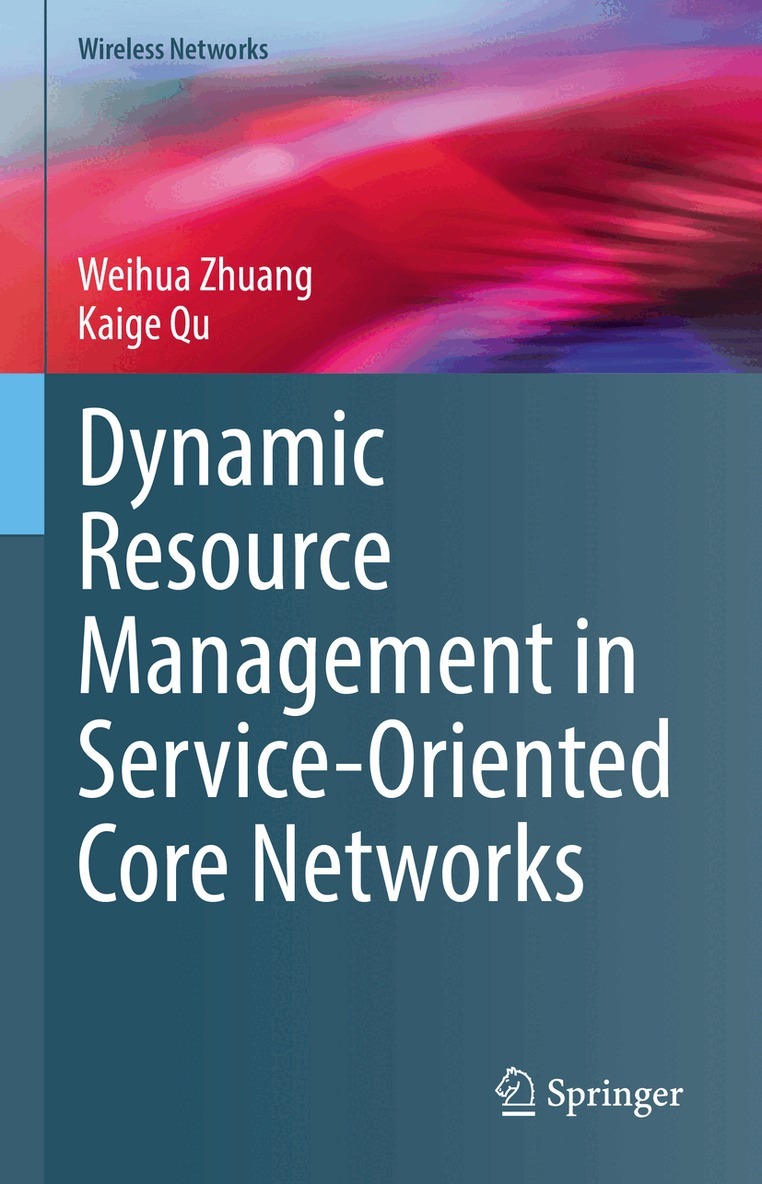
    Dynamic Resource Management in Service-Oriented Core Networks

    AvWeihua Zhuang,Kaige Qu

    Inbunden, Engelska, 2021

    Del i serien Wireless Networks

    1 516 kr

    Beställningsvara. Skickas inom 10-15 vardagar. Fri frakt över 249 kr.

    Fler format och utgåvor

    Häftad

    1 516 kr

    Beskrivning

    This book provides a timely and comprehensive study of dynamic resource management for network slicing in service-oriented fifth-generation (5G) and beyond core networks. This includes the perspective of developing efficient computation resource provisioning and scheduling solutions to guarantee consistent service performance in terms of end-to-end (E2E) data delivery delay. Network slicing is enabled by the software defined networking (SDN) and network function virtualization (NFV) paradigms. For a network slice with a target traffic load, the E2E service delivery is enabled by virtual network function (VNF) placement and traffic routing with static resource allocations. When data traffic enters the network, the traffic load is dynamic and can deviate from the target value, potentially leading to QoS performance degradation and network congestion. Data traffic has dynamics in different time granularities. For example, the traffic statistics (e.g., mean and variance) can be non-stationary and experience significant changes in a coarse time granularity, which are usually predictable. Within a long time duration with stationary traffic statistics, there are traffic dynamics in small timescales, which are usually highly bursty and unpredictable. To provide continuous QoS performance guarantee and ensure efficient and fair operation of the network slices over time, it is essential to develop dynamic resource management schemes for the embedded services in the presence of traffic dynamics during virtual network operation. Queueing theory is used in system modeling, and different techniques including optimization and machine learning are applied to solving the dynamic resource management problems.Based on a simplified M/M/1 queueing model with Poisson traffic arrivals, an optimization model for flow migration is presented to accommodate the large-timescale changes in the average traffic rates with average E2E delay guarantee, while addressing a trade-off between load balancing and flow migration overhead. To overcome the limitations of Poisson traffic model, the authors present a machine learning approach for dynamic VNF resource scaling and migration. The new solution captures the inherent traffic patterns in a real-world traffic trace with non-stationary traffic statistics in large timescale, predicts resource demands for VNF resource scaling, and triggers adaptive VNF migration decision making, to achieve load balancing, migration cost reduction, and resource overloading penalty suppression in the long run. Both supervised and unsupervised machine learning tools are investigated for dynamic resource management. To accommodate the traffic dynamics in small time granularities, the authors present a dynamic VNF scheduling scheme to coordinate the scheduling among VNFs of multiple services, which achieves network utility maximization with delay guarantee for each service. Researchers and graduate students working in the areas of electrical engineering, computing engineering and computer science will find this book useful as a reference or secondary text.  Professionals in industry seeking solutions to dynamic resource management for 5G and beyond networks will also want to purchase this book.

    Produktinformation

    • Utgivningsdatum:2021-11-05
    • Mått:155 x 235 x 16 mm
    • Vikt:453 g
    • Format:Inbunden
    • Språk:Engelska
    • Serie:Wireless Networks
    • Antal sidor:173
    • Upplaga:21001
    • Förlag:Springer Nature Switzerland AG
    • ISBN:9783030871352

    Utforska kategorier

    • Elektronik och kommunikationer inom Naturvetenskap och teknik
    • Systemvetenskap och AI inom Data och IT
    • Hårdvara inom Data och IT

    Mer om författaren

    Dr. Weihua Zhuang has been with the Department of Electrical and Computer Engineering, University of Waterloo, Canada, since 1993, where she is a University Professor and a Tier I Canada Research Chair in Wireless Communication Networks. She was a recipient of the 2021 Women's Distinguished Career Award from the Vehicular Technology Society of the Institute of Electrical and Electronics Engineers (IEEE), 2021 R.A. Fessenden Award from the IEEE Canada, 2017 Technical Recognition Award in Ad Hoc and Sensor Networks from the IEEE Communications Society, and a co-recipient of several Best Paper Awards. She was the Editor-in-Chief of the IEEE Transactions on Vehicular Technology from 2007 to 2013, Technical Program Chair/Co-Chair of the 2017 and 2016 IEEE Vehicular Technology Conferences, and Technical Program Symposia Chair of the 2011 IEEE Global Communications Conference. She is an elected member of the Board of Governors and Vice President for Publications of the IEEE Vehicular Technology Society. Dr. Zhuang is a Fellow of the IEEE, Royal Society of Canada, Canadian Academy of Engineering, and Engineering Institute of Canada.Dr. Kaige Qu received the B.Sc. degree in communication engineering from Shandong University, Jinan, China, in 2013, the M.Sc. degree in integrated circuits engineering and electrical engineering from Tsinghua University, Beijing, China, and KU Leuven, Leuven, Belgium, respectively, in 2016, and the Ph.D. degree in electrical and computer engineering from the University of Waterloo, Waterloo, Ontario, Canada, in 2020. She is currently a Postdoctoral Fellow with the University of Waterloo. Her research interests include resource allocation in SDN/NFV-enabled networks, mobile edge computing, and artificial intelligence in networking.

    Innehållsförteckning

    • Chapter 1 Introduction-. 1.1 Service-Oriented Core Networks-. 1.1.1 Software-Defined Networking (SDN)-. 1.1.2 Network Function Virtualization (NFV)-. 1.1.3 Service Function Chaining-. 1.2 Network Slicing Framework-. 1.2.1 Infrastructure Domain-. 1.2.2 Tenant Domain-. 1.2.3 SDN-NFV Integration-. 1.3 Multi-Timescale Dynamic Resource Management-. 1.3.1 Multi-Timescale Core Network Traffic Dynamics-. 1.3.2 Dynamic Resource Provisioning in Large Timescale-. 1.3.3 Dynamic Resource Scheduling in Small Timescale-. 1.4 Research Contributions-. 1.5 Outline-. References-. Chapter 2 System Model-. 2.1 Services-. 2.2 Virtual Resource Pool-. 2.3 Placement and Scheduling of Virtual Network Function (VNF)-. 2.3 Migration Cost and Reconfiguration Overhead-. References-. Chapter 3 Dynamic Flow Migration: A Model-Based Optimization Approach-. 3.1 Model Assumptions-. 3.1.1 M/M/1 VNF Packet Processing Queueing Model-. 3.1.2 Generalized Processor Sharing (GPS)-. 3.2 Optimization Model for Dynamic Flow Migration-. 3.3 Mixed Integer Quadratically Constrained Programming (MIQCP) Problem Transformation-. 3.3.1 Optimality Gap-. 3.3.2 Optimal Solution Mapping-. 3.4 Low-Complexity Heuristic Flow Migration Algorithm-. 3.4.1 Algorithm Overview-. 3.4.2 Redistribution of Hop Delay Bounds-. 3.4.3 Migration Decision-. 3.4.4 Iterative Resource Loading Threshold Update-. 3.4.5 Complexity Analysis-. 3.5 Simulation Results-. 3.6 Summary-. References-. Chapter 4 Dynamic VNF Resource Scaling and Migration: A Machine Learning Approach-. 4.1 Nonstationary Traffic Model-. 4.2 Machine Learning Tools for Analysis and Decision-. 4.2.1 Bayesian Conjugate Analysis-. 4.2.2 Gaussian Process Regression-. 4.2.3 Reinforcement Learning-. 4.3 Resource Demand Prediction for Dynamic VNF Resource Scaling-. 4.3.1 Bayesian Online Change Point Detection-. 4.3.2 Traffic Parameter Learning-. 4.3.3 Resource Demand Prediction-. 4.4 Deep Reinforcement Learning for Dynamic VNF Migration-. 4.4.1 MarkovDecision Process-. 4.4.2 Penalty-Aware Deep Q-Learning Algorithm-. 4.5 Simulation Results-. 4.6 Summary-. References-. Chapter 5 Dynamic VNF Scheduling for Network Utility Maximization-. 5.1 Discrete-Time VNF Packet Processing Queueing Model-. 5.1.1 Physical Packet Processing Queue-. 5.1.2 Delay-Aware Virtual Packet Processing Queue-. 5.2 Stochastic VNF Scheduling: Problem and Solution-. 5.2.1 Stochastic Problem Formulation-. 5.2.2 Lyapunov Optimization and Problem Transformation-. 5.2.3 Online Distributed Algorithm-. 5.3 VNF Scheduling with Packet Rushing-. 5.3.1 Packet Rushing Analysis-. 5.3.2 Modified VNF Scheduling Algorithm-. 5.4 Simulation Results-. 5.5 Summary-. References-. Chapter 6 Conclusions and Future Research Directions-. 6.1 Conclusions-. 6.2 Future Research Directions-. References.