• Fri frakt över 249 kr
  • •
  • Snabba leveranser
  • •
  • Billiga böcker
Kundservice

Du är på sajten för privatpersoner.

Företag, bibliotek eller offentlig verksamhet?

Du handlar på classic.bokus.com, där alla dina funktioner finns intakta.
Till classic.bokus.com
Bokus logotyp. Gå till startsidan.
  • Erbjudanden
  • Nyheter
  • Student
  • Topplistor
  • Barn & ungdom
  • Bokus Play
  • E-böcker
  • Pocketböcker
  • Spel & pussel

10% rabatt på allt med kod NYSTART10 →

Sidfot

Mina sidor

    Hjälp

    • Kundservice
    • Vanliga frågor och svar
    • Frakt och leverans
    • Retur vid ångerrätt
    • Reklamera vara
    • Betalning
    • Köpvillkor
    • Allmänna villkor
    • Information om webbplatsens tillgänglighet

    Om Bokus

    • Om oss
    • Pressrum
    • För studenter
    • För företag
    • För bibliotek och offentlig verksamhet
    • För leverantörer
    • Hållbarhet

    Populärt

    • Aktuella erbjudanden
    • Presentkort
    • Studentlitteratur
    • Nya böcker
    • Topplistor
    • Signerade böcker
    • Engelska böcker

    Inspiration

    • Boktips
    • BookTok
    • Populära bokserier
    • Barnbokskaraktärer
    • Populära författare
    Logotyp för Bokus
    Följ oss på Facebook (extern länk)Följ oss på Instagram (extern länk)Följ oss på YouTube (extern länk)Följ oss på TikTok (extern länk)
    bokus @ CookiesAnpassa cookiesIntegritetspolicyKöpvillkor
    Till Citymail hemsida (extern länk)Till Budbee hemsida (extern länk)Till Postnord hemsida (extern länk)Till Schenker hemsida (extern länk)Till Early Bird hemsida (extern länk)Till Walleys hemsida (extern länk)
    1. Naturvetenskap och teknik
    2. Matematik och naturvetenskap
    3. Fysik
    4. Tillämpad fysik

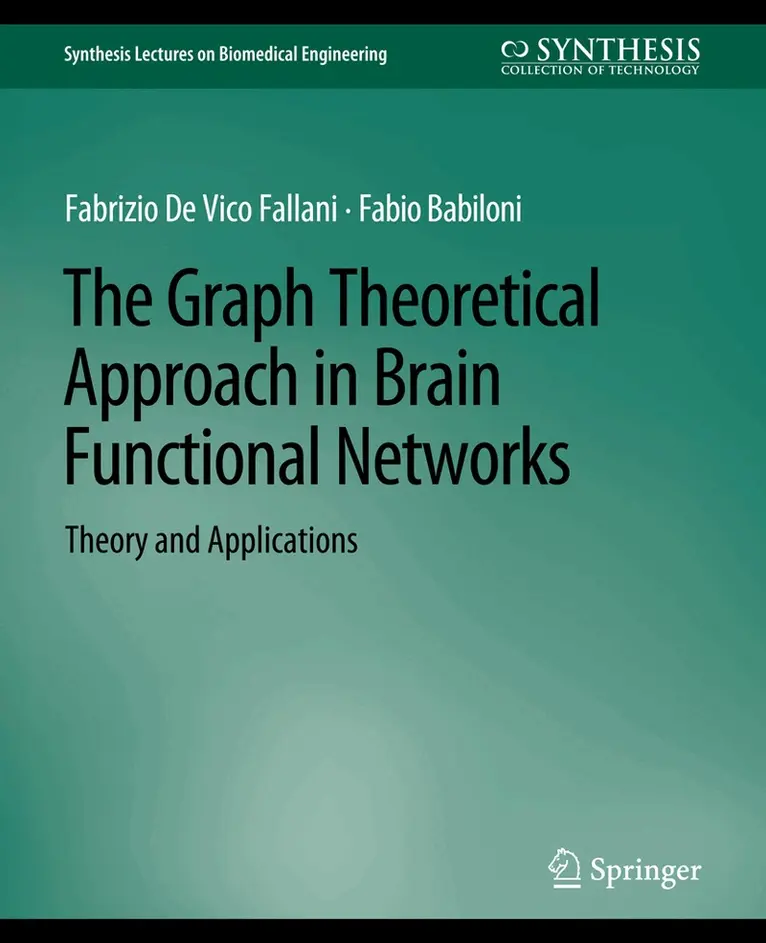
    Graph Theoretical Approach in Brain Functional Networks

    Theory and Applications

    AvFabrizio Fallani,Fabio Babiloni

    Häftad, Engelska, 2010

    Del i serien Synthesis Lectures on Biomedical Engineering

    318 kr

    Beställningsvara. Skickas inom 10-15 vardagar. Fri frakt över 249 kr.

    Beskrivning

    The present book illustrates the theoretical aspects of several methodologies related to the possibility of i) enhancing the poor spatial information of the electroencephalographic (EEG) activity on the scalp and giving a measure of the electrical activity on the cortical surface. ii) estimating the directional influences between any given pair of channels in a multivariate dataset. iii) modeling the brain networks as graphs. The possible applications are discussed in three different experimental designs regarding i) the study of pathological conditions during a motor task, ii) the study of memory processes during a cognitive task iii) the study of the instantaneous dynamics throughout the evolution of a motor task in physiological conditions. The main outcome from all those studies indicates clearly that the performance of cognitive and motor tasks as well as the presence of neural diseases can affect the brain network topology. This evidence gives the power of reflecting cerebral "states" or "traits" to the mathematical indexes derived from the graph theory. In particular, the observed structural changes could critically depend on patterns of synchronization and desynchronization - i.e. the dynamic binding of neural assemblies - as also suggested by a wide range of previous electrophysiological studies. Moreover, the fact that these patterns occur at multiple frequencies support the evidence that brain functional networks contain multiple frequency channels along which information is transmitted. The graph theoretical approach represents an effective means to evaluate the functional connectivity patterns obtained from scalp EEG signals. The possibility to describe the complex brain networks sub-serving different functions in humans by means of "numbers" is a promising tool toward the generation of a better understanding of the brain functions. Table of Contents: Introduction / Brain Functional Connectivity / Graph Theory / High-Resolution EEG / Cortical Networks in Spinal Cord Injured Patients / Cortical Networks During a Lifelike Memory Task / Application to Time-varying Cortical Networks / Conclusions

    Produktinformation

    • Utgivningsdatum:2010-04-07
    • Mått:191 x 235 x 6 mm
    • Vikt:197 g
    • Format:Häftad
    • Språk:Engelska
    • Serie:Synthesis Lectures on Biomedical Engineering
    • Antal sidor:84
    • Förlag:Springer International Publishing AG
    • ISBN:9783031005169
    • Originaltitel:The Graph Theoretical Approach in Brain Functional Networks

    Utforska kategorier

    • Tillämpad fysik inom Naturvetenskap och teknik
    • Teknik: allmänt inom Naturvetenskap och teknik
    • Biomedicinsk teknik inom Medicin

    Mer om författaren

    Fabrizio DeVico Fallani is a Research fellow in the Department of Human Physiology, University of Rome “Sapienza” (Subject - Development and application of brain network analyses in healthy and dis[1]eased human subjects). He is also a term-contract worker at the Neuroeletrical Imaging and Brain Computer Interface Laboratory. IRCCS “Fondazione S.Lucia” (Subject - Development and application of brain network analyses in healthy and diseased human subjects during cognitive and motor tasks). In 2005 he got his master’s degree in Computer Science Engineering at the University of Rome “Sapienza” (Thesis title - Advanced Methods for the Estimation of the Cortical Connectivity from high resolution EEG recordings in a group of Spinal Cord Injured Patients). In 2009, he got his PhD degree in Biophysics at the University of Rome “Sapienza”. (Thesis title - Theoretical Graph Approach to Brain Functional Networks from High-Resolution EEG). He also received the best PhD thesis prize on Biomedical signal processing and imaging awarded by the Italian National Group of Bioengineering. He has participated with both oral and poster presentations at more than 45 international conferences and has received several travel grants and visiting research grants. He is the author of more than 30 scientific articles in peer-reviewed journals and his H-index is 6. His current interests are in the field of graph theoretical approaches, cortical connectivity estimation, and Brain Computer Interface. Fabio Babiloni was born in Rome in 1961. He received his master’s degree in Electronic Engineering at the University of Rome “La Sapienza” and the PhD in Computational Engineering at the Helsinki University of Technology, Helsinki in the 2000 with a dissertation on the multimodal integration of EEG and fMRI. He is currently Associate Professor of Human Physiology at the Faculty of Medicine of the University of Rome “La Sapienza”, Rome, Italy. He is the author of more that 120 papers on bioengineeringand neurophysiological topics in international peer-reviewed scientific journals, and more than 250 contributions to conferences and book chapters. His total impact factor is more than 290 and his H-index is 26. His current interests are in the field of multimodal integration of EEG, MEG and fMRI data, cortical connectivity estimation and Brain Computer Interface. Prof. Babiloni is currently grant reviewer for the National Science Foundation (NSF) USA ,the Academy of Finland, Finland, the Austrian Fund of Research, Austria and the European Union through the FP6 and FP7 research programs. Prof. Babiloni is president of the International Society of Functional Source Imaging, member of the Italian Society of Physiology and the Italian Society of Clinical Neurophysiology. He is an Associate Editor of four scientific Journals “Frontiers in Neuroscience,” “International Journal of Bioelectromagnetism,” “IEEE Trans. On Neural System and Rehabilitation Engineering,” and “Computational Intelligence and Neuroscience.”

    Innehållsförteckning

    • Introduction.- Brain Functional Connectivity.- Graph Theory.- High-Resolution EEG.- Cortical Networks in Spinal Cord Injured Patients.- Cortical Networks During a Lifelike Memory Task.- Application to Time-varying Cortical Networks.- Conclusions.