• Fri frakt över 249 kr
  • •
  • Snabba leveranser
  • •
  • Billiga böcker
Kundservice

Du är på sajten för privatpersoner.

Företag, bibliotek eller offentlig verksamhet?

Du handlar på classic.bokus.com, där alla dina funktioner finns intakta.
Till classic.bokus.com
Bokus logotyp. Gå till startsidan.
  • Erbjudanden
  • Student
  • Topplistor
  • Barn & ungdom
  • Bokus Play
  • E-böcker
  • Ljudböcker
  • Pocketböcker
  • Spel och pussel

Pocketfynda! Hundratals böcker för 49 kr/st →

Sidfot

Mina sidor

    Hjälp

    • Kundservice
    • Vanliga frågor och svar
    • Frakt och leverans
    • Retur vid ångerrätt
    • Reklamera vara
    • Betalning
    • Köpvillkor
    • Allmänna villkor
    • Information om webbplatsens tillgänglighet

    Om Bokus

    • Om oss
    • Pressrum
    • För studenter
    • För företag
    • För bibliotek och offentlig verksamhet
    • För leverantörer
    • Hållbarhet

    Populärt

    • Aktuella erbjudanden
    • Presentkort
    • Studentlitteratur
    • Nya böcker
    • Topplistor
    • Signerade böcker
    • Engelska böcker

    Inspiration

    • Boktips
    • BookTok
    • Barnbokskaraktärer
    • Populära författare
    Logotyp för Bokus
    Följ oss på Facebook (extern länk)Följ oss på Instagram (extern länk)Följ oss på YouTube (extern länk)Följ oss på TikTok (extern länk)
    bokus @ CookiesAnpassa cookiesIntegritetspolicyKöpvillkor
    Till Citymail hemsida (extern länk)Till Budbee hemsida (extern länk)Till Postnord hemsida (extern länk)Till Schenker hemsida (extern länk)Till Early Bird hemsida (extern länk)Till Walleys hemsida (extern länk)
    1. Data och IT
    2. Systemvetenskap och AI

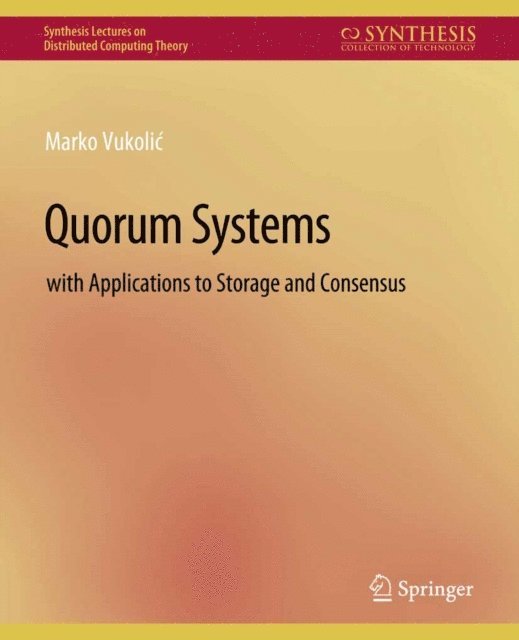
    Quorum Systems

    With Applications to Storage and Consensus

    AvMarko Vukolic

    Häftad, Engelska, 2012

    Del i serien Synthesis Lectures on Distributed Computing Theory

    393 kr

    Beställningsvara. Skickas inom 10-15 vardagar. Fri frakt över 249 kr.

    Fler format och utgåvor

    E-bok

    488 kr

    Beskrivning

    A quorum system is a collection of subsets of nodes, called quorums, with the property that each pair of quorums have a non-empty intersection. Quorum systems are the key mathematical abstraction for ensuring consistency in fault-tolerant and highly available distributed computing. Critical for many applications since the early days of distributed computing, quorum systems have evolved from simple majorities of a set of processes to complex hierarchical collections of sets, tailored for general adversarial structures. The initial non-empty intersection property has been refined many times to account for, e.g., stronger (Byzantine) adversarial model, latency considerations or better availability. This monograph is an overview of the evolution and refinement of quorum systems, with emphasis on their role in two fundamental applications: distributed read/write storage and consensus. Table of Contents: Introduction / Preliminaries / Classical Quorum Systems / Classical Quorum-Based Emulations / Byzantine Quorum Systems / Latency-efficient Quorum Systems / Probabilistic Quorum Systems

    Produktinformation

    • Utgivningsdatum:2012-01-27
    • Mått:191 x 235 x 11 mm
    • Vikt:282 g
    • Format:Häftad
    • Språk:Engelska
    • Serie:Synthesis Lectures on Distributed Computing Theory
    • Antal sidor:130
    • Förlag:Springer International Publishing AG
    • ISBN:9783031008795
    • Originaltitel:Quorum Systems

    Utforska kategorier

    • Systemvetenskap och AI inom Data och IT
    • Referensverk och tvärvetenskap inom Samhälle och politik
    • Programmeringsböcker inom Data och IT

    Mer om författaren

    Marko Vukoli´c is an assistant professor in the Networking and Security Department at Eurécom, France. He received his engineering degree in Communication Systems from University of Belgrade, Serbia in 2001 and his doctor of science degree in Distributed Systems from EPFL, Switzerland in 2008. He was affiliated with IBM Research – Zurich where he spent time in the Storage Systems group as a post-doc from 2008–2010.

    Innehållsförteckning

    • Introduction.- Preliminaries.- Classical Quorum Systems.- Classical Quorum-Based Emulations.- Byzantine Quorum Systems.- Latency-efficient Quorum Systems.- Probabilistic Quorum Systems.