• Fri frakt över 249 kr
  • •
  • Snabba leveranser
  • •
  • Billiga böcker
Kundservice

Du är på sajten för privatpersoner.

Företag, bibliotek eller offentlig verksamhet?

Du handlar på classic.bokus.com, där alla dina funktioner finns intakta.
Till classic.bokus.com
Bokus logotyp. Gå till startsidan.
  • Erbjudanden
  • Student
  • Topplistor
  • Barn & ungdom
  • Bokus Play
  • E-böcker
  • Ljudböcker
  • Pocketböcker
  • Spel och pussel

5% studentrabatt – använd koden KURSBOK27 →

Sidfot

Mina sidor

    Hjälp

    • Kundservice
    • Vanliga frågor och svar
    • Frakt och leverans
    • Retur vid ångerrätt
    • Reklamera vara
    • Betalning
    • Köpvillkor
    • Allmänna villkor
    • Information om webbplatsens tillgänglighet

    Om Bokus

    • Om oss
    • Pressrum
    • För studenter
    • För företag
    • För bibliotek och offentlig verksamhet
    • För leverantörer
    • Hållbarhet

    Populärt

    • Aktuella erbjudanden
    • Presentkort
    • Studentlitteratur
    • Nya böcker
    • Topplistor
    • Signerade böcker
    • Engelska böcker

    Inspiration

    • Boktips
    • BookTok
    • Barnbokskaraktärer
    • Populära författare
    Logotyp för Bokus
    Följ oss på Facebook (extern länk)Följ oss på Instagram (extern länk)Följ oss på YouTube (extern länk)Följ oss på TikTok (extern länk)
    bokus @ CookiesAnpassa cookiesIntegritetspolicyKöpvillkor
    Till Citymail hemsida (extern länk)Till Budbee hemsida (extern länk)Till Postnord hemsida (extern länk)Till Schenker hemsida (extern länk)Till Early Bird hemsida (extern länk)Till Walleys hemsida (extern länk)
    1. Data och IT
    2. Systemvetenskap och AI

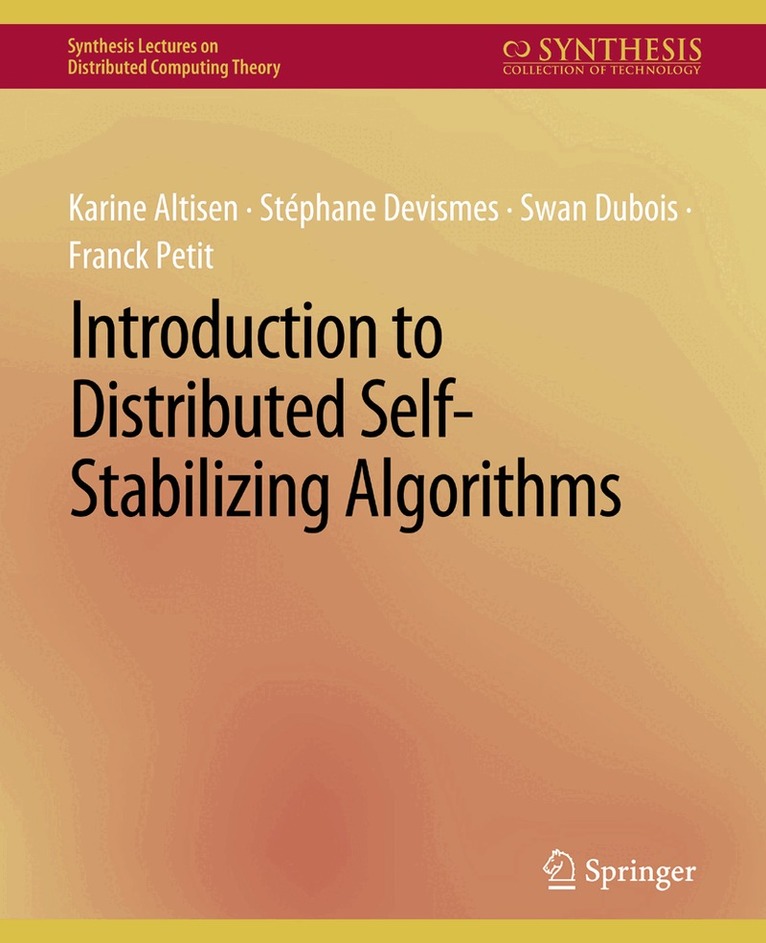
    Introduction to Distributed Self-Stabilizing Algorithms

    AvKarine Altisen,Stéphane Devismes

    Häftad, Engelska, 2019

    Del i serien Synthesis Lectures on Distributed Computing Theory

    669 kr

    Beställningsvara. Skickas inom 10-15 vardagar. Fri frakt över 249 kr.

    Beskrivning

    This book aims at being a comprehensive and pedagogical introduction to the concept of self-stabilization, introduced by Edsger Wybe Dijkstra in 1973. Self-stabilization characterizes the ability of a distributed algorithm to converge within finite time to a configuration from which its behavior is correct (i.e., satisfies a given specification), regardless the arbitrary initial configuration of the system. This arbitrary initial configuration may be the result of the occurrence of a finite number of transient faults. Hence, self-stabilization is actually considered as a versatile non-masking fault tolerance approach, since it recovers from the effect of any finite number of such faults in an unified manner. Another major interest of such an automatic recovery method comes from the difficulty of resetting malfunctioning devices in a large-scale (and so, geographically spread) distributed system (the Internet, Pair-to-Pair networks, and Delay Tolerant Networks are examples of such distributed systems). Furthermore, self-stabilization is usually recognized as a lightweight property to achieve fault tolerance as compared to other classical fault tolerance approaches. Indeed, the overhead, both in terms of time and space, of state-of-the-art self-stabilizing algorithms is commonly small. This makes self-stabilization very attractive for distributed systems equipped of processes with low computational and memory capabilities, such as wireless sensor networks.After more than 40 years of existence, self-stabilization is now sufficiently established as an important field of research in theoretical distributed computing to justify its teaching in advanced research-oriented graduate courses. This book is an initiation course, which consists of the formal definition of self-stabilization and its related concepts, followed by a deep review and study of classical (simple) algorithms, commonly used proof schemes and design patterns, as well as premium results issued from the self-stabilizing community. As often happens in the self-stabilizing area, in this book we focus on the proof of correctness and the analytical complexity of the studied distributed self-stabilizing algorithms.Finally, we underline that most of the algorithms studied in this book are actually dedicated to the high-level atomic-state model, which is the most commonly used computational model in the self-stabilizing area. However, in the last chapter, we present general techniques to achieve self-stabilization in the low-level message passing model, as well as example algorithms.

    Produktinformation

    • Utgivningsdatum:2019-04-15
    • Mått:191 x 235 x 10 mm
    • Vikt:327 g
    • Format:Häftad
    • Språk:Engelska
    • Serie:Synthesis Lectures on Distributed Computing Theory
    • Antal sidor:147
    • Förlag:Springer International Publishing AG
    • ISBN:9783031008856
    • Originaltitel:Introduction to Distributed Self-Stabilizing Algorithms

    Utforska kategorier

    • Systemvetenskap och AI inom Data och IT
    • Referensverk och tvärvetenskap inom Samhälle och politik
    • Programmeringsböcker inom Data och IT

    Mer om författaren

    Karine Altisen is an associate professor at Grenoble-INP/Ensimag (France). She has been a member of the VERIMAG Laboratory since 1998 and obtained a Ph.D. in 2001. Her current research area combines formal methods and distributed computing. She is interested in theoretical and algorithmic aspects of fault-tolerant distributed systems, including their certification.Stephane Devismesis an associate professor at Universite Grenoble Alpes (France). Since 2008 he has been a member of the Synchronous Team of the VERIMAG Laboratory. He received his Ph.D. in 2006 from the University of Picardie Jules Verne (Amiens, France). In 2007, he spent one year as a post-doctoral fellow at CNRS/Universite Paris-Sud. He carries out broad research in theoretical issues of distributed fault-tolerant computing, especially related to self-stabilization.Swan Dubois received a Ph.D. in December 2011 from INRIA and UPMC Sorbonne Universites (Paris, France). He spent one year as a post-doctoral fellow at EPFL (Lausanne, Switzerland). He currently holds an associate professor position at Sorbonne University (formerly University Pierre and Marie Curie). His research domain covers the whole area of fault tolerance in distributed systems with a particular interest for self-stabilization and dynamic systems.Franck Petit received a Ph.D. in Computer Science in 1998. He spent more than ten years in the industry in various positions in Computer Science. He joined the University of Picardie Jules Verne (Amiens, France) as an associate professor in 1998. In 2004, he became a professor in the same university. After one year as a visiting researcher with INRIA LIP/ENS Lyon in 2008, he joined Sorbonne University (formerly University Pierre and Marie Curie), with LiP6 in 2009. His research focuses on algorithmic aspects of synchronization, stabilization, and fault tolerance in distributed systems. He also works in the area of networks of mobile robots.

    Innehållsförteckning

    • Preface.- Acknowledgments.- Introduction.- Preliminaries.- Coloring under a Locally Central Unfair Daemon.- Synchronous Unison.- BFS Spanning Tree Under a Distributed Unfair Daemon.- Dijkstra's Token Ring.- Hierarchical Collateral Composition.- Self-Stabilization in Message Passing Systems.- Bibliography.- Authors' Biographies.- Index.