• Fri frakt över 249 kr
  • •
  • Snabba leveranser
  • •
  • Billiga böcker
Kundservice

Du är på sajten för privatpersoner.

Företag, bibliotek eller offentlig verksamhet?

Du handlar på classic.bokus.com, där alla dina funktioner finns intakta.
Till classic.bokus.com
Bokus logotyp. Gå till startsidan.
  • Erbjudanden
  • Nyheter
  • Student
  • Topplistor
  • Barn & ungdom
  • Bokus Play
  • E-böcker
  • Pocketböcker
  • Spel & pussel

10% rabatt på allt med kod NYSTART10 →

Sidfot

Mina sidor

    Hjälp

    • Kundservice
    • Vanliga frågor och svar
    • Frakt och leverans
    • Retur vid ångerrätt
    • Reklamera vara
    • Betalning
    • Köpvillkor
    • Allmänna villkor
    • Information om webbplatsens tillgänglighet

    Om Bokus

    • Om oss
    • Pressrum
    • För studenter
    • För företag
    • För bibliotek och offentlig verksamhet
    • För leverantörer
    • Hållbarhet

    Populärt

    • Aktuella erbjudanden
    • Presentkort
    • Studentlitteratur
    • Nya böcker
    • Topplistor
    • Signerade böcker
    • Engelska böcker

    Inspiration

    • Boktips
    • BookTok
    • Populära bokserier
    • Barnbokskaraktärer
    • Populära författare
    Logotyp för Bokus
    Följ oss på Facebook (extern länk)Följ oss på Instagram (extern länk)Följ oss på YouTube (extern länk)Följ oss på TikTok (extern länk)
    bokus @ CookiesAnpassa cookiesIntegritetspolicyKöpvillkor
    Till Citymail hemsida (extern länk)Till Budbee hemsida (extern länk)Till Postnord hemsida (extern länk)Till Schenker hemsida (extern länk)Till Early Bird hemsida (extern länk)Till Walleys hemsida (extern länk)
    1. Data och IT
    2. Systemvetenskap och AI

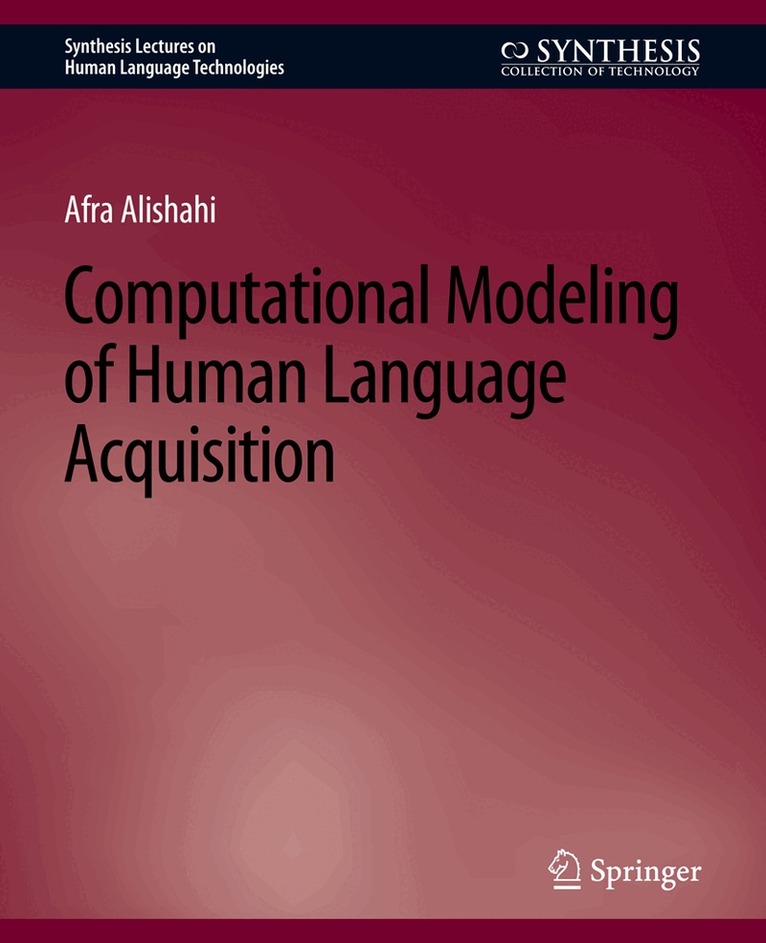
    Computational Modeling of Human Language Acquisition

    AvAfra Alishahi

    Häftad, Engelska, 2010

    Del i serien Synthesis Lectures on Human Language Technologies

    374 kr

    Beställningsvara. Skickas inom 10-15 vardagar. Fri frakt över 249 kr.

    Fler format och utgåvor

    E-bok

    455 kr

    Beskrivning

    Human language acquisition has been studied for centuries, but using computational modeling for such studies is a relatively recent trend. However, computational approaches to language learning have become increasingly popular, mainly due to advances in developing machine learning techniques, and the availability of vast collections of experimental data on child language learning and child-adult interaction. Many of the existing computational models attempt to study the complex task of learning a language under cognitive plausibility criteria (such as memory and processing limitations that humans face), and to explain the developmental stages observed in children. By simulating the process of child language learning, computational models can show us which linguistic representations are learnable from the input that children have access to, and which mechanisms yield the same patterns of behaviour that children exhibit during this process. In doing so, computational modeling provides insight into the plausible mechanisms involved in human language acquisition, and inspires the development of better language models and techniques. This book provides an overview of the main research questions in the field of human language acquisition. It reviews the most commonly used computational frameworks, methodologies and resources for modeling child language learning, and the evaluation techniques used for assessing these computational models. The book is aimed at cognitive scientists who want to become familiar with the available computational methods for investigating problems related to human language acquisition, as well as computational linguists who are interested in applying their skills to the study of child language acquisition. Different aspects of language learning are discussed in separate chapters, including the acquisition of the individual words, the general regularities which govern word and sentence form, and the associations between form and meaning. For eachof these aspects, the challenges of the task are discussed and the relevant empirical findings on children are summarized. Furthermore, the existing computational models that attempt to simulate the task under study are reviewed, and a number of case studies are presented. Table of Contents: Overview / Computational Models of Language Learning / Learning Words / Putting Words Together / Form--Meaning Associations / Final Thoughts

    Produktinformation

    • Utgivningsdatum:2010-10-29
    • Mått:191 x 235 x 7 mm
    • Vikt:219 g
    • Format:Häftad
    • Språk:Engelska
    • Serie:Synthesis Lectures on Human Language Technologies
    • Antal sidor:94
    • Förlag:Springer International Publishing AG
    • ISBN:9783031010125
    • Originaltitel:Computational Modeling of Human Language Acquisition

    Utforska kategorier

    • Systemvetenskap och AI inom Data och IT
    • Artificiell intelligens inom Data och IT
    • Språkvetenskap och lingvistik inom Språk och ordböcker

    Mer om författaren

    Afra Alishahi is a Research Fellow at the Computational Psycholinguistics group in the Computational Linguistics and Phonetics Department at Saarland University, Germany. She received her PhD degree from the Department of Computer Science at University of Toronto in 2008, where she was a member of the Computational Linguistics group. Her research has been focused on developing computational models of various aspects of first language acquisition, including learning the meaning of words, the formation of lexical categories and the acquisition of verb argument structure. She was the runner-up for Marr prize for the best student paper at the 27th Annual Conference of the Cognitive Science Society (CogSci 2005), and the winner of the Cognitive Science Prize for the best paper on Language Modeling at the 30th Annual Conference of the Cognitive Science Society (CogSci 2008). She has offered several courses on the topics covered in this book, including graduate-level lectures and seminars atSaarland University, a tutorial at the 47th Annual Meeting of the Association for Computational Linguistics (ACL 2009) and an advanced course at the European Summer School in Logic, Language and Information (ESSLLI 2010).

    Innehållsförteckning

    • Overview.- Computational Models of Language Learning.- Learning Words.- Putting Words Together.- Form--Meaning Associations.- Final Thoughts.