• Fri frakt över 249 kr
  • •
  • Snabba leveranser
  • •
  • Billiga böcker
Kundservice

Du är på sajten för privatpersoner.

Företag, bibliotek eller offentlig verksamhet?

Du handlar på classic.bokus.com, där alla dina funktioner finns intakta.
Till classic.bokus.com
Bokus logotyp. Gå till startsidan.
  • Erbjudanden
  • Student
  • Topplistor
  • Barn & ungdom
  • Bokus Play
  • E-böcker
  • Ljudböcker
  • Pocketböcker
  • Spel och pussel

Pocketfynda! Hundratals böcker för 49 kr/st →

Sidfot

Mina sidor

    Hjälp

    • Kundservice
    • Vanliga frågor och svar
    • Frakt och leverans
    • Retur vid ångerrätt
    • Reklamera vara
    • Betalning
    • Köpvillkor
    • Allmänna villkor
    • Information om webbplatsens tillgänglighet

    Om Bokus

    • Om oss
    • Pressrum
    • För studenter
    • För företag
    • För bibliotek och offentlig verksamhet
    • För leverantörer
    • Hållbarhet

    Populärt

    • Aktuella erbjudanden
    • Presentkort
    • Studentlitteratur
    • Nya böcker
    • Topplistor
    • Signerade böcker
    • Engelska böcker

    Inspiration

    • Boktips
    • BookTok
    • Barnbokskaraktärer
    • Populära författare
    Logotyp för Bokus
    Följ oss på Facebook (extern länk)Följ oss på Instagram (extern länk)Följ oss på YouTube (extern länk)Följ oss på TikTok (extern länk)
    bokus @ CookiesAnpassa cookiesIntegritetspolicyKöpvillkor
    Till Citymail hemsida (extern länk)Till Budbee hemsida (extern länk)Till Postnord hemsida (extern länk)Till Schenker hemsida (extern länk)Till Early Bird hemsida (extern länk)Till Walleys hemsida (extern länk)
    1. Data och IT
    2. Systemvetenskap och AI

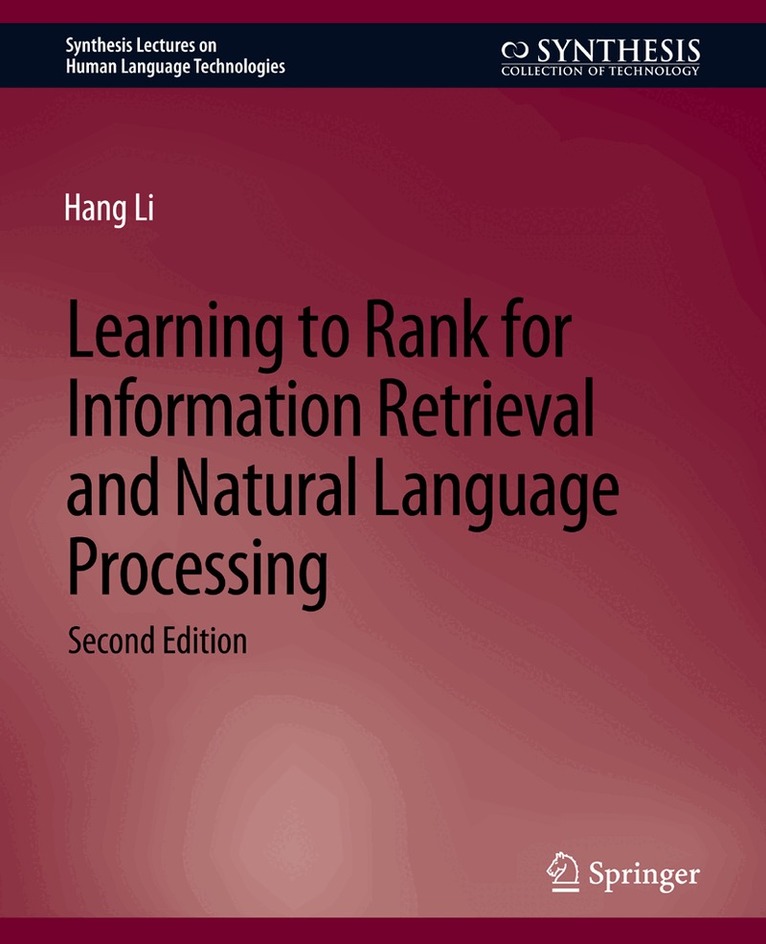
    Learning to Rank for Information Retrieval and Natural Language Processing, Second Edition

    AvHang Li

    Häftad, Engelska, 2014

    Del i serien Synthesis Lectures on Human Language Technologies

    371 kr

    Beställningsvara. Skickas inom 10-15 vardagar. Fri frakt över 249 kr.

    Fler format och utgåvor

    E-bok

    455 kr

    Beskrivning

    Learning to rank refers to machine learning techniques for training a model in a ranking task. Learning to rank is useful for many applications in information retrieval, natural language processing, and data mining. Intensive studies have been conducted on its problems recently, and significant progress has been made. This lecture gives an introduction to the area including the fundamental problems, major approaches, theories, applications, and future work. The author begins by showing that various ranking problems in information retrieval and natural language processing can be formalized as two basic ranking tasks, namely ranking creation (or simply ranking) and ranking aggregation. In ranking creation, given a request, one wants to generate a ranking list of offerings based on the features derived from the request and the offerings. In ranking aggregation, given a request, as well as a number of ranking lists of offerings, one wants to generate a new ranking list of the offerings. Ranking creation (or ranking) is the major problem in learning to rank. It is usually formalized as a supervised learning task. The author gives detailed explanations on learning for ranking creation and ranking aggregation, including training and testing, evaluation, feature creation, and major approaches. Many methods have been proposed for ranking creation. The methods can be categorized as the pointwise, pairwise, and listwise approaches according to the loss functions they employ. They can also be categorized according to the techniques they employ, such as the SVM based, Boosting based, and Neural Network based approaches. The author also introduces some popular learning to rank methods in details. These include: PRank, OC SVM, McRank, Ranking SVM, IR SVM, GBRank, RankNet, ListNet & ListMLE, AdaRank, SVM MAP, SoftRank, LambdaRank, LambdaMART, Borda Count, Markov Chain, and CRanking. The author explains several example applications of learning to rank including web search, collaborative filtering, definition search, keyphrase extraction, query dependent summarization, and re-ranking in machine translation. A formulation of learning for ranking creation is given in the statistical learning framework. Ongoing and future research directions for learning to rank are also discussed. Table of Contents: Learning to Rank / Learning for Ranking Creation / Learning for Ranking Aggregation / Methods of Learning to Rank / Applications of Learning to Rank / Theory of Learning to Rank / Ongoing and Future Work

    Produktinformation

    • Utgivningsdatum:2014-11-05
    • Mått:191 x 235 x 8 mm
    • Vikt:248 g
    • Format:Häftad
    • Språk:Engelska
    • Serie:Synthesis Lectures on Human Language Technologies
    • Antal sidor:107
    • Upplaga:2
    • Förlag:Springer International Publishing AG
    • ISBN:9783031010279
    • Originaltitel:Learning to Rank for Information Retrieval and Natural Language Processing, Second Edition

    Utforska kategorier

    • Systemvetenskap och AI inom Data och IT
    • Artificiell intelligens inom Data och IT
    • Språkvetenskap och lingvistik inom Språk och ordböcker

    Mer om författaren

    Hang Li is chief scientist of the Noahs Ark Lab of Huawei Technologies. He is also adjunct professor at Peking University, Nanjing University, Xian Jiaotong University, and Nankai University. His research areas include information retrieval, natural language processing, statistical machine learning, and data mining. He graduated from Kyoto University in 1988 and earned his PhD from the University of Tokyo in 1998. He worked at the NEC lab in Japan during 1991 and 2001. He joined Microsoft Research Asia in 2001 and has been working there until present. Hang has about 100 publications at top international journals and conferences, including SIGIR, WWW, WSDM, ACL, EMNLP, ICML, NIPS, and SIGKDD. He and his colleagues papers received the SIGKDD08 best application paper award and the SIGIR08 best student paper award. Hang has also been working on the development of several products. These include Microsoft SQL Server 2005, Microsoft Office 2007 and Office 2010, Microsoft Live Search 2008, Microsoft Bing 2009 and Bing 2010. He has also been very active in the research communities and served or is serving the top conferences and journals. For example, in 2011, he is PC co-chair of WSDM11; area chairs of SIGIR11, AAAI11, NIPS11; PC members of WWW11, ACL-HLT11, SIGKDD11, ICDM11, EMNLP11; and an editorial board member on both the Journal of the American Society for Information Science and the Journal of Computer Science & Technology.

    Innehållsförteckning

    • Learning to Rank.- Learning for Ranking Creation.- Learning for Ranking Aggregation.- Methods of Learning to Rank.- Applications of Learning to Rank.- Theory of Learning to Rank.- Ongoing and Future Work .