Häftad, Engelska, 2013
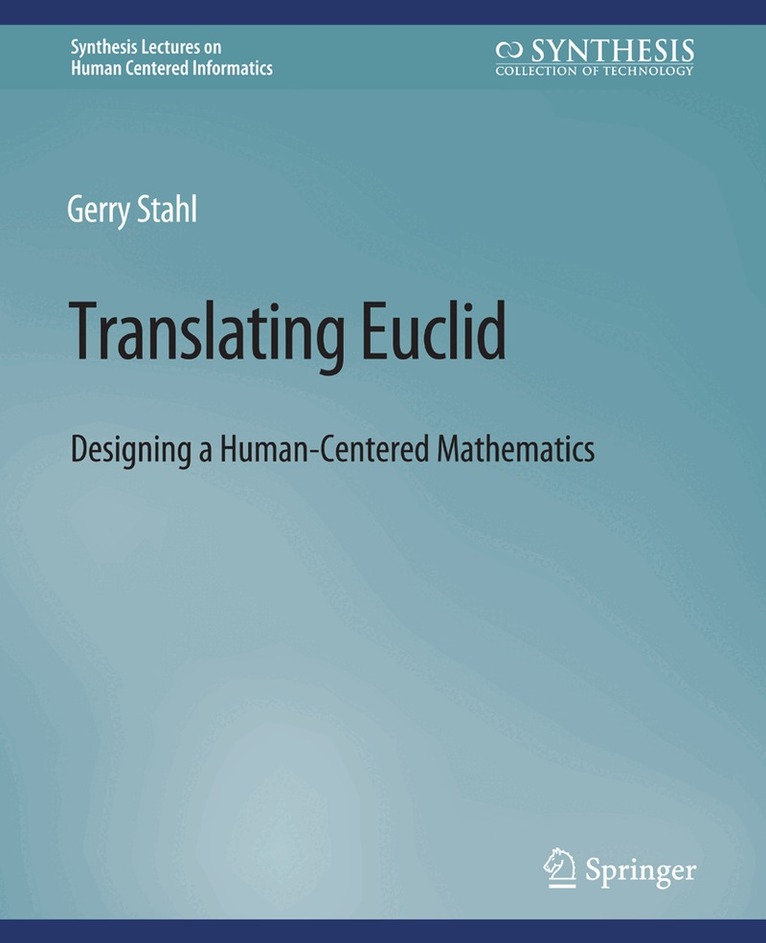
Translating Euclid
Av Gerry Stahl
456 kr
Beställningsvara. Skickas inom 10-15 vardagar. Fri frakt över 249 kr.
Beskrivning
Translating Euclid reports on an effort to transform geometry for students from a stylus-and-clay-tablet corpus of historical theorems to a stimulating computer-supported collaborative-learning inquiry experience. The origin of geometry was a turning point in the pre-history of informatics, literacy, and rational thought. Yet, this triumph of human intellect became ossified through historic layers of systematization, beginning with Euclid’s organization of the Elements of geometry. Often taught by memorization of procedures, theorems, and proofs, geometry in schooling rarely conveys its underlying intellectual excitement. The recent development of dynamic-geometry software offers an opportunity to translate the study of geometry into a contemporary vernacular. However, this involves transformations along multiple dimensions of the conceptual and practical context of learning. Translating Euclid steps through the multiple challenges involved in redesigning geometry education to take advantage of computer support. Networked computers portend an interactive approach to exploring dynamic geometry as well as broadened prospects for collaboration. The proposed conception of geometry emphasizes the central role of the construction of dependencies as a design activity, integrating human creation and mathematical discovery to form a human-centered approach to mathematics. This book chronicles an iterative effort to adapt technology, theory, pedagogy and practice to support this vision of collaborative dynamic geometry and to evolve the approach through on-going cycles of trial with students and refinement of resources. It thereby provides a case study of a design-based research effort in computer-supported collaborative learning from a human-centered informatics perspective.
Produktinformation
- Utgivningsdatum: 2013-05-10
- Mått: 191 x 235 x 16 mm
- Vikt: 462 g
- Format: Häftad
- Språk: Engelska
- Serie: Synthesis Lectures on Human-Centered Informatics
- Antal sidor: 221
- Förlag: Springer International Publishing AG
- ISBN: 9783031010729
- Originaltitel: Translating Euclid
Utforska kategorier
Betyg & recensioner
0 recensioner
Inga recensioner tillgängliga.