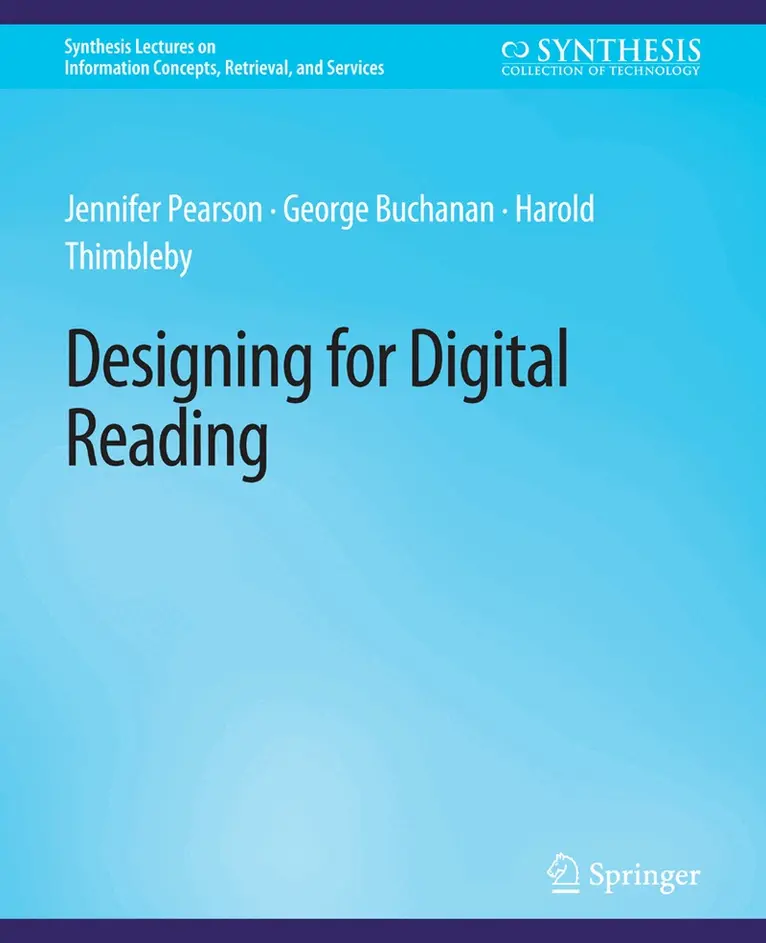
Häftad, Engelska, 2013
Designing for Digital Reading
Av Jennifer Pearson, George Buchanan, Harold Thimbleby
377 kr
Beställningsvara. Skickas inom 10-15 vardagar. Fri frakt över 249 kr.
Beskrivning
Reading is a complex human activity that has evolved, and co-evolved, with technology over thousands of years. Mass printing in the fifteenth century firmly established what we know as the modern book, with its physical format of covers and paper pages, and now-standard features such as page numbers, footnotes, and diagrams. Today, electronic documents are enabling paperless reading supported by eReading technologies such as Kindles and Nooks, yet a high proportion of users still opt to print on paper before reading. This persistent habit of "printing to read" is one sign of the shortcomings of digital documents -- although the popularity of eReaders is one sign of the shortcomings of paper. How do we get the best of both worlds? The physical properties of paper (for example, it is light, thin, and flexible) contribute to the ease with which physical documents are manipulated; but these properties have a completely different set of affordances to their digital equivalents. Paper can befolded, ripped, or scribbled on almost subconsciously -- activities that require significant cognitive attention in their digital form, if they are even possible. The nearly subliminal interaction that comes from years of learned behavior with paper has been described as lightweight interaction, which is achieved when a person actively reads an article in a way that is so easy and unselfconscious that they are not apt to remember their actions later. Reading is now in a period of rapid change, and digital text is fast becoming the predominant mode of reading. As a society, we are merely at the start of the journey of designing truly effective tools for handling digital text. This book investigates the advantages of paper, how the affordances of paper can be realized in digital form, and what forms best support lightweight interaction for active reading. To understand how to design for the future, we review the ways reading technology and reader behavior have both changed and remainedconstant over hundreds of years. We explore the reasoning behind reader behavior and introduce and evaluate several user interface designs that implement these lightweight properties familiar from our everyday use of paper. We start by looking back, reviewing the development of reading technology and the progress of research on reading over many years. Drawing key concepts from this review, we move forward to develop and test methods for creating new and more effective interactions for supporting digital reading. Finally, we lay down a set of lightweight attributes which can be used as evidence-based guidelines to improve the usability of future digital reading technologies. By the end of this book, then, we hope you will be equipped to critique the present state of digital reading, and to better design and evaluate new interaction styles and technologies.
Produktinformation
- Utgivningsdatum: 2013-10-28
- Mått: 191 x 235 x 11 mm
- Vikt: 278 g
- Format: Häftad
- Språk: Engelska
- Serie: Synthesis Lectures on Information Concepts, Retrieval, and Services
- Antal sidor: 115
- Förlag: Springer International Publishing AG
- ISBN: 9783031012020
- Originaltitel: Designing for Digital Reading
Utforska kategorier
Betyg & recensioner
0 recensioner
Inga recensioner tillgängliga.