E-bok, Engelska, 2022
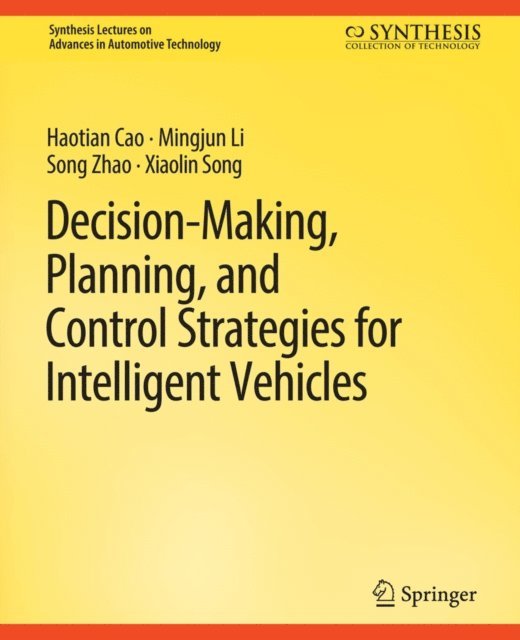
Decision Making, Planning, and Control Strategies for Intelligent Vehicles
Av Xiaolin Song, Song Zhao, Mingjun Li, Haotian Cao
815 kr
Läs direkt i Bokus Reader – eller ladda ned till din enhet (PDF kräver ofta zoom och scroll på små skärmar).
Beskrivning
The intelligent vehicle will play a crucial and essential role in the development of the future intelligent transportation system, which is developing toward the connected driving environment, ultimate driving safety, and comforts, as well as green efficiency. While the decision making, planning, and control are extremely vital components of the intelligent vehicle, these modules act as a bridge, connecting the subsystem of the environmental perception and the bottom-level control execution of the vehicle as well. This short book covers various strategies of designing the decision making, trajectory planning, and tracking control, as well as share driving, of the human-automation to adapt to different levels of the automated driving system.
More specifically, we introduce an end-to-end decision-making module based on the deep Q-learning, and improved path-planning methods based on artificial potentials and elastic bands which are designed for obstacle avoidance. Then, the optimal method based on the convex optimization and the natural cubic spline is presented.
As for the speed planning, planning methods based on the multi-object optimization and high-order polynomials, and a method with convex optimization and natural cubic splines, are proposed for the non-vehicle-following scenario (e.g., free driving, lane change, obstacle avoidance), while the planning method based on vehicle-following kinematics and the model predictive control (MPC) is adopted for the car-following scenario. We introduce two robust tracking methods for the trajectory following. The first one, based on nonlinear vehicle longitudinal or path-preview dynamic systems, utilizes the adaptive sliding mode control (SMC) law which can compensate for uncertainties to follow the speed or path profiles. The second one is based on the five-degrees-of-freedom nonlinear vehicle dynamical system that utilizes the linearized time-varying MPC to track the speed and path profile simultaneously.
Toward human-automation cooperative driving systems, we introduce two control strategies to address the control authority and conflict management problems between the human driver and the automated driving systems. Driving safety field and game theory are utilized to propose a game-based strategy, which is used to deal with path conflicts during obstacle avoidance. Driver''s driving intention, situation assessment, and performance index are employed for the development of the fuzzy-based strategy.
Multiple case studies and demos are included in each chapter to show the effectiveness of the proposed approach. We sincerely hope the contents of this short book provide certain theoretical guidance and technical supports for the development of intelligent vehicle technology.
Produktinformation
- Utgivningsdatum: 2022-05-31
- Språk: Engelska
- Filformat: PDF
- Kopieringsskydd: LCP
- ISBN: 9783031015069
- Förlag: Springer International Publishing
Utforska kategorier
Betyg & recensioner
0 recensioner
Inga recensioner tillgängliga.