E-bok, Engelska, 2022
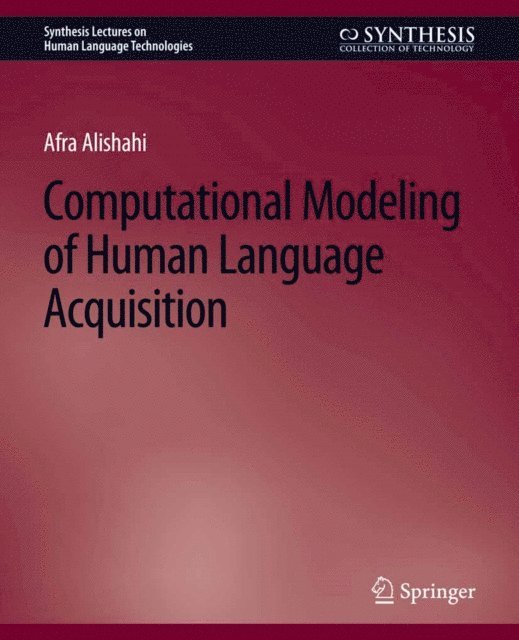
Computational Modeling of Human Language Acquisition
470 kr
Läs direkt i Bokus Reader – eller ladda ned till din enhet (PDF kräver ofta zoom och scroll på små skärmar).
Beskrivning
Human language acquisition has been studied for centuries, but using computational modeling for such studies is a relatively recent trend. However, computational approaches to language learning have become increasingly popular, mainly due to advances in developing machine learning techniques, and the availability of vast collections of experimental data on child language learning and child-adult interaction. Many of the existing computational models attempt to study the complex task of learning a language under cognitive plausibility criteria (such as memory and processing limitations that humans face), and to explain the developmental stages observed in children. By simulating the process of child language learning, computational models can show us which linguistic representations are learnable from the input that children have access to, and which mechanisms yield the same patterns of behaviour that children exhibit during this process. In doing so, computational modeling provides insight into the plausible mechanisms involved in human language acquisition, and inspires the development of better language models and techniques. This book provides an overview of the main research questions in the field of human language acquisition. It reviews the most commonly used computational frameworks, methodologies and resources for modeling child language learning, and the evaluation techniques used for assessing these computational models. The book is aimed at cognitive scientists who want to become familiar with the available computational methods for investigating problems related to human language acquisition, as well as computational linguists who are interested in applying their skills to the study of child language acquisition. Different aspects of language learning are discussed in separate chapters, including the acquisition of the individual words, the general regularities which govern word and sentence form, and the associations between form and meaning. For eachof these aspects, the challenges of the task are discussed and the relevant empirical findings on children are summarized. Furthermore, the existing computational models that attempt to simulate the task under study are reviewed, and a number of case studies are presented. Table of Contents: Overview / Computational Models of Language Learning / Learning Words / Putting Words Together / Form--Meaning Associations / Final Thoughts
Produktinformation
- Utgivningsdatum: 2022-06-01
- Språk: Engelska
- Filformat: PDF
- Kopieringsskydd: LCP
- ISBN: 9783031021404
- Förlag: Springer International Publishing
Utforska kategorier
Betyg & recensioner
0 recensioner
Inga recensioner tillgängliga.