• Fri frakt över 249 kr
  • •
  • Snabba leveranser
  • •
  • Billiga böcker
Kundservice

Du är på sajten för privatpersoner.

Företag, bibliotek eller offentlig verksamhet?

Du handlar på classic.bokus.com, där alla dina funktioner finns intakta.
Till classic.bokus.com
Bokus logotyp. Gå till startsidan.
  • Erbjudanden
  • Nyheter
  • Student
  • Topplistor
  • Barn & ungdom
  • Bokus Play
  • E-böcker
  • Pocketböcker
  • Spel & pussel

10% rabatt på allt med kod NYSTART10 →

Sidfot

Mina sidor

    Hjälp

    • Kundservice
    • Vanliga frågor och svar
    • Frakt och leverans
    • Retur vid ångerrätt
    • Reklamera vara
    • Betalning
    • Köpvillkor
    • Allmänna villkor
    • Information om webbplatsens tillgänglighet

    Om Bokus

    • Om oss
    • Pressrum
    • För studenter
    • För företag
    • För bibliotek och offentlig verksamhet
    • För leverantörer
    • Hållbarhet

    Populärt

    • Aktuella erbjudanden
    • Presentkort
    • Studentlitteratur
    • Nya böcker
    • Topplistor
    • Signerade böcker
    • Engelska böcker

    Inspiration

    • Boktips
    • BookTok
    • Populära bokserier
    • Barnbokskaraktärer
    • Populära författare
    Logotyp för Bokus
    Följ oss på Facebook (extern länk)Följ oss på Instagram (extern länk)Följ oss på YouTube (extern länk)Följ oss på TikTok (extern länk)
    bokus @ CookiesAnpassa cookiesIntegritetspolicyKöpvillkor
    Till Citymail hemsida (extern länk)Till Budbee hemsida (extern länk)Till Postnord hemsida (extern länk)Till Schenker hemsida (extern länk)Till Early Bird hemsida (extern länk)Till Walleys hemsida (extern länk)
    1. Data och IT
    2. Systemvetenskap och AI

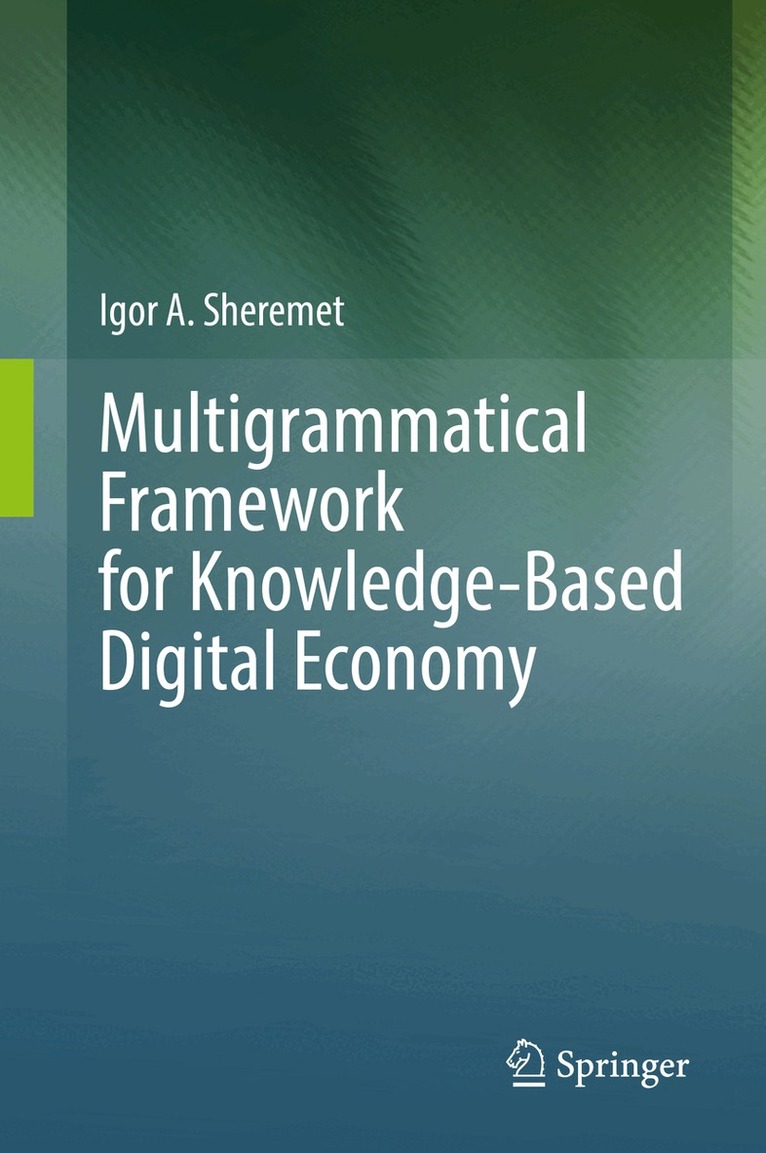
    Multigrammatical Framework for Knowledge-Based Digital Economy

    AvIgor A. Sheremet

    Inbunden, Engelska, 2022

    2 164 kr

    Beställningsvara. Skickas inom 10-15 vardagar. Fri frakt över 249 kr.

    Fler format och utgåvor

    E-bok

    2 833 kr

    Häftad

    2 164 kr

    Beskrivning

    This monograph introduces a novel multiset-based conceptual, mathematical and knowledge engineering paradigm, called multigrammatical framework (MGF), used for planning and scheduling in resource-consuming, resource-producing (industrial) and resource-distributing (economical) sociotechnological systems (STS). This framework is meant to enable smart operation not only in a “business-as-usual” mode, but also in extraordinary, highly volatile or hazardous environments. It is the result of convergence and deep integration into a unified, flexible and effectively implemented formalism operating on multisets of several well-known paradigms from classical operations research and modern knowledge engineering, such as: mathematical programming, game theory, optimal scheduling, logic programming and constraint programming. The mathematical background needed for MGF, its algorithmics, applications, implementation issues, as well as its nexus with known models from operations research and theoretical computer science areas are considered. The resilience and recovery issues of an STS are studied by applying the MGF toolkit and on paying special attention to the multigrammatical assessment of resilience of energy infrastructures. MGF-represented resource-based games are introduced, and directions for further development are discussed. The author presents multiple applications to business intelligence, critical infrastructure, ecology, economy and industry. This book is addressed to scholars working in the areas of theoretical and applied computer science, artificial intelligence, systems analysis, operations research, mathematical economy and critical infrastructure protection, to engineers developing software-intensive solutions for implementation of the knowledge-based digital economy and Industry 4.0, as well as to students, aspirants and university staff. Foundational knowledge of set theory, mathematicallogic and routine operations on data bases is needed to read this book. The content of the monograph is gradually presented, from simple to complex, in a well-understandable step-by-step manner. Multiple examples and accompanying figures are included in order to support the explanation of the various notions, expressions and algorithms.

    Produktinformation

    • Utgivningsdatum:2022-10-30
    • Mått:155 x 235 x 31 mm
    • Vikt:875 g
    • Format:Inbunden
    • Språk:Engelska
    • Antal sidor:461
    • Förlag:Springer International Publishing AG
    • ISBN:9783031138577

    Utforska kategorier

    • Systemvetenskap och AI inom Data och IT
    • Artificiell intelligens inom Data och IT
    • Företagsekonomi inom Ekonomi och Ledarskap

    Mer om författaren

    Prof. Dr. Igor Sheremet is Deputy Director for Science at the Russian Foundation for Basic Research and full member of the Russian Academy of Sciences. Over the last twenty years, using techniques from optimization theory and knowledge engineering, he has developed a theory of recursive multisets that has applications to digital economies, resource-based games, the modelling of large sociotechnological systems and the assessment of their resilience to various destructive impacts. Igor Sheremet has (co)authored more than 20 monographs, including the Springer edited volume “Resilience in the Digital Age”. Between 2014 and 2020, he was a member of the Science Advisory Committee of the International Institute of Applied Systems Analysis (IIASA). Since 2018, he is co-chair of the Advanced Mathematical Tools for Data-Driven Applied Systems Analysis task group established by the Committee on Data (CODATA) of the International Science Council. Between 2020 and 2022, he was chair of the joint IIASA-CODATA workgroup on Open Data, Big Data and Systems Analysis. Among thirty-two mathematicians and thought leaders from across the globe, he is co-author of the recent book “Mathematics for Action. Supporting Science-Based Decision-Making” published by UNESCO in 2022.

    Innehållsförteckning

    • Preface.- Introduction.- Sociotechnological systems and associated problems.- Syntax, semantics and mathematical properties of multiset grammars.- Basic algorithmics of multiset grammars and metagrammars.- Resource-consuming sociotechnological systems.- Industrial sociotechnological systems.- Economical sociotechnological systems and economical combinatorics.- Resilience and recovery of sociotechnological systems.- Resource-based games.- Multigrammatical representation of classic problems of operations research.- Interconnections between multiset grammars and models of computation.- Implementation issues and future developments.- Conclusion.- References.- Index.- List of Acronyms.