• Fri frakt över 249 kr
  • •
  • Snabba leveranser
  • •
  • Billiga böcker
Kundservice

Du är på sajten för privatpersoner.

Företag, bibliotek eller offentlig verksamhet?

Du handlar på classic.bokus.com, där alla dina funktioner finns intakta.
Till classic.bokus.com
Bokus logotyp. Gå till startsidan.
  • Erbjudanden
  • Nyheter
  • Student
  • Topplistor
  • Barn & ungdom
  • Bokus Play
  • E-böcker
  • Pocketböcker
  • Spel & pussel

Må bättre, för mindre! Upp till 50% rabatt på hälsoböcker

Sidfot

Mina sidor

    Hjälp

    • Kundservice
    • Vanliga frågor och svar
    • Frakt och leverans
    • Retur vid ångerrätt
    • Reklamera vara
    • Betalning
    • Köpvillkor
    • Allmänna villkor
    • Information om webbplatsens tillgänglighet

    Om Bokus

    • Om oss
    • Pressrum
    • För studenter
    • För företag
    • För bibliotek och offentlig verksamhet
    • För leverantörer
    • Hållbarhet

    Populärt

    • Aktuella erbjudanden
    • Presentkort
    • Studentlitteratur
    • Nya böcker
    • Topplistor
    • Signerade böcker
    • Engelska böcker

    Inspiration

    • Boktips
    • BookTok
    • Populära bokserier
    • Barnbokskaraktärer
    • Populära författare
    Logotyp för Bokus
    Följ oss på Facebook (extern länk)Följ oss på Instagram (extern länk)Följ oss på YouTube (extern länk)Följ oss på TikTok (extern länk)
    bokus @ CookiesAnpassa cookiesIntegritetspolicyKöpvillkor
    Till Citymail hemsida (extern länk)Till Budbee hemsida (extern länk)Till Postnord hemsida (extern länk)Till Schenker hemsida (extern länk)Till Early Bird hemsida (extern länk)Till Walleys hemsida (extern länk)
    1. Naturvetenskap och teknik
    2. Geovetenskap
    3. Miljövetenskap och miljöpolitik

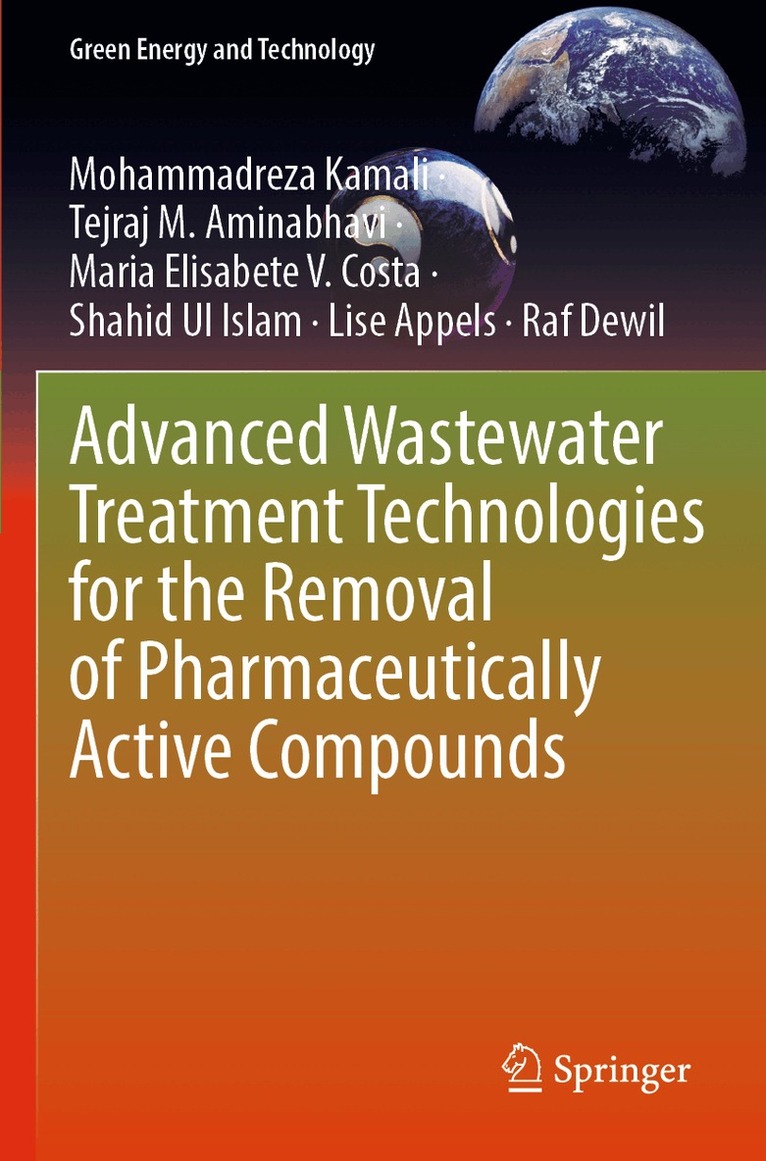
    Advanced Wastewater Treatment Technologies for the Removal of Pharmaceutically Active Compounds

    AvMohammadreza Kamali,Tejraj M. Aminabhavi

    Häftad, Engelska, 2024

    Del i serien Green Energy and Technology

    1 734 kr

    Beställningsvara. Skickas inom 10-15 vardagar. Fri frakt över 249 kr.

    Fler format och utgåvor

    Inbunden

    1 734 kr

    Övrigt

    646 kr

    Beskrivning

    This book reports on the treatment of waters and wastewaters with contaminants of emerging concern such as pharmaceutically active compounds. It shows how to prevent the contamination of the environment with such pollutants in the content of effluents. This book reviews various physico-chemical and biological methods that have been developed in order to deal with the polluted effluents. It also evaluates the already developed technologies regarding the sustainability criteria. The chapters discuss technical aspects and put the spotlight on the sustainability aspects of the water and wastewater treatment technologies.

    Produktinformation

    • Utgivningsdatum:2024-02-22
    • Mått:155 x 235 x 15 mm
    • Vikt:411 g
    • Format:Häftad
    • Språk:Engelska
    • Serie:Green Energy and Technology
    • Antal sidor:239
    • Upplaga:2023
    • Förlag:Springer International Publishing AG
    • ISBN:9783031208089

    Utforska kategorier

    • Miljövetenskap och miljöpolitik inom Naturvetenskap och teknik
    • Hydrologi inom Naturvetenskap och teknik
    • Miljöteknik inom Naturvetenskap och teknik

    Mer om författaren

    Mohammadreza Kamali is a research and teaching academic staff at Process and Environmental Technology Lab (PETLab), Department of Chemical Engineering, KU Leuven, Belgium. He has over ten years of experience in the design, construction, and operation of large-scale wastewater treatment plants. He works mainly on developing novel (waste) water treatment technologies (especially using advanced and sustainable materials), waste valorization for environmental applications, and sustainability and life cycle assessment of advanced technologies.Tejraj M. Aminabhavi is a director of Research at School of Advanced Sciences, KLE Technological University, Hubballi, India, and a diamond jubilee professor for life at Karnatak University, Dharwad, India, in addition to an honorary visiting professor at Macquaire University, Sydney, Australia. Aminabhavi obtained Ph.D. in polymer science from the University of Texas, Austin, Texas, USA; he has over 45 years of experience in academia, teaching, research, and industry. He works in the area of membrane transport processes, molecular modeling of polymer surfaces, wastewater treatment technologies, drug delivery polymers, and sustainable environmental engineering. Aminabhavi received Nikkei Asia Award in 2013 from Japan, Kwarizmi International Award from Iran in 2009, and CIPET Award in 2014 from ministry of fertilizers and chemicals, India. Elisabete Costa is an assistant professor of the University of Aveiro (UA), Portugal, at the Department of Materials and Ceramic Engineering (DEMaC), and a researcher of CICECO, Aveiro Materials Institute. She has a Chemical Engineering degree (Coimbra University) and a Ph.D. in Materials Science and Engineering (UA). Her teaching activities have covered different engineering courses and the supervision of student’s research projects and industry internships. She held several institutional coordination positions, among which a coordinator of DEMaC Scientific Council, a master in Materials Science and Engineering, and a director of Doctoral Program in Nanosciences and Nanotechnology. Her current R&D interests encompass a wide range of materials regarding composition, dimensionality, and properties, for different applications (electronics, biomedical, and environment), i.e., synthesis and processing of nanoparticles, nanostructures, thin/thick films, single crystals, ceramic bulk materials and ceramic polymer composites, and characterization of their structure, microstructure, mechanical, dielectric, piezoelectric, and ferroelectric properties. Shahid-ul-Islam is a fulbright research scientist at the University of California (Davis), California, USA. Before joining UC, he was working as a principal scientist at the Indian Institute of Technology Delhi, India, where he led projects funded by the Science and Engineering Research Board (DST-SERB) and the Council of Scientific and Industrial Research (CSIR), Govt. of India. His research goals are interdisciplinary, with a main emphasis on green engineering, sustainable chemistry, and the design and development of biologically active materials and surfaces for different application sectors. He is a fellow of the International Society for Development and Sustainability (ISDS), Japan; a member of many groups, including the American Chemical Society (USA); and is a life member of the Asian Polymer Association. Lise Appels is the head of the Process and Environmental Technology Lab (PETLab), which focusses on resource recovery and the treatment of aqueous waste and side streams. Within PETLab, she coordinates the research line on optimization of mixed-culture microbial processes toward the production of energy carriers and renewable chemicals, using (polluted) organic side streams as feedstock. She is a subject editor of Renewable Energy (IF= 8.001), EBM of various international journals (Renewable and Sustainable EnergyReviews, Chemical Engineering Journal, Energies, …), and a regular reviewer for numerous international journals.  Raf Dewil received his M.Sc. in Chemical Engineering Science from the University of Leuven (KU Leuven - Belgium) in 2003. Between 2003 and 2006, he carried out Ph.D. research at the University of Antwerp (Belgium). He was awarded his Ph.D. in Bioscience Engineering (Environmental Engineering) at this university in 2006. Following a one-year postdoctoral fellowship at the University of Antwerp, he was appointed as an assistant professor at KU Leuven association in November 2007, followed by a part-time associated professorship at the Chemical Engineering Department of KU Leuven in 2009. In 2014, he became a full-time associate professor at the same department. In 2018, he was promoted to professor. At KU Leuven, Raf Dewil leads a research group of about 20 members, mainly working on the treatment of hazardous waste(water) streams and sustainable resource recovery.

    Innehållsförteckning

    • Pharmaceutically Active Compounds in Water Bodies - Occurrence, Fate, and Toxicity.- Techniques for the Detection, Quantifications, and Identification of Pharmaceutically Active Compounds and their Removal Mechanisms.- Removal of Pharmaceutically Active Compounds in Water Bodies - Science history and research hotspots.- Pharmaceutically Active Compounds in Activated Sludge Systems - Presence, Fate, and Removal Efficiency.- Pharmaceutically Active Compounds in Anaerobic Digestion Processes – Biodegradation and Fate.- Microbial Fuel Cells for the Bioelectricity Generation from Effluents Containing Pharmaceutically Active Compounds.- Constructed Wetlands for the Elimination of Pharmaceutically Active Compounds; Fundamentals and Prospects.- Membrane Separation Technologies for the Elimination of Pharmaceutically Active Compounds - Progress and Challenges.- Adsorptive Techniques for the Removal of Pharmaceutically Active Compounds - Materials and Mechanisms.- Homogeneous Advanced OxidationProcesses for the Removal of Pharmaceutically Active Compounds – Current Status and Research Gaps.- Heterogeneous Advanced Oxidation Processes (HE-AOPs) for the Removal of Pharmaceutically Active Compounds - Pros and Cons.