• Fri frakt över 249 kr
  • •
  • Snabba leveranser
  • •
  • Billiga böcker
Kundservice

Du är på sajten för privatpersoner.

Företag, bibliotek eller offentlig verksamhet?

Du handlar på classic.bokus.com, där alla dina funktioner finns intakta.
Till classic.bokus.com
Bokus logotyp. Gå till startsidan.
  • Erbjudanden
  • Student
  • Topplistor
  • Barn & ungdom
  • Bokus Play
  • E-böcker
  • Ljudböcker
  • Pocketböcker
  • Spel & pussel

Upp till 25% på utvalda nyheter →

Sidfot

Mina sidor

    Hjälp

    • Kundservice
    • Vanliga frågor och svar
    • Frakt och leverans
    • Retur vid ångerrätt
    • Reklamera vara
    • Betalning
    • Köpvillkor
    • Allmänna villkor
    • Information om webbplatsens tillgänglighet

    Om Bokus

    • Om oss
    • Pressrum
    • För studenter
    • För företag
    • För bibliotek och offentlig verksamhet
    • För leverantörer
    • Hållbarhet

    Populärt

    • Aktuella erbjudanden
    • Presentkort
    • Studentlitteratur
    • Nya böcker
    • Topplistor
    • Signerade böcker
    • Engelska böcker

    Inspiration

    • Boktips
    • BookTok
    • Populära bokserier
    • Barnbokskaraktärer
    • Populära författare
    Logotyp för Bokus
    Följ oss på Facebook (extern länk)Följ oss på Instagram (extern länk)Följ oss på YouTube (extern länk)Följ oss på TikTok (extern länk)
    bokus @ CookiesAnpassa cookiesIntegritetspolicyKöpvillkor
    Till Citymail hemsida (extern länk)Till Budbee hemsida (extern länk)Till Postnord hemsida (extern länk)Till Schenker hemsida (extern länk)Till Early Bird hemsida (extern länk)Till Walleys hemsida (extern länk)
    1. Data och IT
    2. Systemvetenskap och AI
    3. Artificiell intelligens

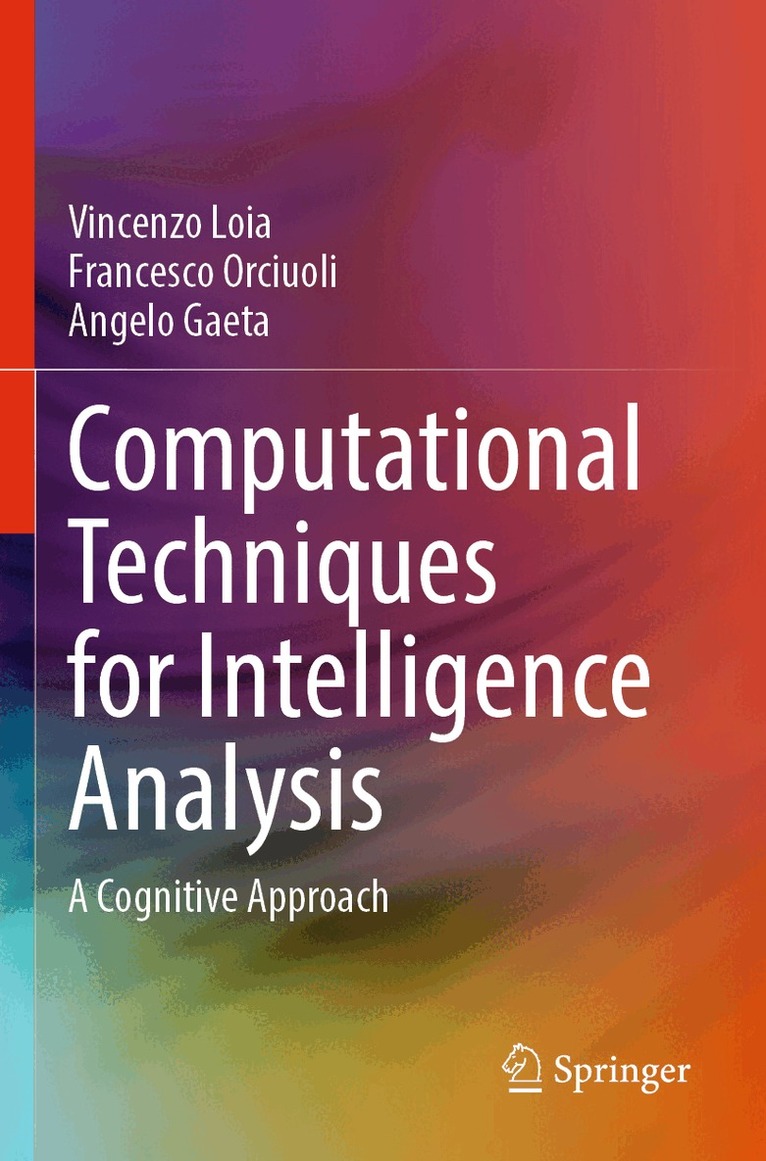
    Computational Techniques for Intelligence Analysis

    A Cognitive Approach

    AvVincenzo Loia,Francesco Orciuoli

    Häftad, Engelska, 2024

    674 kr

    Beställningsvara. Skickas inom 10-15 vardagar. Fri frakt över 249 kr.

    Fler format och utgåvor

    Inbunden

    952 kr

    Häftad

    646 kr

    Beskrivning

    This book focuses on the definition and implementation of data-driven computational tools supporting decision-making along heterogeneous intelligence scenarios. Intelligence analysis includes methodologies, activities, and tools aimed at obtaining complex information from a set of isolated data gathered from different sensors. The tools aim at increasing the level of situation awareness of decision-makers through the construction of abstract structures supporting human operators in reasoning and making decisions. This book appeals to students, professionals, and academic researchers in computational intelligence and approximate reasoning applications. It is a comprehensive textbook on the subject, supported with case studies and practical examples in Python. The readers will learn how to define decision support systems for the intelligence analysis through the application of situation awareness and granular computing for information processing.

    Produktinformation

    • Utgivningsdatum:2024-01-04
    • Mått:155 x 235 x 11 mm
    • Vikt:306 g
    • Format:Häftad
    • Språk:Engelska
    • Antal sidor:181
    • Förlag:Springer International Publishing AG
    • ISBN:9783031208539

    Utforska kategorier

    • Artificiell intelligens inom Data och IT

    Mer om författaren

    Vincenzo Loia received the master’s degree in computer science from the University of Salerno, Fisciano, Italy, in 1985, and the Ph.D. degree in computer science from the University of Paris 6, Paris, France, in 1989. He is currently a rector of the University of Salerno (from November 2019) and a full professor of computer science with the University of Salerno where he held the position of researcher from 1989 to 2000 and as an associate professor from 2000 to 2004. Since the beginning of his career, he has shown a deep and operational research interest, in particular in the use of innovative approaches for solving complex problems through new paradigms of software design and programming, that of agent and multi-agent systems; in the design and testing of systems for approximate reasoning, through the synergistic use of standard semantic technologies, description logic and fuzzy logic; in the definition of original conceptual data analysis methodologies for the extraction of knowledge from unstructured resources; in the creation of decision support systems conveyed by artificial intelligence models, cognitive architectures, computational intelligence and granular computing. Precisely with respect to the latter, it demonstrates that it has the sensitivity to understand, apply and contribute to research on models, such as granular and cognitive computing, which strongly base their principles on aspects concerning the study and analysis of human cognitive processes. These research interests have characterized his path of international dissemination through which he has established a rich network of scientific collaborations with researchers worldwide (including the close relationship with the founder of the fuzzy theory, Lotfi Zadeh). The pillars that characterize his scientific research over the years have been reflected in various application domains, from medical to legal, and more recently in the field of cyber-intelligence. Precisely in the latter area, he showshis great predisposition to multidisciplinarity, coordinating the scientific committee of the "Multidisciplinary Observatory for the fight against organized crime and terrorism" which implements a continuous scientific research activity applied to the thematic areas of computational intelligence and countering terrorist activities spread on the Web and Deep Web, in support of information analysis projects for crimes under the responsibility of DNA (National Anti-Mafia and Anti-Terrorism Directorate). Vincenzo Loia is:• Editor-in-Chief and Founder of the international journal “Ambient Intelligence and Humanized Computing,” Springer• Editor-in-Chief of the international magazine "Evolutionary Intelligence," Springer• Editor Responsible for Special Issues of the international magazine “Soft Computing,” Springer• Co-Editor-in-Chief of the international journal "Information Processing Systems"• Associate Editor of the IEEE Transaction Systems, Man and Cybernetics: Systems journals; IEEE Transactions on Fuzzy Systems; IEEE Transactions on Cognitive and Developmental Systems.Francesco Orciuoli received the master’s degree cum laude in computer science from the University of Salerno, Fisciano, Italy. He is an associate professor of computer science with the University of Salerno. His scientific activity, since the beginning of his career, is aimed at defining methods and techniques for supporting human cognitive processes (learning, decision making, reasoning and problem solving). In this regard, in recent years, he is investigating how the paradigms of granular computing (implemented with methods for approximate reasoning such as, for example, probabilistic rough set theory) and cognitive computing (e.g., three-way decisions) can be applied in synergy with other computational approaches to offer an adequate formal framework for human–data interaction applied to different domains such as, for example, intelligence, surveillance, emergency management. He is a co-author of more than 130 scientific publications indexed by SCOPUS, a co-founder of a university spin-off involved in several R&D project related to e-Health and a co-author of a patent in the e-health sector. He is a member of the IEEE and the IEEE Computational Intelligence Society. He is an associate editor of the International Journal of Big Data Intelligence (IJBDI) and serves as a reviewer for numerous international journals such as knowledge-based systems (Elsevier) and IEEE Transactions on Cybernetics and Applied Intelligence (Springer).Angelo Gaeta received the master’s degree cum laude in electronic engineering and Ph.D. degree in Management and Information Technology from the University of Salerno, Fisciano, Italy. He is currently a research assistant in computer science at the University of Salerno. His research interests relate to situation awareness, approximate reasoning and computational intelligence for decision making and intelligence analysis. He is a co-author of more than 50 scientific publications indexed by SCOPUS on these topics. He is an associate editor of the International Journal Ambient Intelligence and Humanized Computing (Springer) and serves as a reviewer of several international journals.

    Innehållsförteckning

    • Introduction.- Intelligence Analysis.- Foundations of the computational techniques.- Applying Situation Awareness to Intelligence Analysis.- Decision making through what-if analysis.- System modelling with graphs.- Behaviour modelling with fuzzy signatures.- Concept drift analysis with structures of opposition.- Comparing different approaches for implementing probability based rough set operators.- Data streaming scenarios.- Dealing with continuous variables: neighborhood and dominance based rough sets.