• Fri frakt över 249 kr
  • •
  • Snabba leveranser
  • •
  • Billiga böcker
Kundservice

Du är på sajten för privatpersoner.

Företag, bibliotek eller offentlig verksamhet?

Du handlar på classic.bokus.com, där alla dina funktioner finns intakta.
Till classic.bokus.com
Bokus logotyp. Gå till startsidan.
  • Erbjudanden
  • Nyheter
  • Student
  • Topplistor
  • Barn & ungdom
  • Bokus Play
  • E-böcker
  • Pocketböcker
  • Spel & pussel

10% rabatt på allt med kod: NYSTART10 →

Sidfot

Mina sidor

    Hjälp

    • Kundservice
    • Vanliga frågor och svar
    • Frakt och leverans
    • Retur vid ångerrätt
    • Reklamera vara
    • Betalning
    • Köpvillkor
    • Allmänna villkor
    • Information om webbplatsens tillgänglighet

    Om Bokus

    • Om oss
    • Pressrum
    • För studenter
    • För företag
    • För bibliotek och offentlig verksamhet
    • För leverantörer
    • Hållbarhet

    Populärt

    • Aktuella erbjudanden
    • Presentkort
    • Studentlitteratur
    • Nya böcker
    • Topplistor
    • Signerade böcker
    • Engelska böcker

    Inspiration

    • Boktips
    • BookTok
    • Populära bokserier
    • Barnbokskaraktärer
    • Populära författare
    Logotyp för Bokus
    Följ oss på Facebook (extern länk)Följ oss på Instagram (extern länk)Följ oss på YouTube (extern länk)Följ oss på TikTok (extern länk)
    bokus @ CookiesAnpassa cookiesIntegritetspolicyKöpvillkor
    Till Citymail hemsida (extern länk)Till Budbee hemsida (extern länk)Till Postnord hemsida (extern länk)Till Schenker hemsida (extern länk)Till Early Bird hemsida (extern länk)Till Walleys hemsida (extern länk)
    1. Naturvetenskap och teknik
    2. Geovetenskap
    3. Geovetenskap

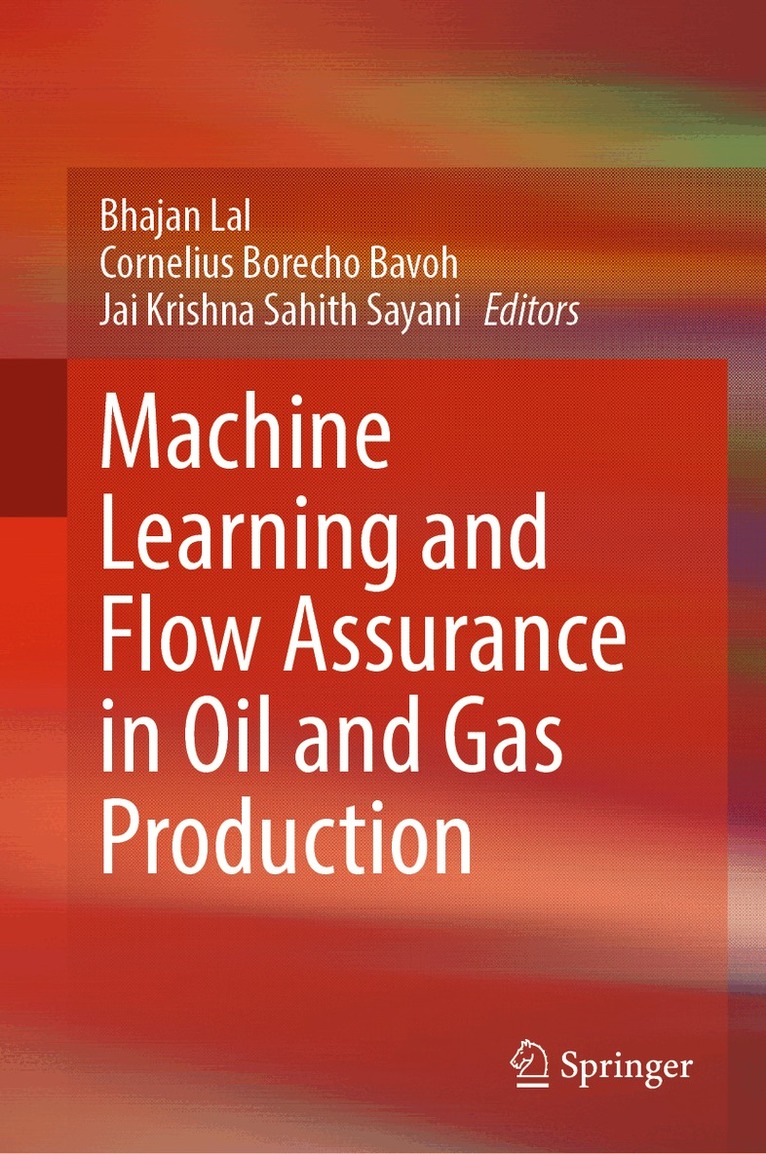
    Machine Learning and Flow Assurance in Oil and Gas Production

    AvBhajan Lal,Cornelius Borecho Bavoh

    Inbunden, Engelska, 2023

    1 734 kr

    Beställningsvara. Skickas inom 10-15 vardagar. Fri frakt över 249 kr.

    Beskrivning

    This book is useful to flow assurance engineers, students, and industries who wish to be flow assurance authorities in the twenty-first-century oil and gas industry.The use of digital or artificial intelligence methods in flow assurance has increased recently to achieve fast results without any thorough training effectively. Generally, flow assurance covers all risks associated with maintaining the flow of oil and gas during any stage in the petroleum industry. Flow assurance in the oil and gas industry covers the anticipation, limitation, and/or prevention of hydrates, wax, asphaltenes, scale, and corrosion during operation. Flow assurance challenges mostly lead to stoppage of production or plugs, damage to pipelines or production facilities, economic losses, and in severe cases blowouts and loss of human lives. A combination of several chemical and non-chemical techniques is mostly used to prevent flow assurance issues in the industry. However, the use of models to anticipate, limit, and/or prevent flow assurance problems is recommended as the best and most suitable practice. The existing proposed flow assurance models on hydrates, wax, asphaltenes, scale, and corrosion management are challenged with accuracy and precision. They are not also limited by several parametric assumptions. Recently, machine learning methods have gained much attention as best practices for predicting flow assurance issues. Examples of these machine learning models include conventional approaches such as artificial neural network, support vector machine (SVM), least square support vector machine (LSSVM), random forest (RF), and hybrid models. The use of machine learning in flow assurance is growing, and thus, relevant knowledge and guidelines on their application methods and effectiveness are needed for academic, industrial, and research purposes.In this book, the authors focus on the use and abilities of various machine learning methods in flow assurance. Initially, basic definitions and use of machine learning in flow assurance are discussed in a broader scope within the oil and gas industry. The rest of the chapters discuss the use of machine learning in various flow assurance areas such as hydrates, wax, asphaltenes, scale, and corrosion. Also, the use of machine learning in practical field applications is discussed to understand the practical use of machine learning in flow assurance.

    Produktinformation

    • Utgivningsdatum:2023-03-12
    • Mått:155 x 235 x 18 mm
    • Vikt:452 g
    • Format:Inbunden
    • Språk:Engelska
    • Antal sidor:177
    • Förlag:Springer International Publishing AG
    • ISBN:9783031242304

    Utforska kategorier

    • Geovetenskap inom Naturvetenskap och teknik
    • Energiteknik inom Naturvetenskap och teknik
    • Systemvetenskap och AI inom Data och IT

    Mer om författaren

    Dr. Bhajan Lal, chartered chemist, is a senior lecturer (2013-conti..) in Chemical Engineering Department and a core research member of CO2 Research Centre in Institute of Contaminant Management (ICM) at the Universiti Teknologi PETRONAS-Malaysia. After receiving M.Sc., Ph.D. degree (Physical Chemistry) in 2004 from JMI Central University, New Delhi, India, Dr. Lal worked as a postdoc fellow and research scientist in USA, Canada, South Africa, Turkey, and Malaysia (2004-2013). His main areas of research interests are CO2 hydrates and its application in CO2 capture and storage, desalination, and flow assurance. He graduated 6 M.Sc., 5 Ph.D., 2 postdocs, and more than 60 chemical engineering undergrads FYPI students since 2013. Dr. Lal has published 4 books related to oil and gas industry, 120 peer-reviewed journal papers, 50 conference papers, and 4 book chapters (H-index 36, i-10 index 93, no of being cited 3825). In addition, as a project leader, he has secured 18 gas hydrate-related research projects worth RM 3.4 million from oil and gas industries, UTP, and Malaysian Government. He achieved Gold Medal in ITEX2021, EREKA 2022 -Malaysia for his novel gas hydrate-based desalination product exhibition. He delivered customized online/face-to-face short courses in flow assurance, machine learning, and gas hydrate related to oil and gas industry.Cornelius Borecho Bavoh is a researcher and academician. He worked at the Phase Separation Laboratory of the Research Center for CO2 Capture (RCCO2C) in the Chemical Engineering Department of Universiti Teknologi PETRONAS (UTP), Seri Iskandar, Perak Darul Ridzuan, Malaysia. He has more than 5 years of experience in tutoring and research at the Universiti Teknologi PETRONAS, Malaysia. He has worked on several industrial and fundamental projects related to drilling, gas hydrate, and CO2 capture and separation, and published more than 30 scientific papers in peer-reviewed journals, conferences, and book chapters. Bavoh holds Ph.D. and M.Sc. degrees in chemical engineering and B.Sc. (Hons) degree in petroleum engineering. His research expertise includes thermodynamics and kinetics of reservoir fluid phase modeling and characterization, gas hydrate in flow assurance, production of naturally deposited methane hydrates, and application of gas hydrate-based technology in CO2 capture and natural gas storage and transportation, drilling fluid technology, rheology, and cuttings transport. Bavoh is a member of the Society of Petroleum Engineers (SPE).Dr. Jai Krishna Sahith graduated in mechanical engineering department from University Technology PETRONAS, Malaysia, and currently doing postdoc in University College Dublin (UCD). Previously, he completed his masters from Jawaharlal Nehru Technological University Kakinada, India. He filed the IP and patent on gas hydrate-related applications. At present, he is working on gas hydrate-based desalination process. He has published hisresearch work in peer-reviewed journals and book chapters.

    Innehållsförteckning

    • Chapter 1: Machine Learning and Flow Assurance Issues.- Chapter 2: Machine Learning in Oil and Gas Industry.- Chapter 3: Multiphase Flow Systems and Potential of Machine Learning Approaches in Cutting Transport and Liquid Loading Scenarios.- Chapter 4: Machine Learning in Corrosion.- Chapter 5: Machine Learning in Asphaltenes Mitigation.- Chapter 6: Machine learning for Scale deposition in oil and gas industry.- Chapter 7: Machine Learning in CO2 sequestration.- Chapter 8: Machine Learning in Wax Deposition.- Chapter 9: Machine Learning Application in Gas Hydrates.- Chapter 10: Machine Learning Application Guidelines in Flow Assurance.