Beställningsvara. Skickas inom 10-15 vardagar. Fri frakt över 249 kr.
Beskrivning
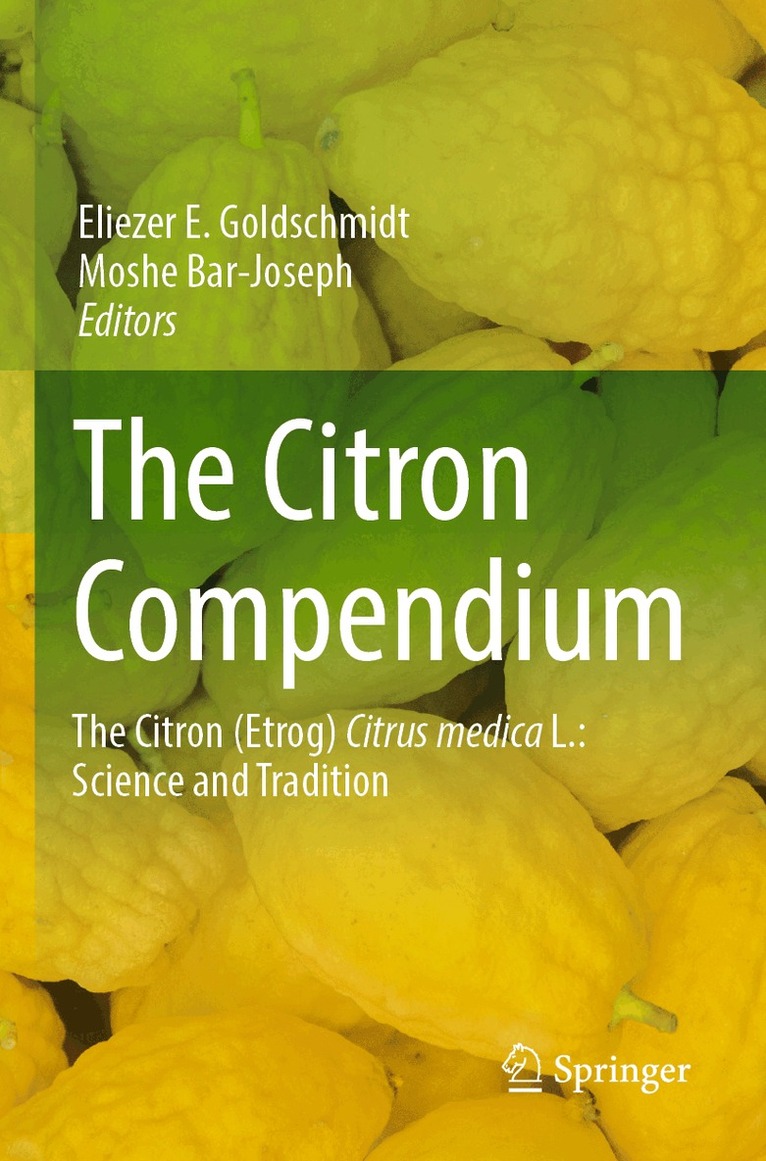
This book’s three sections address biology (botany, genomics, Chinese and Mediterranean citrons, diseases, pests, and horticulture), tradition (Talmudic discourse, mysticism, medicine, literature, art, food, and beverages) and history (archaeology, trade, grafting controversies);
Produktinformation
Utgivningsdatum:2024-06-08
Mått:155 x 235 x 31 mm
Vikt:1 030 g
Format:Häftad
Språk:Engelska
Antal sidor:607
Förlag:Springer International Publishing AG
ISBN:9783031257773
Originaltitel:The Etrog Citron (Citrus medica L.), Tradition and Research
Eliezer E. Goldschmidt (born 1938, Jerusalem) is a James De Rothschild Professor of Horticulture, emeritus, at the Hebrew University of Jerusalem. He earned his Ph.D. in 1968 and has been a professor since 1982. His research has focused on horticultural productivity with an emphasis on citrus. Prof. Goldschmidt is primarily known for his research on citron history and genetics. He developed a synthetic auxin treatment which is instrumental for the maintenance of a persistent style of; a feature which is highly significant in determining the halachic status of etrog citrons for their use in the feast of Tabernacles.Moshe Bar-Joseph ( born 1939, Romania), founder and former Head of the S. Tolkowsky Laboratory for Citrus Disease Research at the Volcani Institute, ARO; Retired adjunct Professor of Plant Virology, Ben-Gurion University, Beer Sheva, Israel. He earned his Ph.D. in 1972. Moshe Bar-Joseph is a world-renowned citrus pathologist specializing in plant virology and experienced in citron propagation for viroid diagnosis. He conducted seminal investigations of the Citrus Tristeza Virus (CTV) disease and its spread in Israeli citrus orchards.
Recensioner i media
“Considering the high quality of the articles, written by experts in their respective fields, and the broad, multidisciplinary character, the volume will be of interest to a range of readers, including researchers, students, and interested laymen. The subjects covered include all the components of economic botany: botany, horticulture, history, folklore, religion, commerce, and their fascinating interactions.” (Ari Shaffir, Economic Botany, Vol. 78 (1), 2024)
Innehållsförteckning
The Biology of the Citron.- Citron Genomics.- Citron Phytochemistry.- Selected Aspects of Commercial Production in Etrog Orchards.- Preserving Etrog Quality After Harvest: Doctrine and Practice.- Citron Arthropod Pests in the Mediterranean, Their Origin and Notes On Their Biology and Management.- Diseases of the Etrog Citron and Other Citrus Trees.- The Citron ( Citrus medica L.) in China.- The Citron in Italy and Its cultivation in Calabria.- The Citron in Corsica.- The Citron in the United States.- The Citron in Mediterranean Food and Beverages.- 'Fruit of the Goodly Trees’: The Talmudic Discourse on the Etrog Citron.- From Theophrastus to the Present: The Citron in Medicine.- The Etrog Citron in Art.- The Etrog Citron in Midrashic and Kabbalistic Literature.- From ‘An Etrog’ to ‘One's Etrog’: A Literary Analysis of S.Y. Agnon’s Story.- History of the Citron in Ancient Israel and the Near East.- The Etrog Citron Trail to the North: Genoa and Trieste.- The Corfu Etrog Citron Polemic.-The Grafted Etrog Citron Controversy.- Etrog Citrons of the Land of Israel in Modern Times.