• Fri frakt över 249 kr
  • •
  • Snabba leveranser
  • •
  • Billiga böcker
Kundservice

Du är på sajten för privatpersoner.

Företag, bibliotek eller offentlig verksamhet?

Du handlar på classic.bokus.com, där alla dina funktioner finns intakta.
Till classic.bokus.com
Bokus logotyp. Gå till startsidan.
  • Erbjudanden
  • Nyheter
  • Student
  • Topplistor
  • Barn & ungdom
  • Bokus Play
  • E-böcker
  • Pocketböcker
  • Spel & pussel

10% rabatt på allt med kod NYSTART10 →

Sidfot

Mina sidor

    Hjälp

    • Kundservice
    • Vanliga frågor och svar
    • Frakt och leverans
    • Retur vid ångerrätt
    • Reklamera vara
    • Betalning
    • Köpvillkor
    • Allmänna villkor
    • Information om webbplatsens tillgänglighet

    Om Bokus

    • Om oss
    • Pressrum
    • För studenter
    • För företag
    • För bibliotek och offentlig verksamhet
    • För leverantörer
    • Hållbarhet

    Populärt

    • Aktuella erbjudanden
    • Presentkort
    • Studentlitteratur
    • Nya böcker
    • Topplistor
    • Signerade böcker
    • Engelska böcker

    Inspiration

    • Boktips
    • BookTok
    • Populära bokserier
    • Barnbokskaraktärer
    • Populära författare
    Logotyp för Bokus
    Följ oss på Facebook (extern länk)Följ oss på Instagram (extern länk)Följ oss på YouTube (extern länk)Följ oss på TikTok (extern länk)
    bokus @ CookiesAnpassa cookiesIntegritetspolicyKöpvillkor
    Till Citymail hemsida (extern länk)Till Budbee hemsida (extern länk)Till Postnord hemsida (extern länk)Till Schenker hemsida (extern länk)Till Early Bird hemsida (extern länk)Till Walleys hemsida (extern länk)
    1. Data och IT
    2. Systemvetenskap och AI

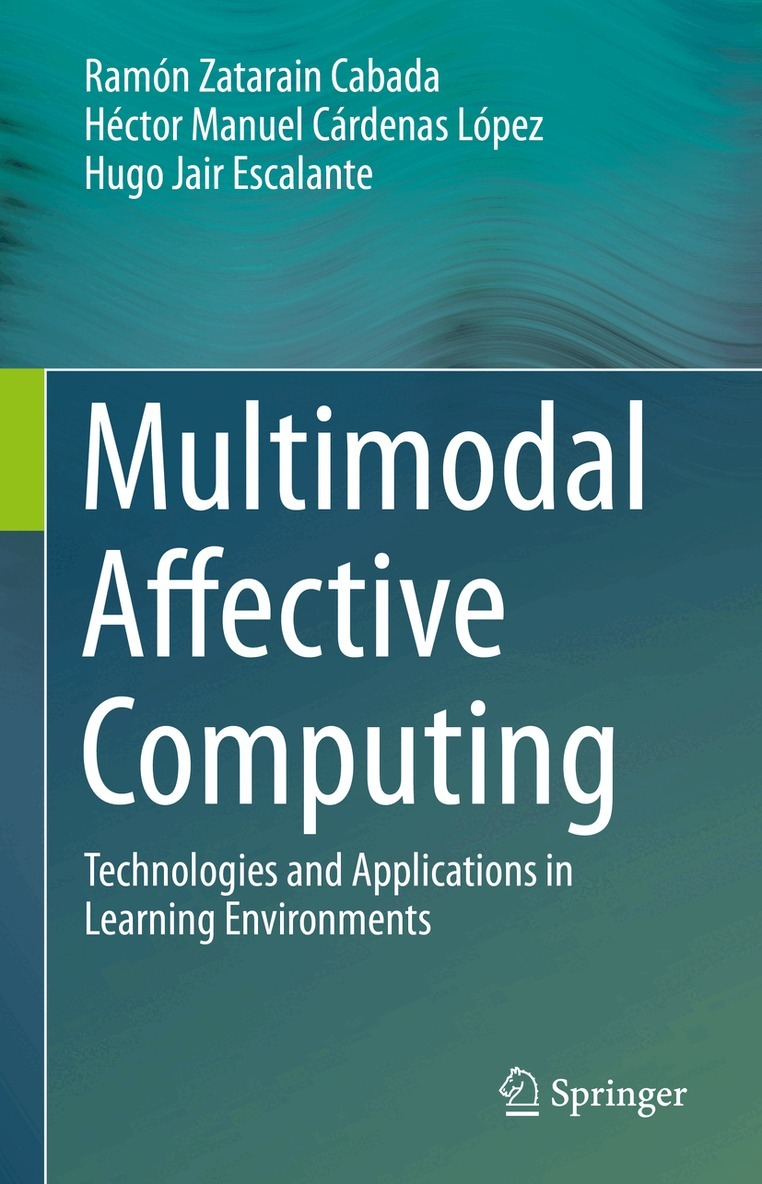
    Multimodal Affective Computing

    Technologies and Applications in Learning Environments

    AvRamón Zatarain Cabada,Héctor Manuel Cárdenas López

    Inbunden, Engelska, 2023

    1 787 kr

    Beställningsvara. Skickas inom 10-15 vardagar. Fri frakt över 249 kr.

    Fler format och utgåvor

    Häftad

    1 787 kr

    Beskrivning

    This book explores AI methodologies for the implementation of affective states in intelligent learning environments. Divided into four parts, Multimodal Affective Computing: Technologies and Applications in Learning Environments begins with an overview of Affective Computing and Intelligent Learning Environments, from their fundamentals and essential theoretical support up to their fusion and some successful practical applications. The basic concepts of Affective Computing, Machine Learning, and Pattern Recognition in Affective Computing, and Affective Learning Environments are presented in a comprehensive and easy-to-read manner. In the second part, a review on the emerging field of Sentiment Analysis for Learning Environments is introduced, including a systematic descriptive tour through topics such as building resources for sentiment detection, methods for data representation, designing and testing the classification models, and model integration into a learningsystem. The methodologies corresponding to Multimodal Recognition of Learning-Oriented Emotions are presented in the third part of the book, where topics such as building resources for emotion detection, methods for data representation, multimodal recognition systems, and multimodal emotion recognition in learning environments are presented. The fourth and last part of the book is devoted to a wide application field of the combination of methodologies, such as Automatic Personality Recognition, dealing with issues such as building resources for personality recognition, methods for data representation, personality recognition models, and multimodal personality recognition for affective computing.  This book can be very useful not only for beginners who are interested in affective computing and intelligent learning environments, but also for advanced and experts in the practice and developments of the field. It complies an end-to-end treatment on these subjects, especially with educational applications, making it easy for researchers and students to get on track with fundamentals, established methodologies, conventional evaluation protocols, and the latest progress on these subjects.

    Produktinformation

    • Utgivningsdatum:2023-06-27
    • Mått:155 x 235 x 19 mm
    • Vikt:518 g
    • Format:Inbunden
    • Språk:Engelska
    • Antal sidor:213
    • Förlag:Springer International Publishing AG
    • ISBN:9783031325410

    Utforska kategorier

    • Systemvetenskap och AI inom Data och IT
    • Pedagogisk psykologi inom Psykologi och pedagogik
    • Material och digital teknik i undervisningen inom Psykologi och pedagogik

    Mer om författaren

    Ramon Zatarain Cabada. Professor and Researcher at the Instituto Tecnológico de Culiacán, Mexico. He is a regular member of the Mexican Academy of Computing (AMEXCOMP), the Mexican Society of Artificial Intelligence (SMIA), and the Mexican System of Researchers Level I (SNI). He has been a professor and Researcher at institutions such as Instituto Tecnológico de Toluca, the University of the State of México (UAEM), and the Instituto Tecnológico de Aguascalientes. He was a leader to create programs for Computer Science (Master and PhD). He has served as co-editor of a special issue of Educational Technology and Society and author of chapters in different Springer books such as Soft Computing for Recognition Based on Biometrics, Social Networking and Education, and Current Trends on Knowledge-Based Systems. As a researcher he has been a leader in more than 20 research projects and has more than 100 publications in different international journals and proceedings. His researchinterests are on Intelligent Learning Environments, Affective Computing, and Artificial Intelligence applied to Education.Héctor Manuel Cárdenas López. Research assistant at the Instituto Tecnológico de Culiacán, Mexico. He is currently working towards a PhD degree in Engineering Sciences with the topic Multimodal Emotion and Personality Recognition. He is a member of the Thematic Network of Applied Computational Intelligence (RedICA). His main research interest includes Multimodal deep learning techniques, human behavior classification for emotion and personality recognition, affective tutoring systems, and cognitive oriented emotions.Hugo Jair Escalante. Senior researcher scientist INAOE, Mexico and member of the board of directors of ChaLearn USA, Chair officer of the IAPR Technical Committee 12. He is a regular member of the Mexican Academy of Sciences (AMC), the Mexican Academy of Computing (AMEXCOMP) and Mexican System of Researchers Level II (SNI). He was editor of the Springer Series on Challenges in Machine Learning 2017-2023 and is Associate Editor of IEEE Transactions on Affective Computing. He has been involved in the organization of several challenges in machine learning and computer vision collocated with top venues. He has served as competition chair of NeurIPS2020, FG2020 and ICPR2020, NeurIPS2019, PAKDD2019-2018, IJCNN2019. His research interests are on machine learning, challenge organization, and its applications on language and vision.

    Innehållsförteckning

    • Part I: Fundamentals.- Chapter 1. Affective Computing.- Chapter 2. Machine learning and pattern recognition in affective computing.- Chapter 3. Affective Learning Environments.- Part II: Sentiment Analysis for Learning Environments.- Chapter 4. Building resources for sentiment detection.- Chapter 5. Methods for data representation.- Chapter 6. Designing and testing the classification models.- Chapter 7. Model integration to a learning system.- Part III: Multimodal Recognition of Learning-Oriented Emotions.- Chapter 8. Building Resources for Emotion Detection.- Chapter 9. Methods for Data Representation.- Chapter 10. Multimodal recognition systems.- Chapter 11. Multimodal emotion recognition in learning environments.- Part IV: Automatic Personality Recognition.- Chapter 12. Building resources for personality recognition.- Chapter 13. Methods for data representation.- Chapter 14. Personality recognition models.- Chapter 15. Multimodal personality recognition for affective computing.