• Fri frakt över 249 kr
  • •
  • Snabba leveranser
  • •
  • Billiga böcker
Kundservice

Du är på sajten för privatpersoner.

Företag, bibliotek eller offentlig verksamhet?

Du handlar på classic.bokus.com, där alla dina funktioner finns intakta.
Till classic.bokus.com
Bokus logotyp. Gå till startsidan.
  • Erbjudanden
  • Nyheter
  • Student
  • Topplistor
  • Barn & ungdom
  • Bokus Play
  • E-böcker
  • Pocketböcker
  • Spel & pussel

10% rabatt på allt med kod NYSTART10 →

Sidfot

Mina sidor

    Hjälp

    • Kundservice
    • Vanliga frågor och svar
    • Frakt och leverans
    • Retur vid ångerrätt
    • Reklamera vara
    • Betalning
    • Köpvillkor
    • Allmänna villkor
    • Information om webbplatsens tillgänglighet

    Om Bokus

    • Om oss
    • Pressrum
    • För studenter
    • För företag
    • För bibliotek och offentlig verksamhet
    • För leverantörer
    • Hållbarhet

    Populärt

    • Aktuella erbjudanden
    • Presentkort
    • Studentlitteratur
    • Nya böcker
    • Topplistor
    • Signerade böcker
    • Engelska böcker

    Inspiration

    • Boktips
    • BookTok
    • Populära bokserier
    • Barnbokskaraktärer
    • Populära författare
    Logotyp för Bokus
    Följ oss på Facebook (extern länk)Följ oss på Instagram (extern länk)Följ oss på YouTube (extern länk)Följ oss på TikTok (extern länk)
    bokus @ CookiesAnpassa cookiesIntegritetspolicyKöpvillkor
    Till Citymail hemsida (extern länk)Till Budbee hemsida (extern länk)Till Postnord hemsida (extern länk)Till Schenker hemsida (extern länk)Till Early Bird hemsida (extern länk)Till Walleys hemsida (extern länk)
    1. Data och IT
    2. Nätverk och kommunikation

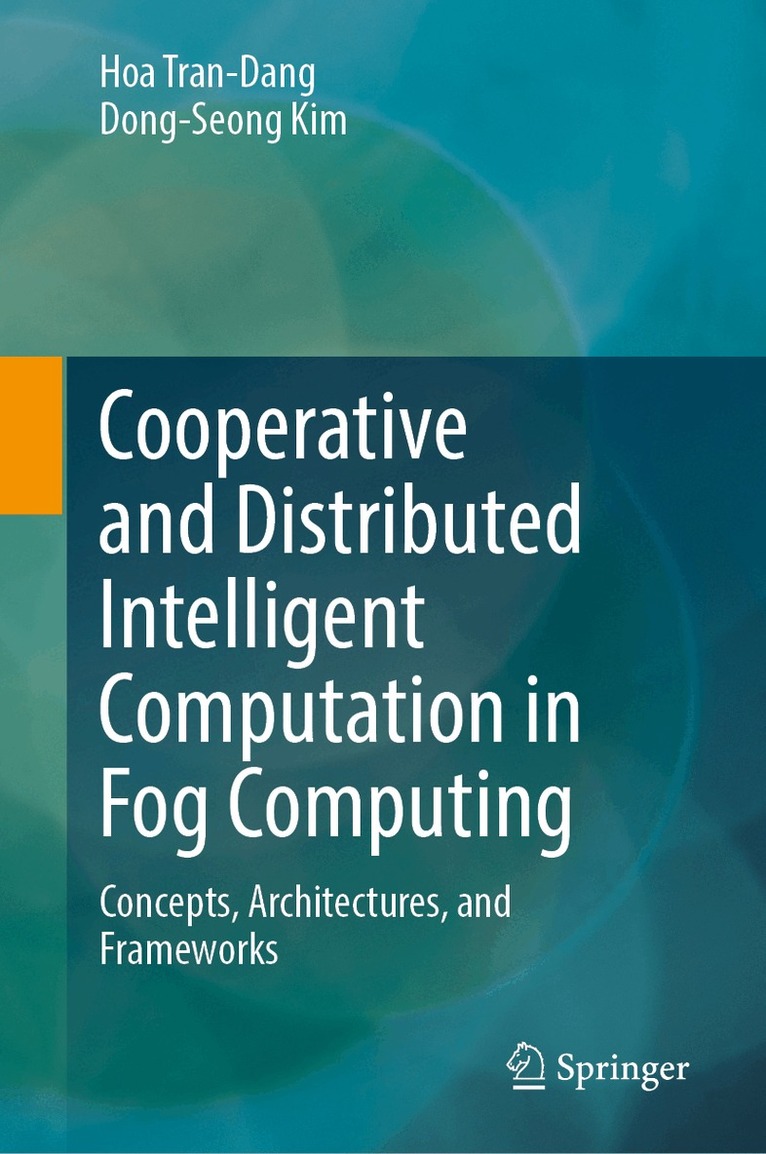
    Cooperative and Distributed Intelligent Computation in Fog Computing

    Concepts, Architectures, and Frameworks

    AvHoa Tran-Dang,Dong-Seong Kim

    Inbunden, Engelska, 2023

    1 896 kr

    Beställningsvara. Skickas inom 10-15 vardagar. Fri frakt över 249 kr.

    Fler format och utgåvor

    Häftad

    1 896 kr

    Beskrivning

    This informative text/reference presents a detailed review of the state of the art in fog computing paradigm. In particular, the book examines a broad range of important cooperative and distributed computation algorithms, along with their design objectives and technical challenges.The coverage includes the conceptual fundamental of fog computing, its practical applications, cooperative and distributed computation algorithms using optimization, swarm intelligence, matching theory, and reinforcement learning methods. Discussions are also provided on remaining challenges and open research issues for designing and developing the efficient distributed computation solutions in the next-generation of fog-enabled IoT systems.

    Produktinformation

    • Utgivningsdatum:2023-06-23
    • Mått:155 x 235 x 18 mm
    • Vikt:500 g
    • Format:Inbunden
    • Språk:Engelska
    • Antal sidor:202
    • Upplaga:2023
    • Förlag:Springer International Publishing AG
    • ISBN:9783031339196

    Utforska kategorier

    • Nätverk och kommunikation inom Data och IT
    • Programmeringsböcker inom Data och IT

    Mer om författaren

    Dr. Hoa Tran-Dang is research professor, working in the ICT-Convergence research center, in the department of IT convergence engineering at Kumoh National Institute of Technology (KIT). His research interests include Fog/Edge computing, Wireless Communication Networks, Resource Optimization, Machine Learning, and AI.Prof. Dong-Seong Kim is Director of Networked System Laboratory/ICT-Convergence Research Center (ITRC program), supported by the Korean government, at Kumoh National Institute of Technology, Gumi, South Korea. He is a senior member of the IEEE, and ACM. His research interests include real-time IoT, industrial wireless control network, networked embedded system and Fieldbus.

    Innehållsförteckning

    • Fog Computing: Concepts & Recent Advances.- 1.1 Introduction.- 1.2 Fog Computing Architectures.- 1.2.1 Hierarchical Architecture Model.- 1.2.2 Layered Architecture Model.- 1.3 Computation Offloading in Fog Computing Architectures.- 1.4 Key Technologies for Future Fog Computing Architectures .- 1.4.1 Communication and Networking Technologies.- 1.4.2 Virtualization Technologies .- 1.4.3 Storage Technologies.- 1.4.4 Privacy and Data Security Technologies .- 1.5 Conclusions.- 2Applications of Fog Computing.- 2.1 Introduction.- 2.2 Typical Applications of Fog Computing.- 2.2.1 Healthcare.- 2.2.2 Smart Cities.- 2.2.3 Smart Grid.- 2.2.4 Industrial Robotics and Automation in Smart Factories.- 2.2.5 Agriculture.- 2.2.6 Logistics and Supply Chains.- 2.3 Summary and Conclusions.- .- 3Cooperation for Distributed Task Offloading in Fog Computing Networks.- 3.1 Introduction.- 3.2 System Model.- 3.2.1 Fog Computing Networks.- 3.2.2 Computation Tasks.- 3.2.3 Computation Offloading Model.- 3.3 Cooperation-based Task Offloading Models.- 3.4 Open Research Issues.- 3.4.1 Data Fragmentation.- 3.4.2 Distribution of Fog Networks.- 3.4.3 Advances of Distributed Algorithms.- 3.4.4 Comprehensive Performance Analysis.- 3.5 Conclusions.- .- 4Fog Resource Aware Framework for Adaptive Task Offloading in Fog-based IoT Systems.- 4.1 Introduction.- 4.2 Related Works.- 4.3 System Model and Problem Formulation.- 4.3.1 System Model.- 4.3.2 Problem Formulation 4.4 FRATO: Fog Resource Aware Task Offloading Framework.- 4.4.1 Offloading Strategies for Minimizing Service Provisioning Delay.- 4.4.2 Mathematical Formulation of FRATO .- 4.4.3 Solution Deployment Analysis.- 4.5 Distributed Resource Allocation in Fog.- 4.5.1 Task Priority-based Resource Allocation .- 4.5.2 Maximal Resource Utilization based Allocation .- 4.6 Simulation and Performance Evaluation.- 4.6.1 Simulation Environment Setup .- 4.6.2 Comparative Approaches.- 4.6.3 Evaluation and Analysis.- 4.6.4 Further Analysis of Computation Time and Complexity .- 4.7 Conclusions.- 4.8 Future Works.- 4.8.1 Data Fragmentation .- 4.8.2 Distribution of Fog Networks.- 4.8.3 Advance of Optimization Algorithms.- 4.8.4 Comprehensive Performance Analysis.- .- 5Dynamic Collaborative Task Offloading in Fog computing Systems.- 5.1 Introduction.- 5.2 Related Works.- 5.3 System Model and Problem Formulation.- 5.3.1 System Model.- 5.3.2 Computation Task Model.- 5.3.3 Problem Formulation.- 5.4 Optimization Problem for Minimization of Task Execution Delay .- 5.5 Simulation and Performance Evaluation .- 5.5.1 Simulation Environment Setup.- 5.5.2 Evaluation and Analysis.- 5.6 Conclusions and Future Works.- 6 Fundamentals of Matching Theory.- 6.1 Introduction.- 6.2 Basic Concepts and Terminologies .- 6.3 Classification.- 6.3.1 One-to-One (OTO) Matching.- 6.3.2 Many-to-One (MTO) Matching.- 6.3.3 Many-to-Many (MTM) Matching.- 6.3.4 Variants of Matching Models.- 6.4 Matching Algorithms.- 6.5 Conclusions.- 7Matching Theory for Distributed Computation Offloading in Fog Computing Systems.- 7.1 Introduction.- 7.2 System and Offloading Problem Description .- 7.2.1 System Model.- 7.2.2 Computation Tasks .- 7.2.3 Computation Offloading Models.- 7.2.4 Optimization Problems of Computational Offloading .- 7.3 Proposed Matching-based Models for Distributed Computation .- 7.3.1 One-to-One (OTO) Matching.- 7.3.2 Many-to-One (MTO) Matching7.- 7.3.3 Many-to-Many (MTM) Matching.- 7.4 Challenges and Open Research Issues.- 7.4.1 Matching With Dynamics.- 7.4.2 Matching with Groups.- 7.4.3 Matching with Externality.- 7.4.4 Security and Privacy of Data and End Users.- 7.4.5 New Offloading Application Scenarios.- 7.4.6 Application of AI and ML-Based Techniques.- 7.5 Conclusions.- 8Distributed Computation Offloading Frameworks for Fog Networks.- 8.1 Introduction.- 8.2 Preliminary and Related Works.- 8.2.1 Preliminary of Many-to-One (M2O) Matching Model.- 8.2.2 Related Works.- 8.3 System Model.- 8.3.1 Fog Computing Networks .- 8.3.2 Computation Offloading Model.- 8.4 Problem Formulation.- 8.5 Description of DISCO Framework.- 8.5.1 Overview.- 8.5.2 PL Construction.- 8.5.3 Matching Algorithms.- 8.5.4 Optimal Task Offloading and Communication Scheduling Algorithm.- 8.5.5 Stability Analysis.- 8.6 Simulations and Performance Evaluation .- 8.6.1 Simulation Environment Setup .- 8.6.2 Evaluation and Analysis .- 8.7 Conclusions .- 9 Reinforcement Learning-based Resource Allocations in Fog Networks.- 9.1 Introduction.- 9.2 Fog Computing Environment.- 9.2.1 System Model.- 9.2.2 Resource Allocation Problems in Fog Computing Systems.- 9.3 Reinforcement Learning.- 9.3.1 Basic Concepts.- 9.3.2 Taxonomy of RL Algorithms.- 9.4 RL based Algorithms for Resource Allocation in FC Systems.- 9.4.1 Resource Sharing and Management.- 9.4.2 Task Scheduling.- 9.4.3 Task Offloading and Redistribution.- 9.5 Challenges and Open Issues of RL-based Resource Allocations.- 9.5.1 RL-related Challenges.- 9.5.2 Fog Computing Environment related Challenges.- 9.5.3 Computation Task related Challenges.- 9.6 Conclusions and Discussions.- .- .- 10 Bandit Learning and Matching based Distributed Task Offloading in Fog Networks.- 10.1 Introduction.- 10.2 Bacground and Related Works.- 10.2.1 One-to-One Matching-based Task Offloading.- 10.2.2 Bandit Learning-based Computation Offloading.- 10.3 System Model.- 10.3.1 Fog Computing networks.- 10.3.2 Computation Offloading Model.- 10.4 Design of BLM-DTO Algorithm.- 10.4.1 OTO Matching Model for Computation Offloading.- 10.4.2 Multi-Player Multi-Armed Bandit with TS.- 10.5 Simulation Results and Evaluation Analysis.- 10.5.1 Simulation Environment Configuration.- 10.5.2 Comparative Evaluation and Analysis.- 10.6 Conclusions and Discussions.