• Fri frakt över 249 kr
  • •
  • Snabba leveranser
  • •
  • Billiga böcker
Kundservice

Du är på sajten för privatpersoner.

Företag, bibliotek eller offentlig verksamhet?

Du handlar på classic.bokus.com, där alla dina funktioner finns intakta.
Till classic.bokus.com
Bokus logotyp. Gå till startsidan.
  • Erbjudanden
  • Nyheter
  • Student
  • Topplistor
  • Barn & ungdom
  • Bokus Play
  • E-böcker
  • Pocketböcker
  • Spel & pussel

10% rabatt på allt med kod: NYSTART10 →

Sidfot

Mina sidor

    Hjälp

    • Kundservice
    • Vanliga frågor och svar
    • Frakt och leverans
    • Retur vid ångerrätt
    • Reklamera vara
    • Betalning
    • Köpvillkor
    • Allmänna villkor
    • Information om webbplatsens tillgänglighet

    Om Bokus

    • Om oss
    • Pressrum
    • För studenter
    • För företag
    • För bibliotek och offentlig verksamhet
    • För leverantörer
    • Hållbarhet

    Populärt

    • Aktuella erbjudanden
    • Presentkort
    • Studentlitteratur
    • Nya böcker
    • Topplistor
    • Signerade böcker
    • Engelska böcker

    Inspiration

    • Boktips
    • BookTok
    • Populära bokserier
    • Barnbokskaraktärer
    • Populära författare
    Logotyp för Bokus
    Följ oss på Facebook (extern länk)Följ oss på Instagram (extern länk)Följ oss på YouTube (extern länk)Följ oss på TikTok (extern länk)
    bokus @ CookiesAnpassa cookiesIntegritetspolicyKöpvillkor
    Till Citymail hemsida (extern länk)Till Budbee hemsida (extern länk)Till Postnord hemsida (extern länk)Till Schenker hemsida (extern länk)Till Early Bird hemsida (extern länk)Till Walleys hemsida (extern länk)
    1. Naturvetenskap och teknik
    2. Teknik och industri
    3. Elektronik och kommunikationer

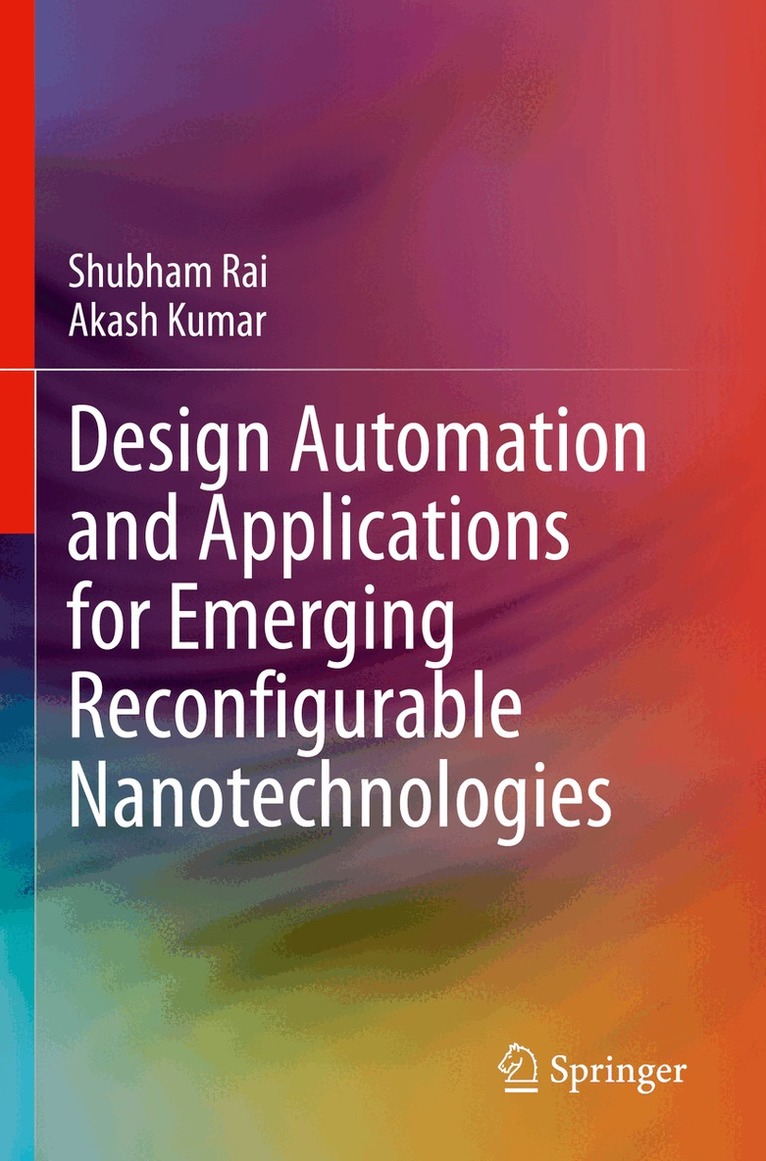
    Design Automation and Applications for Emerging Reconfigurable Nanotechnologies

    AvShubham Rai,Akash Kumar

    Häftad, Engelska, 2024

    1 194 kr

    Beställningsvara. Skickas inom 10-15 vardagar. Fri frakt över 249 kr.

    Fler format och utgåvor

    Inbunden

    1 194 kr

    Beskrivning

    This book is a single-source solution for anyone who is interested in exploring emerging reconfigurable nanotechnology at the circuit level. It lays down a solid foundation for circuits based on this technology having considered both manual as well as automated design flows. The authors discuss the entire design flow, consisting of both logic and physical synthesis for reconfigurable nanotechnology-based circuits. The authors describe how transistor reconfigurable properties can be exploited at the logic level to have a more efficient circuit design flow, as compared to conventional design flows suited for CMOS. Further, the book provides insights into hardware security features that can be intrinsically developed  using the runtime reconfigurable features of this nanotechnology.

    Produktinformation

    • Utgivningsdatum:2024-09-13
    • Mått:155 x 235 x 13 mm
    • Vikt:365 g
    • Format:Häftad
    • Språk:Engelska
    • Antal sidor:210
    • Förlag:Springer International Publishing AG
    • ISBN:9783031379260

    Utforska kategorier

    • Elektronik och kommunikationer inom Naturvetenskap och teknik
    • Systemvetenskap och AI inom Data och IT
    • Hårdvara inom Data och IT

    Mer om författaren

    Shubham Rai is working as a Research Engineer at Robert Bosch Research Center, Renningen, Germany. He was working as a research associate in the group from Oct, 2016. He obtained his Ph.D. Degree (Dr. Ing.) from TU Dresden, Germany in 2022. He received his B.Engg. in Electrical and Electronics engineering and M.Sc. in Physics from Birla Institute of Technology and Science Pilani, India. From 2011 till 2016, he worked in an RnD role at Mentor Graphics (Now under Siemens group), Noida India. Then, he worked at Green IC group at NUS, Singapore  as a research assistant for 5 months before coming to Germany. His research interests are HW-SW codesign, logic synthesis, hardware security, reconfigurable platforms. He is a member of the IEEE and of the ACM. He has received Best Paper award nominations at IWLS 2021, and ISVLSI 2020.Akash Kumar is a chaired Professor of Processor Design (with tenure) in the department of Computer Science at Technische Universität Dresden (TUD), Germany. From 2009 to 2015, he was with the Department of Electrical and Computer Engineering, NUS. He received the joint Ph.D. degree in electrical engineering in embedded systems from Eindhoven University of Technology (TU/e) and National University of Singapore (NUS), in 2009; joint Master’s degree from TU/e and NUS in 2005 in embedded systems and Bachelor of Computer Engineering degree from NUS in 2002.His research interests span various aspects of design automation in the context of embedded real-time systems with particular emphasis on reliable, resource-efficient and predictable architectures for embedded systems, including FPGA-based architectures. His research spans across various layers in the system design from hardware design to application analysis. He has published close to 240 articles in premier international conferences and journals in the area of design automation. Together with his research group, he has released many open-source tool flows for system design and analysis to allow the community to reproduce their results and to further research in the related areas.He serves (or has recently served) on the program committee of renowned conferences in the area like DAC, DATE, FPL and CASES. He was the program chair of International Conference on Compilers, Architecture, and Synthesis for Embedded Systems (CASES’18 and ’19), Embedded Systems for Real-Time Multimedia (ESTIMedia ’17), subcommittee chair for several editions of Design Automation and Test in Europe (DATE) conference and Brief Presentations Chair for Real-time Systems Symposium (RTSS’19) and Associate Editor for Elsevier Microprocessors and Microsystems journal for 2013-2017.

    Innehållsförteckning

    • Chapter 1. Introduction.- Chapter 2. Preliminaries.- Chapter 3. Exploring Circuit Design Topologies for RFETs.- Chapter 4. Standard Cells and Technology Mapping.- Chapter 5. Logic Synthesis with XOR-Majority Graphs.- Chapter 6. Physical synthesis flow and liberty generation.- Chapter 7. Polymporphic Primitives for Hardware Security .- Chapter 8. Conclusion.