• Fri frakt över 249 kr
  • •
  • Snabba leveranser
  • •
  • Billiga böcker
Kundservice

Du är på sajten för privatpersoner.

Företag, bibliotek eller offentlig verksamhet?

Du handlar på classic.bokus.com, där alla dina funktioner finns intakta.
Till classic.bokus.com
Bokus logotyp. Gå till startsidan.
  • Erbjudanden
  • Student
  • Topplistor
  • Barn & ungdom
  • Bokus Play
  • E-böcker
  • Ljudböcker
  • Pocketböcker
  • Spel & pussel

10% rabatt på allt med kod NYSTART10 →

Sidfot

Mina sidor

    Hjälp

    • Kundservice
    • Vanliga frågor och svar
    • Frakt och leverans
    • Retur vid ångerrätt
    • Reklamera vara
    • Betalning
    • Köpvillkor
    • Allmänna villkor
    • Information om webbplatsens tillgänglighet

    Om Bokus

    • Om oss
    • Pressrum
    • För studenter
    • För företag
    • För bibliotek och offentlig verksamhet
    • För leverantörer
    • Hållbarhet

    Populärt

    • Aktuella erbjudanden
    • Presentkort
    • Studentlitteratur
    • Nya böcker
    • Topplistor
    • Signerade böcker
    • Engelska böcker

    Inspiration

    • Boktips
    • BookTok
    • Populära bokserier
    • Barnbokskaraktärer
    • Populära författare
    Logotyp för Bokus
    Följ oss på Facebook (extern länk)Följ oss på Instagram (extern länk)Följ oss på YouTube (extern länk)Följ oss på TikTok (extern länk)
    bokus @ CookiesAnpassa cookiesIntegritetspolicyKöpvillkor
    Till Citymail hemsida (extern länk)Till Budbee hemsida (extern länk)Till Postnord hemsida (extern länk)Till Schenker hemsida (extern länk)Till Early Bird hemsida (extern länk)Till Walleys hemsida (extern länk)
    1. Naturvetenskap och teknik
    2. Matematik och naturvetenskap
    3. Fysik
    4. Klassisk mekanik

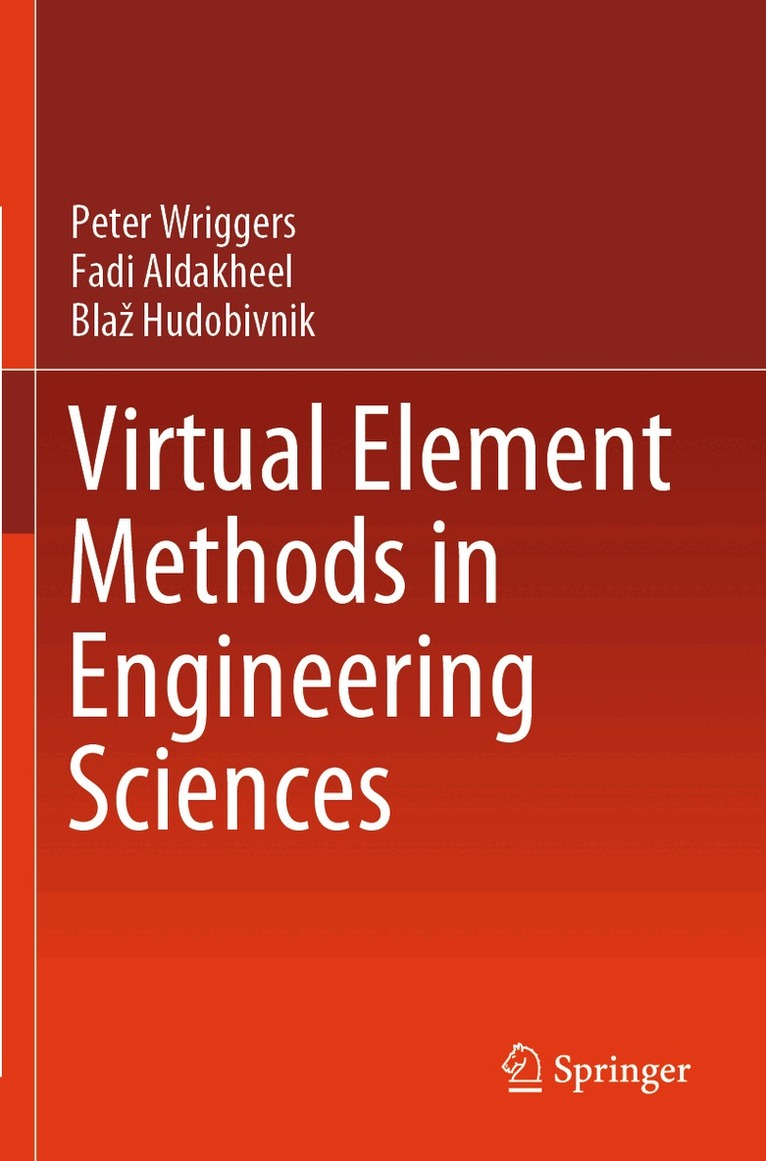
    Virtual Element Methods in Engineering Sciences

    AvPeter Wriggers,Fadi Aldakheel

    Häftad, Engelska, 2024

    1 946 kr

    Beställningsvara. Skickas inom 10-15 vardagar. Fri frakt över 249 kr.

    Fler format och utgåvor

    Inbunden

    1 946 kr

    Beskrivning

    This book provides a comprehensive treatment of the virtual element method (VEM) for engineering applications, focusing on its application in solid mechanics. Starting with a continuum mechanics background, the book establishes the necessary foundation for understanding the subsequent chapters. It then delves into the VEM's Ansatz functions and projection techniques, both for solids and the Poisson equation, which are fundamental to the method. The book explores the virtual element formulation for elasticity problems, offering insights into its advantages and capabilities. Moving beyond elasticity, the VEM is extended to problems in dynamics, enabling the analysis of dynamic systems with accuracy and efficiency. The book also covers the virtual element formulation for finite plasticity, providing a framework for simulating the behavior of materials undergoing plastic deformation. Furthermore, the VEM is applied to thermo-mechanical problems, where it allows for the investigation ofcoupled thermal and mechanical effects. The book dedicates a significant portion to the virtual elements for fracture processes, presenting techniques to model and analyze fractures in engineering structures. It also addresses contact problems, showcasing the VEM's effectiveness in dealing with contact phenomena. The virtual element method's versatility is further demonstrated through its application in homogenization, offering a means to understand the effective behavior of composite materials and heterogeneous structures. Finally, the book concludes with the virtual elements for beams and plates, exploring their application in these specific structural elements. Throughout the book, the authors emphasize the advantages of the virtual element method over traditional finite element discretization schemes, highlighting its accuracy, flexibility, and computational efficiency in various engineering contexts.

    Produktinformation

    • Utgivningsdatum:2024-10-29
    • Mått:155 x 235 x 24 mm
    • Vikt:789 g
    • Format:Häftad
    • Språk:Engelska
    • Antal sidor:452
    • Förlag:Springer International Publishing AG
    • ISBN:9783031392573

    Utforska kategorier

    • Klassisk mekanik inom Naturvetenskap och teknik
    • Maskinteknik och material inom Naturvetenskap och teknik

    Mer om författaren

    Professor Dr.-Ing. habil. P. Wriggers studied Civil Engineering at the University Hannover; he obtained his Dr.-Ing degree at the University of Hannover in 1980 on “Contact-impact problems.” Since April 2022, he is Emeritus Professor at Leibniz Universität Hannover. Peter Wriggers is Member of the “Braunschweigische Wissenschaftliche Gesellschaft,” the Academy of Science and Literature in Mainz, the German National Academy of Engineering “acatech” and the National Academy of Croatia. He was President of GAMM, President of GACM and Vice-President of IACM. Furthermore, he acts as Editor-in-Chief for the International Journal “Computational Mechanics” and “Computational Particle Mechanics.” He was awarded the Fellowship of IACM and received the “Computational Mechanics Award” and the “IACM Award” of IACM, the “Euler Medal” of ECCOMAS as well as three honorary degrees from the Universities of Poznan, ENS Cachan and TU Darmstadt.Professor Dr.-Ing. habil. F. Aldakheel is since April 2023 professor for high performance computing at Leibniz Universität Hannover. After studying engineering in Aleppo, he initially worked at Alfurat University in Syria before moving to the Institute of Applied Mechanics at the University of Stuttgart for the master and Ph.D. studies and then the postdoc period. There he was course director for the international master's programme "Computational Mechanics of Materials and Structures" (COMMAS) as well as local director for the excellence programme "Erasmus Mundus Master of Science in Computational Mechanics". Most recently, he was Chief-Engineer/Group-Leader at the Institute for Continuum Mechanics at Leibniz Universität Hannover and Associate Professor (Honorary) at the Zienkiewicz Centre for Computational Engineering at Swansea University, UK. He has been awarded numerous awards, among them the Richard-von-Mises Prize of GAMM (Association of Applied Mathematics and Mechanics). His research interests are related tothe modeling of material behaviors, variational principles, computational solid mechanics, structural mechanics, finite and virtual element methods, multiphysics and multi-scales problems, machine learning, energy transition and experimental validation.Dr. Blaž Hudobivnik studied Civil Engineering at the University of Ljubljana. He was awarded his Doctoral degree in 2016 under the supervision of Prof. Jože Korelc. He worked as Young researcher/Researcher between 2011 and October 2016 at the University of Ljubljana and after that he was employed as Postdoctoral researcher until April 2023 at the Institute of Continuum Mechanics at the Leibniz Universität Hannover. Since April 2023 he is employed in industry as simulation expert in mechanical design of batteries. His primary research fields are efficient implementation of nonlinear coupled problems, the development of the virtual element method and its application to a wide range of engineering problems. This includes 2D and 3D applications for linear and nonlinear materials, for static and dynamic solids, plate and contact problems, coupled problems (thermo-hydro-mechanics), phase field methods, multi-scale and optimization problems. Alongside research, he advises other institute members in numerical implementations due to his expert knowledge of the Software-Tool AceGen/AceFEM, developed by his doctoral advisor Prof. Korelc.

    Innehållsförteckning

    • Introduction.- Continuum mechanics background.- VEM Ansatz functions and projection for solids.- VEM Ansatz functions and projection for the Poisson equation.- Virtual elements for elasticity problems.- Virtual elements for problems in dynamics.- Virtual element formulation for finite plasticity.- Virtual elements for thermo-mechanical problems.- Virtual elements for fracture processes.- Virtual element formulation for contact.- Virtual elements for homogenization.- Virtual elements for beams and plates.