• Fri frakt över 249 kr
  • •
  • Snabba leveranser
  • •
  • Billiga böcker
Kundservice

Du är på sajten för privatpersoner.

Företag, bibliotek eller offentlig verksamhet?

Du handlar på classic.bokus.com, där alla dina funktioner finns intakta.
Till classic.bokus.com
Bokus logotyp. Gå till startsidan.
  • Erbjudanden
  • Student
  • Topplistor
  • Barn & ungdom
  • Bokus Play
  • E-böcker
  • Ljudböcker
  • Pocketböcker
  • Spel och pussel

5% studentrabatt – använd koden KURSBOK27 →

Sidfot

Mina sidor

    Hjälp

    • Kundservice
    • Vanliga frågor och svar
    • Frakt och leverans
    • Retur vid ångerrätt
    • Reklamera vara
    • Betalning
    • Köpvillkor
    • Allmänna villkor
    • Information om webbplatsens tillgänglighet

    Om Bokus

    • Om oss
    • Pressrum
    • För studenter
    • För företag
    • För bibliotek och offentlig verksamhet
    • För leverantörer
    • Hållbarhet

    Populärt

    • Aktuella erbjudanden
    • Presentkort
    • Studentlitteratur
    • Nya böcker
    • Topplistor
    • Signerade böcker
    • Engelska böcker

    Inspiration

    • Boktips
    • BookTok
    • Barnbokskaraktärer
    • Populära författare
    Logotyp för Bokus
    Följ oss på Facebook (extern länk)Följ oss på Instagram (extern länk)Följ oss på YouTube (extern länk)Följ oss på TikTok (extern länk)
    bokus @ CookiesAnpassa cookiesIntegritetspolicyKöpvillkor
    Till Citymail hemsida (extern länk)Till Budbee hemsida (extern länk)Till Postnord hemsida (extern länk)Till Schenker hemsida (extern länk)Till Early Bird hemsida (extern länk)Till Walleys hemsida (extern länk)
    1. Data och IT
    2. Systemvetenskap och AI

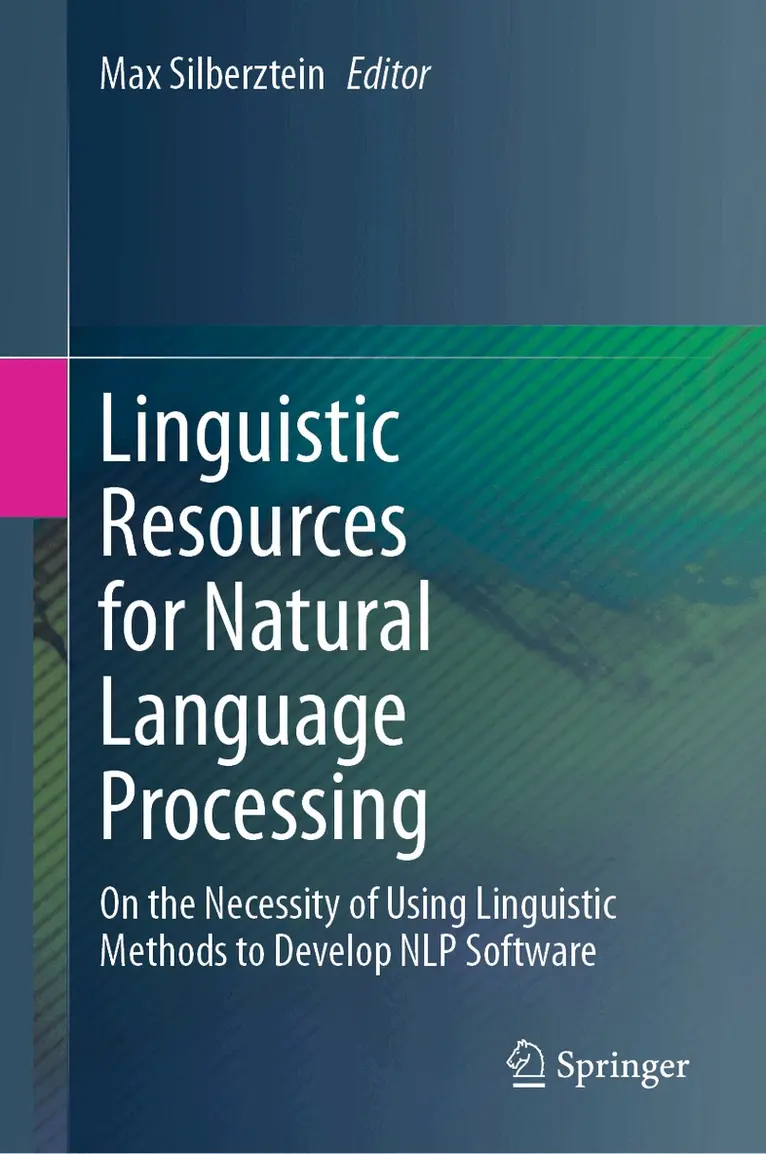
    Linguistic Resources for Natural Language Processing

    On the Necessity of Using Linguistic Methods to Develop NLP Software

    AvMax Silberztein

    Inbunden, Engelska, 2024

    1 614 kr

    Beställningsvara. Skickas inom 10-15 vardagar. Fri frakt över 249 kr.

    Beskrivning

    Empirical — data-driven, neural network-based, probabilistic, and statistical — methods seem to be the modern trend. Recently, OpenAI’s ChatGPT, Google’s Bard and Microsoft’s Sydney chatbots have been garnering a lot of attention for their detailed answers across many knowledge domains. In consequence, most AI researchers are no longer interested in trying to understand what common intelligence is or how intelligent agents construct scenarios to solve various problems. Instead, they now develop systems that extract solutions from massive databases used as cheat sheets. In the same manner, Natural Language Processing (NLP) software that uses training corpora associated with empirical methods are trendy, as most researchers in NLP today use large training corpora, always to the detriment of the development of formalized dictionaries and grammars.Not questioning the intrinsic value of many software applications based on empirical methods, this volume aims at rehabilitating the linguistic approach to NLP. In an introduction, the editor uncovers several limitations and flaws of using training corpora to develop NLP applications, even the simplest ones, such as automatic taggers.The first part of the volume is dedicated to showing how carefully handcrafted linguistic resources could be successfully used to enhance current NLP software applications. The second part presents two representative cases where data-driven approaches cannot be implemented simply because there is not enough data available for low-resource languages. The third part addresses the problem of how to treat multiword units in NLP software, which is arguably the weakest point of NLP applications today but has a simple and elegant linguistic solution.It is the editor's belief that readers interested in Natural Language Processing will appreciate the importance of this volume, both for its questioning of the training corpus-based approaches and for the intrinsic value of the linguistic formalization and the underlying methodology presented.

    Produktinformation

    • Utgivningsdatum:2024-03-14
    • Mått:155 x 235 x 19 mm
    • Vikt:530 g
    • Format:Inbunden
    • Språk:Engelska
    • Antal sidor:217
    • Upplaga:2024
    • Förlag:Springer International Publishing AG
    • ISBN:9783031438103

    Utforska kategorier

    • Systemvetenskap och AI inom Data och IT
    • Artificiell intelligens inom Data och IT
    • Språkvetenskap och lingvistik inom Språk och ordböcker

    Mer om författaren

    Max Silberztein is a Professor of Linguistics, Computational Linguistics and Computer Science at the Université de Franche-Comté. He is the author of the three NLP software platforms (INTEX, NooJ and ATISHS), two books (Dictionnaires électroniques et analyse automatique de textes: le système INTEX, Masson 1993; Formalizing Natural Languages: the NooJ approach, Wiley 2016), and editor of over 15 volumes of selected Proceedings in Springer CCIS and LNCS series.

    Innehållsförteckning

    • In honor of Peter.- Foreword. - Preface.- About this book. Part 1. Introduction.- 1. The Limitations of Corpus-based Methods in NLP.- Part 2.- 2. Developing Linguistic-based NLP Software.- 3. Linguistic Resources for the Automatic Generation of Texts in Natural Language.- 4. Towards a More Efficient Arabic-French Translation.- 5. Linguistic Resources and Methods and Algorithms for Belarusian Natural Language Processing.- Part 3.- Linguistic Resources for Low-resource Languages.- 6. A New Set of Linguistic Resources for Ukrainian.- 7. Formalization of the Quechua Morphology.- 8. The Challenging Task of Translating the Language of Tango.- 9. A Polylectal Linguistic Resource for Rromani.- Part 4. Processing Multiword Units: The Linguistic Approach.- 10. Using Linguistic Criteria to Define Multiword Units.- 11. A Linguistic Approach to English Phrasal Verbs.- 12. Analysis of Indonesian Multiword Expressions: Linguistic vs Data-driven Approach.