• Fri frakt över 249 kr
  • •
  • Snabba leveranser
  • •
  • Billiga böcker
Kundservice

Du är på sajten för privatpersoner.

Företag, bibliotek eller offentlig verksamhet?

Du handlar på classic.bokus.com, där alla dina funktioner finns intakta.
Till classic.bokus.com
Bokus logotyp. Gå till startsidan.
  • Erbjudanden
  • Nyheter
  • Student
  • Topplistor
  • Barn & ungdom
  • Bokus Play
  • E-böcker
  • Pocketböcker
  • Spel & pussel

10% rabatt på allt med kod: NYSTART10 →

Sidfot

Mina sidor

    Hjälp

    • Kundservice
    • Vanliga frågor och svar
    • Frakt och leverans
    • Retur vid ångerrätt
    • Reklamera vara
    • Betalning
    • Köpvillkor
    • Allmänna villkor
    • Information om webbplatsens tillgänglighet

    Om Bokus

    • Om oss
    • Pressrum
    • För studenter
    • För företag
    • För bibliotek och offentlig verksamhet
    • För leverantörer
    • Hållbarhet

    Populärt

    • Aktuella erbjudanden
    • Presentkort
    • Studentlitteratur
    • Nya böcker
    • Topplistor
    • Signerade böcker
    • Engelska böcker

    Inspiration

    • Boktips
    • BookTok
    • Populära bokserier
    • Barnbokskaraktärer
    • Populära författare
    Logotyp för Bokus
    Följ oss på Facebook (extern länk)Följ oss på Instagram (extern länk)Följ oss på YouTube (extern länk)Följ oss på TikTok (extern länk)
    bokus @ CookiesAnpassa cookiesIntegritetspolicyKöpvillkor
    Till Citymail hemsida (extern länk)Till Budbee hemsida (extern länk)Till Postnord hemsida (extern länk)Till Schenker hemsida (extern länk)Till Early Bird hemsida (extern länk)Till Walleys hemsida (extern länk)
    1. Naturvetenskap och teknik
    2. Matematik och naturvetenskap
    3. Kemi

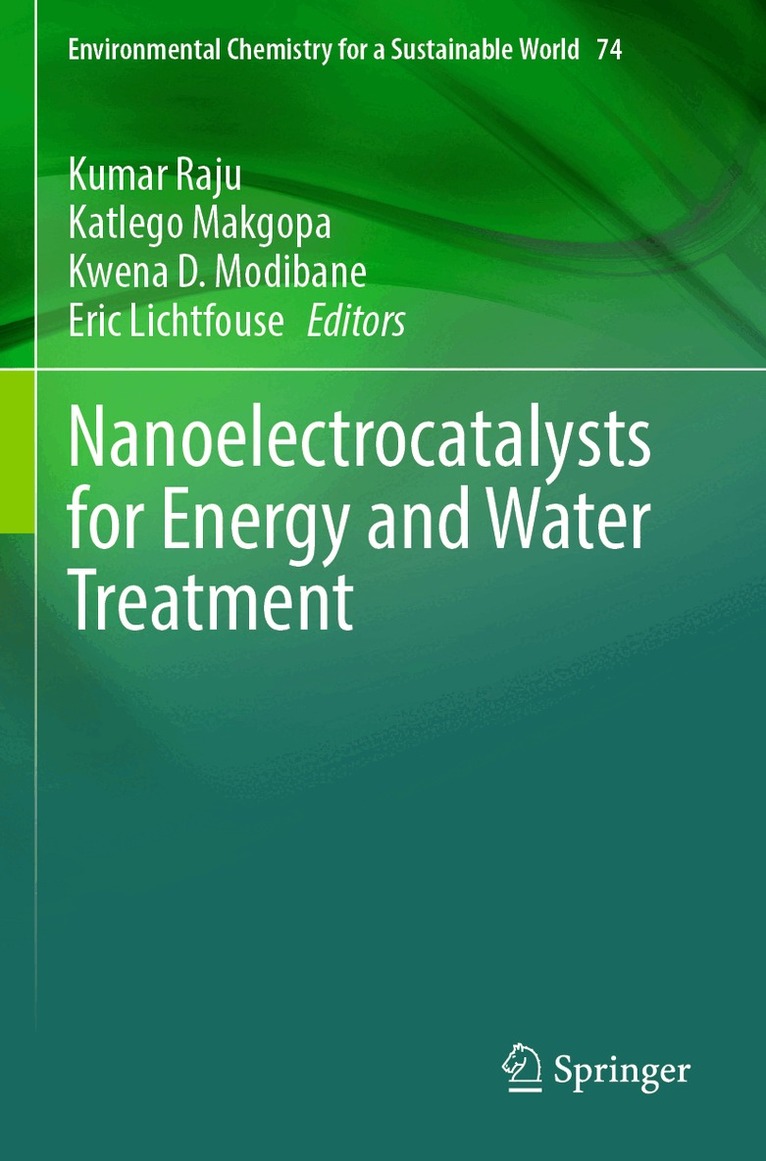
    Nanoelectrocatalysts for Energy and Water Treatment

    AvKumar Raju,Katlego Makgopa

    Häftad, Engelska, 2025

    Del 74 i serien Environmental Chemistry for a Sustainable World

    2 705 kr

    Beställningsvara. Skickas inom 10-15 vardagar. Fri frakt över 249 kr.

    Beskrivning

    Nanomaterials have recently garnered significant attention and practical importance for heterogeneous electrocatalysis. This book presents recent developments in the design, synthesis, and characterisation of nanostructured electrocatalytic materials, with a focus on applications to energy and wastewater treatment. Electrocatalytic nanomaterials can enhance process efficiency and sustainability, thus providing innovative solutions for a wide array of areas such as sustainable energy production, conversion, and wastewater treatment. Readers will gain insights into the latest breakthroughs in electrocatalysis and the activity of nanomaterials in energy conversion applications, e.g., fuel cells, hydrogen production, water splitting, and electro/photocatalytic water splitting, as well as for wastewater treatment. The book explores the development of advanced electrocatalysts, particularly hybrid materials.

    Produktinformation

    • Utgivningsdatum:2025-05-22
    • Mått:155 x 235 x 28 mm
    • Vikt:768 g
    • Format:Häftad
    • Språk:Engelska
    • Serie:Environmental Chemistry for a Sustainable World
    • Antal sidor:497
    • Förlag:Springer International Publishing AG
    • ISBN:9783031553318

    Utforska kategorier

    • Kemi inom Naturvetenskap och teknik
    • Hydrologi inom Naturvetenskap och teknik
    • Teknik: allmänt inom Naturvetenskap och teknik

    Mer om författaren

    Kumar Raju is currently a Faraday Institution Research Fellow at the Institute of Manufacturing (IfM), Department of Engineering, University of Cambridge, United Kingdom. He conducted his doctoral research at the University of Madras, India, followed by postdoctoral work at Hanyang University, South Korea. He also worked for several years as a senior research scientist at the Energy Centre, Council for Scientific and Industrial Research (CSIR), South Africa. His current research focuses on the processing of advanced cathode materials, encompassing the development of innovative methods for structuring electrode materials and studying their processing into advanced electrodes for batteries and supercapacitors. Dr Raju actively engages with the international scientific community, serving as a reviewer for numerous scientific journals. He has received several research excellence awards, including the CSIR Energy Centre Emerging Researcher Award.Dr. KatlegoMakgopa is a Physical Chemistry Lecturer, Deputy Director of Centre for Applied Chemistry Research (CACRe), and a Leader of the Nanomaterials for Electrochemistry Applications Research Team (NEART), Chemistry Department, Tshwane University of Technology (TUT), South Africa. He is a C2-rated researcher recognized by the National Research Foundation (NRF), South African and serve as the President of the South African Nanotechnology Initiative (SANi). His current research interests entail the electrochemistry of nanostructured materials and their potential applications in energy storage (i.e., supercapacitors), hydrogen production and wastewater treatment.  He has published his research findings in various high impact factor international peer-reviewed journals in the form of articles and book chapters, and presented his research outputs at several scientific conferences. He has participated as reviewer for many accredited international journals, a member of several scientific/professional societies (SACNASP, SACI and SANi) and has attracted several funding from NRF, South Africa. Kwena D. Modibane is currently working at the University of Limpopo (UL) as an associate professor, and leader of the Nanotechnology Research Group (NanoRG@UL), South Africa. He is the DSI-NRF South African Research Chair Initiative (SARChI) Chair in Green Hydrogen. His duties involve lecturing of third and second levels in the area of Analytical and Inorganic Chemistry; and specialized topics on electrochemistry, advanced separation techniques and spectroscopies at Honours level. He is also a part-time Lecturer (since 2013) at the University of the Western Cape (UWC) for MSc Nanoscience Programme, where he teaches electrochemical energy, kinetics and thermodynamics of hydrogen energy storage and conversion processes, and photophysical chemistry. His current research outputs are on preparation of nanocomposites for various applications such as electrochemical hydrogen production, hydrogen storage, supercapacitors and water treatment. He participates in several research activities aimed at keeping himself abreast with trends in his field, as reviewer for a number of journals that include Elsevier journals, Nature and Springer. He received the University of Limpopo Vice Chancellor's established Researcher Award for 2019 in the school.Dr. Eric Lichtfouse is professor of environmental chemistry and scientific writing at Xi'an Jiatong University. Eric Lichtfouse graduated with a Bachelor and a Master of Science in Organic Chemistry from Claude Bernard University, Lyon, and a PhD Thesis in Organic Geochemistry from Louis Pasteur University, Strasbourg, in 1989. After post-doctoral positions at Indiana University, USA, in 1990, and the KFA Juelich Research Center, in 1992, he did molecular and isotopic research on carbon and contaminants in soils, waters, plants and the atmosphere at Pierre and Marie Curie University, Nancy University, Bourgogne University, and Aix-Marseille University. He has invented carbon 13-relative dating and discovered molecular temporal pools in environmental media, thus opening the discipline of single sample molecular chronology.

    Innehållsförteckning

    • 1. Fundamentals and roles of nanoelectrocatalysis for sustainable energy and water.-  2. Advanced Nanomaterials for Hydrogen Production.- 3. Emerging nanoelectrocatalysts for the oxidation of ethanol in alkaline fuel cells.- 4. Carbon Nanostructures as Support Material in Fuel Cells.- 5. Challenges and Approaches of Nanoelectrocatalysts for Fuel Cell.- 6. Development of advanced Pd-based electrocatalysts for high performing fuel cell system.- 7. Progress in metal-organic framework composites for electrocatalytic hydrogen evolution reaction.- 8. Advanced Nanomaterials for Hydrogen Production.- 9. Bio-inspired metal-metal oxides as Pd support catalysts for CO2 electro-reduction into electrofuels.- 10. Nanostructured copolymer and dendrimer-based sensor for the detection of organic pollutants in wastewater samples.- 11. Recent developments in titania–carbon nanotube nanohybrids towards enhanced photocatalytic efficiency.- 12. Nanostructured silver-iron-functionalized titanium dioxide photo electrocatalyst for industrial effluent remediation.- 13. Nanoelectrocatalysts-enhanced methods for removal of volatile organic compounds in wastewater.