• Fri frakt över 249 kr
  • •
  • Snabba leveranser
  • •
  • Billiga böcker
Kundservice

Du är på sajten för privatpersoner.

Företag, bibliotek eller offentlig verksamhet?

Du handlar på classic.bokus.com, där alla dina funktioner finns intakta.
Till classic.bokus.com
Bokus logotyp. Gå till startsidan.
  • Erbjudanden
  • Nyheter
  • Student
  • Topplistor
  • Barn & ungdom
  • Bokus Play
  • E-böcker
  • Pocketböcker
  • Spel & pussel

10% rabatt på allt med kod NYSTART10 →

Sidfot

Mina sidor

    Hjälp

    • Kundservice
    • Vanliga frågor och svar
    • Frakt och leverans
    • Retur vid ångerrätt
    • Reklamera vara
    • Betalning
    • Köpvillkor
    • Allmänna villkor
    • Information om webbplatsens tillgänglighet

    Om Bokus

    • Om oss
    • Pressrum
    • För studenter
    • För företag
    • För bibliotek och offentlig verksamhet
    • För leverantörer
    • Hållbarhet

    Populärt

    • Aktuella erbjudanden
    • Presentkort
    • Studentlitteratur
    • Nya böcker
    • Topplistor
    • Signerade böcker
    • Engelska böcker

    Inspiration

    • Boktips
    • BookTok
    • Populära bokserier
    • Barnbokskaraktärer
    • Populära författare
    Logotyp för Bokus
    Följ oss på Facebook (extern länk)Följ oss på Instagram (extern länk)Följ oss på YouTube (extern länk)Följ oss på TikTok (extern länk)
    bokus @ CookiesAnpassa cookiesIntegritetspolicyKöpvillkor
    Till Citymail hemsida (extern länk)Till Budbee hemsida (extern länk)Till Postnord hemsida (extern länk)Till Schenker hemsida (extern länk)Till Early Bird hemsida (extern länk)Till Walleys hemsida (extern länk)
    1. Naturvetenskap och teknik
    2. Geovetenskap
    3. Miljövetenskap och miljöpolitik

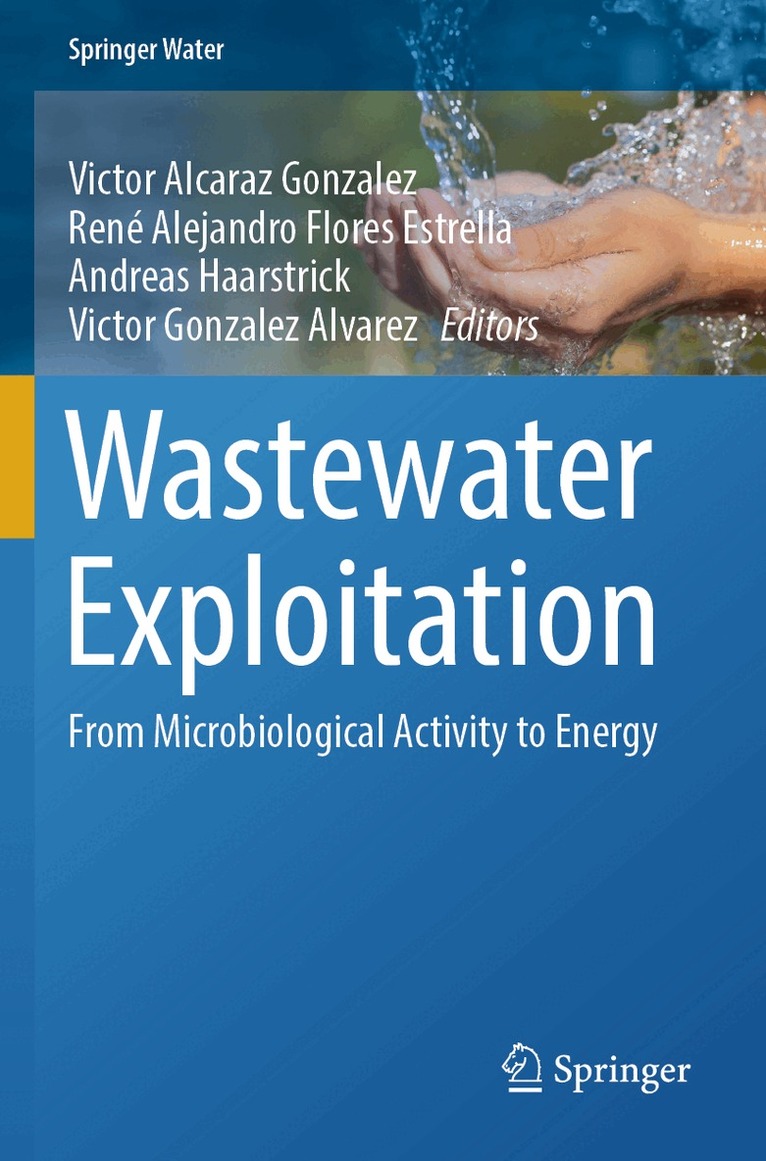
    Wastewater Exploitation

    From Microbiological Activity to Energy

    AvVictor Alcaraz Gonzalez,René Alejandro Flores Estrella

    Häftad, Engelska, 2025

    Del i serien Springer Water

    1 839 kr

    Beställningsvara. Skickas inom 10-15 vardagar. Fri frakt över 249 kr.

    Beskrivning

    With all the current efforts to use non-fossil sources as a starting point for future energy solutions, consideration is also being given to using microbial activities as a direct or indirect source of energy production. This ranges from the use of algae as biomass or as H2 producers, anaerobic microorganisms to produce methane, hydrogen, and even electricity directly.This book deals with both theoretical and technical possibilities of using anaerobic microorganisms in combination with wastewater as a substrate source to produce biofuels and bioenergy in the form of biomass, CH4 and H2 as well as the corresponding power densities and electricity quantities in economically justifiable processes. Unique process facilities are widely addressed; however, special interest is also placed in biorefinery and circular economy related concepts. The theoretical background as well as application examples are presented.

    Produktinformation

    • Utgivningsdatum:2025-06-21
    • Mått:155 x 235 x 22 mm
    • Vikt:593 g
    • Format:Häftad
    • Språk:Engelska
    • Serie:Springer Water
    • Antal sidor:371
    • Förlag:Springer International Publishing AG
    • ISBN:9783031577376

    Utforska kategorier

    • Miljövetenskap och miljöpolitik inom Naturvetenskap och teknik
    • Energiteknik inom Naturvetenskap och teknik
    • Miljöteknik inom Naturvetenskap och teknik

    Mer om författaren

    Víctor Alcaraz-González is Chemical Engineer by Universidad de Guadalajara (UdeG, Mexico) in 1991, and received his Ph.D. degree in Engineering Sciences from Université de Perpignan in France in 2001. Since 2002, he is Member of the (Mexican) National Researchers System that is founded by the Mexican National Council of Humanities, Science and Technology (CONAHCyT). Currently, he is Full Professor Researcher at the Department of Chemical Engineering, at UdeG, and Founder Member of the Bioprocess Engineering Research Group (CA-496) at the same university. His current research topics and interests deal with modeling and control of bioprocesses for wastewater treatment, focusing on obtaining bioenergy and added-value products from wastewater.René Alejandro Flores-Estrella was born in Mérida, Yucatán, Mexico. He received the B.Sc. degree in chemical engineering from the Universidad Autónoma de Yucatán (UADY, Mexico) in 2002, the M.Sc. degree from Instituto Tecnológico de Celaya (TecNM Celaya, Mexico) in 2007, and Ph.D. degree from Instituto Potosino de Investigación Científica y Tecnológica A.C. (IPICYT, Mexico) in 2013. He is Member of the National Researchers System that is founded by the Mexican National Council of Humanities, Science and Technology (CONAHCyT). Currently, he is Full Researcher at the Department of Sustainability, at El Colegio de la Frontera Sur (ECOSUR, Mexico). His scientific interests include mathematical modeling, dynamics, and control of bioprocesses.Andreas Haarstrick studied Chemistry at the Technische Universität Braunschweig, Germany (1983–1989) and received his doctorate in 1992 in bioengineering. Since 2006, he is Professor for Bioprocess Engineering at the TU Braunschweig. His teaching and research cover modeling biological and chemical processes in heterogeneous systems, development of models predicting pollutant reduction in and emission behavior of landfills, growth kinetics at low substrate concentrations under changing environmental conditions, advanced oxidation processes (AOP), and groundwater management. Since 2012, he is Managing Director of the DAAD exceed-Swindon Project dealing with sustainable water management in developing countries.Víctor González-Álvarez holds a B.S. degree from the University of Guadalajara, Mexico and a Ph. D. degree from the University of Minnesota, USA, both in Chemical Engineering. His research interests focused on the design and implementation of nonlinear robust monitoring and control techniques in chemical and biochemical processes. He has authored and co-authored more than 200 research papers in peer-reviewed journals and conference proceedings, edited 3 books, and held 3 patents. He has supervised 30 Ph.D. and 72 M.S. students. He was Dean of the University of Guadalajara (UDG, Mexico) Institute of Technology (2004–2010). Later, he was in charge of the (UdeG) Graduate School and Research System and was the liaison of UdeG with the Regional and National Councils of Humanities, Science and Technology (COECyTJal and CONAHCyT, respectively) and his duties focused on the quality assurance of all graduate programs and the establishment of technology transfer policies at UdeG.

    Innehållsförteckning

    • Introduction.- General view on synergies and trade-offs using wastewater and anaerobic processes for current in the form of biomass, CH4 and H2 as well as energy production systems.- Anaerobic Digestion.- Decreasing the retention time as a way for stabilizing anaerobic digestion processes.- Dark Fermentation.- Microbial population dynamics in continuous hydrogen production systems by dark fermentation of tequila vinasse.- Practical applications of dark fermentation for hydrogen production.- Biohydrogen Production: A Focus on Dark Fermentation Technology.- Experiences of Biohydrogen Production from various feedstocks by Dark Fermentation at laboratory scale.- Microbial communities in Dark Fermentation, analytical tools to elucidate key microorganisms and metabolic profiles.- Microbial Fuel Cells.- Microbial fuel cell systems for wastewater treatment and energy generation from organic carbon and nitrogen: fundamentals, optimization, and novel processes.- Microbial Electrolysis Cells.- Online optimization of Microbial Electrolysis Cells.- Bioethanol and Butanol Systems.- Optimizing Bioethanol Production via Extremum Seeking Control in a Continuous Stirred Tank Bioreactor.-  Performance evaluation of the non-structured and structured kinetic modelling for the abe process. From batch to continuous fermentation.- Microalgae.- Microalgae-Based Diesel: A Historical Perspective to Future Directions.- Bioconversion of industrial CO2 into synthetic fuels.- Future trends.- Bioprocesses Coupling for Biohydrogen Production: Applications and Challenges.- Harvesting biofuels with Microbial Electrochemical Technologies (METs): state of the art and future challenges.- Evolution of the biorefinery concept and its evaluation tools toward a circular bioeconomy.