• Fri frakt över 249 kr
  • •
  • Snabba leveranser
  • •
  • Billiga böcker
Kundservice

Du är på sajten för privatpersoner.

Företag, bibliotek eller offentlig verksamhet?

Du handlar på classic.bokus.com, där alla dina funktioner finns intakta.
Till classic.bokus.com
Bokus logotyp. Gå till startsidan.
  • Erbjudanden
  • Student
  • Topplistor
  • Barn & ungdom
  • Bokus Play
  • E-böcker
  • Ljudböcker
  • Pocketböcker
  • Spel och pussel

Pocketfynda! Hundratals böcker för 49 kr/st →

Sidfot

Mina sidor

    Hjälp

    • Kundservice
    • Vanliga frågor och svar
    • Frakt och leverans
    • Retur vid ångerrätt
    • Reklamera vara
    • Betalning
    • Köpvillkor
    • Allmänna villkor
    • Information om webbplatsens tillgänglighet

    Om Bokus

    • Om oss
    • Pressrum
    • För studenter
    • För företag
    • För bibliotek och offentlig verksamhet
    • För leverantörer
    • Hållbarhet

    Populärt

    • Aktuella erbjudanden
    • Presentkort
    • Studentlitteratur
    • Nya böcker
    • Topplistor
    • Signerade böcker
    • Engelska böcker

    Inspiration

    • Boktips
    • BookTok
    • Barnbokskaraktärer
    • Populära författare
    Logotyp för Bokus
    Följ oss på Facebook (extern länk)Följ oss på Instagram (extern länk)Följ oss på YouTube (extern länk)Följ oss på TikTok (extern länk)
    bokus @ CookiesAnpassa cookiesIntegritetspolicyKöpvillkor
    Till Citymail hemsida (extern länk)Till Budbee hemsida (extern länk)Till Postnord hemsida (extern länk)Till Schenker hemsida (extern länk)Till Early Bird hemsida (extern länk)Till Walleys hemsida (extern länk)
    1. Historia och arkeologi
    2. Arkeologi

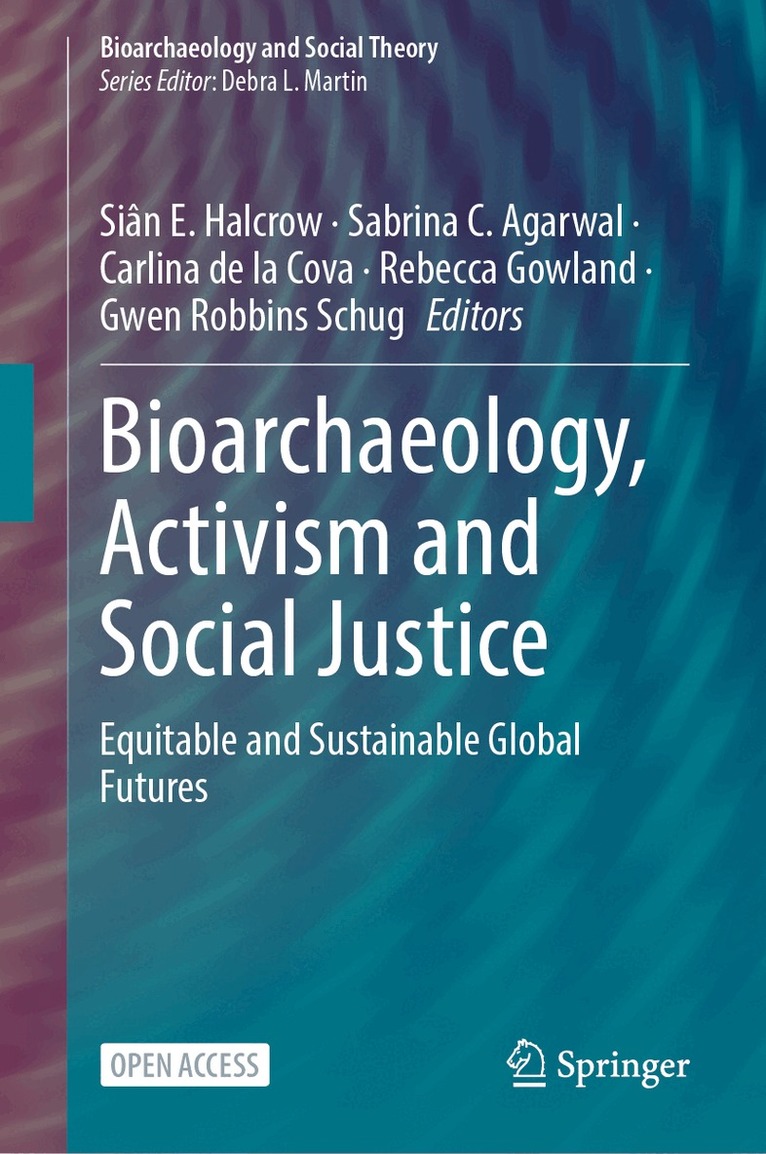
    Bioarchaeology, Activism and Social Justice

    Equitable and Sustainable Global Futures

    AvSiân E. Halcrow,Sabrina C. Agarwal

    Inbunden, Engelska, 2026

    Del i serien Bioarchaeology and Social Theory

    559 kr

    Beställningsvara. Skickas inom 10-15 vardagar. Fri frakt över 249 kr.

    Beskrivning

    This open access volume is the first dedicated to action within bioarchaeology and cognate disciplines, with the aim of fostering social and political change. The editors bring together a diverse range of bioarchaeologists and related practitioners whose work engages with some of the most pressing social issues facing humanity today, including infectious disease, structural violence, healthcare and inequitable access to resources, racial injustice, ethics, food insecurity, displacement, equitable education, and the intersections of these challenges with identities such as race, ethnicity, gender, sexuality, class, and disability. These issues explored in this volume are at the heart of the United Nations 2030 Agenda for Sustainable Development, adopted in 2015, and encapsulated in the 17 UN Sustainable Development Goals. Each chapter makes explicit connections to contemporary issues and demonstrates how our work can be used to effect social change, offering practical steps for developing an activist lens in research, practice, and academia. This volume will be of interest to academics, practitioners, and students in bioarchaeology and related disciplines.

    Produktinformation

    • Utgivningsdatum:2026-03-31
    • Mått:155 x 235 x 21 mm
    • Vikt:586 g
    • Format:Inbunden
    • Språk:Engelska
    • Serie:Bioarchaeology and Social Theory
    • Antal sidor:2
    • Förlag:Springer Nature Switzerland AG
    • ISBN:9783032103536

    Utforska kategorier

    • Arkeologi inom Historia och arkeologi
    • Diskriminering och rättvisa inom Samhälle och politik

    Mer om författaren

    Sabrina C. Agarwal is a Professor and Chair of the Department of Anthropology at the University of California, Berkeley. She is engaged in the application of research in bone maintenance to dialogues of social identity, embodiment, developmental plasticity, and inequality in bioarchaeology. She has examined age- and growth-related changes in cortical bone microstructure, trabecular architecture, bone mineral density, and bone strength in several historic British and Italian archaeological populations, and has examined the long-term effect of growth and reproduction (parity and lactation) on the human and non-human primate maternal skeleton, and studying samples from prehistoric Turkey and Japan. Her current research is also invested in bioethics of skeletal biology/bioarchaeology, specifically the practice and ethics curation and repatriation of skeletal/ancestral remains. She has numerous peer-reviewed publications and co-edited volumes including Social Bioarchaeology and Exploring Sex and Gender in Bioarchaeology, and co-author of the best-selling textbook Laboratory Manual and Workbook for Biological Anthropology. She is co-founder of the Western Bioarchaeology Group (WeBiG), co-founder and former co-chair of the Bioarchaeology Interest Group in the Society for American Archaeology (SAA), is co-founding Editor-in-Chief of Bioarchaeology International, and currently serves on the Editorial Board of American Antiquity.

    Innehållsförteckning

    • Chapter 1. Introduction: Bioarchaeologists Should be Activists Too (Halcrow et al).- Part 1. Social Justice in Academia: Towards a More Inclusive and Equitable Discipline.- Chapter 2. Justice, Equality and Diversity within the Academy (Gowland and Daxini).- Chapter 3. Racial Equity, Ethics, and Sustainable Futures in Anatomical Sciences (Schug et al).- Chapter 4. Diversity, Representation, and Inclusion in Forensic Anthropology (Paz et al).- Chapter 5. Cripping, Queering, and Transforming Education in Biological Anthropology (Blatta et al).- Part 2. Structural Violence, Marginalization, and Systems of Colonialism.- Chapter 6. Institutionalization and Health in Past Populations: Social Justice Perspectives (Zuckerman and Willis).- Chapter 7. The Unborn in Bioarchaeology: Personhood, Care, and Pregnant Person-infant Health Through a Structural Violence Lens (Halcrow et al).- Chapter 8. Marginalization in Life and Death: Moving Towards Re-humanization of Archaeological Bodies (Sohler-Snoddy and Kendall).- Chapter 9. The Past, Present, and Future of Eating Animals (Agarwal).- Part 3. Community Bioarchaeology, Stakeholders, and Ethics.- Chapter 10. Engaging the Public: Anthropology's Power to Impact Communities (Alexander).- Chapter 11. Human Remains as ‘Conflict Antiquities’ and How Bioarchaeology and Forensic Anthropology Can Change the Narrative (Huffer et al).- Chapter 12. The Road to Hell is Paved with Good Intentions: Queering Biotechnical Analysis of Sex Estimation (Geller).- Chapter 13. Ethics and Exhibition of Historical Human Body Casts: A Brief Case Study from Pompeii, Campania Region, Southern Italy with an Activist Lens (Arizza et al).- Chapter 14. Conclusions/Afterword: Towards Becoming an Activist Academic (Halcrow et al).