• Fri frakt över 249 kr
  • •
  • Snabba leveranser
  • •
  • Billiga böcker
Kundservice

Du är på sajten för privatpersoner.

Företag, bibliotek eller offentlig verksamhet?

Du handlar på classic.bokus.com, där alla dina funktioner finns intakta.
Till classic.bokus.com
Bokus logotyp. Gå till startsidan.
  • Erbjudanden
  • Student
  • Topplistor
  • Barn & ungdom
  • Bokus Play
  • E-böcker
  • Ljudböcker
  • Pocketböcker
  • Spel & pussel

10% rabatt på allt med kod NYSTART10 →

Sidfot

Mina sidor

    Hjälp

    • Kundservice
    • Vanliga frågor och svar
    • Frakt och leverans
    • Retur vid ångerrätt
    • Reklamera vara
    • Betalning
    • Köpvillkor
    • Allmänna villkor
    • Information om webbplatsens tillgänglighet

    Om Bokus

    • Om oss
    • Pressrum
    • För studenter
    • För företag
    • För bibliotek och offentlig verksamhet
    • För leverantörer
    • Hållbarhet

    Populärt

    • Aktuella erbjudanden
    • Presentkort
    • Studentlitteratur
    • Nya böcker
    • Topplistor
    • Signerade böcker
    • Engelska böcker

    Inspiration

    • Boktips
    • BookTok
    • Populära bokserier
    • Barnbokskaraktärer
    • Populära författare
    Logotyp för Bokus
    Följ oss på Facebook (extern länk)Följ oss på Instagram (extern länk)Följ oss på YouTube (extern länk)Följ oss på TikTok (extern länk)
    bokus @ CookiesAnpassa cookiesIntegritetspolicyKöpvillkor
    Till Citymail hemsida (extern länk)Till Budbee hemsida (extern länk)Till Postnord hemsida (extern länk)Till Schenker hemsida (extern länk)Till Early Bird hemsida (extern länk)Till Walleys hemsida (extern länk)
    1. Data och IT
    2. Tillämpad datateknik

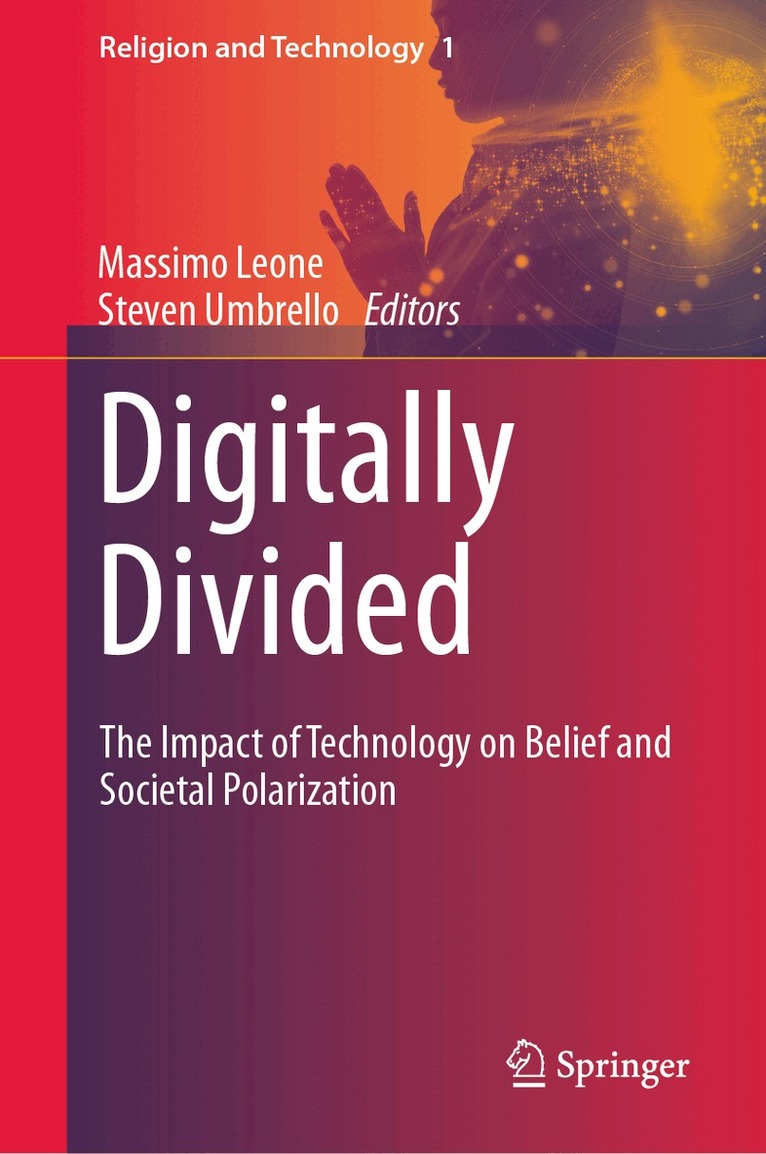
    Digitally Divided

    The Impact of Technology on Belief and Societal Polarization

    AvMassimo Leone,Steven Umbrello

    Inbunden, Engelska, 2026

    Del 1 i serien Religion and Technology

    2 165 kr

    Beställningsvara. Skickas inom 10-15 vardagar. Fri frakt över 249 kr.

    Beskrivning

    This book offers a critical exploration of how digital technologies are reshaping religious belief, ethical frameworks, and social cohesion. As faith and ideology increasingly migrate to online platforms, the book examines how algorithm-driven content, echo chambers, and decentralized authority structures influence discourse and deepen societal divides. Drawing from interdisciplinary perspectives in religious studies, sociology, philosophy, and digital humanities, this volume interrogates how sacred rituals, spaces, and moral narratives are being transformed in the digital age. Amid rising concerns over misinformation and polarization, this timely work challenges the assumption that technology must inevitably fragment communities. Instead, it explores how digital spaces might also foster new forms of dialogue, connection, and meaning. From online religious practices to surveillance ethics and the digital reshaping of spiritual authority, Digitally Divided maps the risks and possibilities at the intersection of belief and technology. Essential reading for scholars, students, and practitioners across multiple disciplines, it is a vital contribution to understanding how we live, believe, and connect in an increasingly digitized world.

    Produktinformation

    • Utgivningsdatum:2026-04-28
    • Mått:155 x 235 x 19 mm
    • Vikt:522 g
    • Format:Inbunden
    • Språk:Engelska
    • Serie:Religion and Technology
    • Antal sidor:230
    • Förlag:Springer Nature Switzerland AG
    • ISBN:9783032104212

    Utforska kategorier

    • Tillämpad datateknik inom Data och IT

    Mer om författaren

    Massimo Leone is Director of ISR-FBK, the Center for Religious Studies at the “Fondazione Bruno Kessler” in Trento; Full Professor of Philosophy of Communication, Cultural Semiotics, and Visual Semiotics at the Department of Philosophy and Educational Sciences of the University of Turin, Italy; Professor of Semiotics at the Department of Chinese Language and Literature of Shanghai University, China; Associate Member of Cambridge Digital Humanities, University of Cambridge, United Kingdom; Adjunct Professor at UCAB University in Caracas, Venezuela; and Adjunct Professor at the Korea University, Seoul, Korea. A member of the Academia Europaea, he has been a visiting professor at several universities across five continents. He is the author of seventeen books, has edited more than seventy collective volumes, and has published over seven hundred articles in semiotics, religious studies, and visual studies. He is the recipient of an ERC Consolidator Grant (2018) and an ERC Proof of Concept Grant (2022). He serves as Editor-in-Chief of Lexia, the semiotic journal of the Interdisciplinary Research Center on Communication at the University of Turin, as well as of Semiotica (De Gruyter). He is also the director of the book series I Saggi di Lexia (Rome: Aracne), Semiotics of Religion (Berlin and Boston: Walter de Gruyter), Advances in Face Studies (London and New York: Routledge), and Religion and Technology (Springer).Steven Umbrello is currently the Managing Director at the Institute for Ethics and Emerging Technologies and a research fellow at the University of Turin. He is also an associate researcher at the Collège des Bernardins, where he works on digital humanism, and was previously a research fellow at the Delft University of Technology. He is the editor of several international academic journals, such as the International Journal of Technoethics, the Journal of Responsible Technology, and the Journal of Ethics and Emerging Technologies. He was formerly a Stiftung Südtiroler Sparkasse Global Fellow at Eurac Research, where he worked on the philosophy, religion, and society program, and a researcher at the Bruno Kessler Foundation, where he worked on the ethics of generative AI. He is the author of several books, including Designed for Death: Controlling Killer Robots (Trivent, 2022) and Technology Ethics: Responsible Innovation and Design Strategies (Polity, 2024).

    Innehållsförteckning

    • Introduction (Leone and Umbrello).- Part I: Theoretical and Historical Foundations of Digital Polarization.- Chapter 1. Divine Violence: From Problem to Theme – The Example of Deborah’s Song (Tonelli).- Chapter 2. The Impact of Cultural Dynamics on Spiritual Perception: The Cult of Saints in the Ethiopian Orthodox Täwaḥǝdo Church (Samuelson).- Chapter 3. The Walking Dead in Muslim Tradition (Bernoussi).- Chapter 4. Religious Minorities and Polarized Communication: The Impact of Offensive and Hurtful Speech (Fabretti and Rähme).- Chapter 5. Depolarization in Religion and Ethics: A Perspective from the Social Sciences (Hejazi).- Part II: Transformation of Religious and Ideological Beliefs.- Chapter 6. Polarization and Depolarization in Religion Online: Hagiographic Memes Between Proselytism, Satire, and Play (Marino).- Chapter 7. Digital Decoloniality: Perspectives for De-Universalizing, Decentralizing, and Re-Territorializing Today’s Digital Ecosystem (Gherlone).- Part III: Sacred Spaces, Rituals, and Digital Surveillance.- Chapter 8. The Resemiotization of Catholic Church-Buildings in Italy in Cases of Desacralization and Reuse (Ponzo).- Chapter 9. The Facial Data of the Devotees: A Pinnacle of Digital Symbolic Effectiveness (Acebal and Voto).- Part IV: Ethical, Psychological, and Theological Challenges in the Digital Age.- Chapter 10. Moral Resilience: Endurance, Faith, Belief, Commitment (Costa).- Chapter 11. A Theological Doctrine on Sexuality and Forms of Life in the Open Society: Female Authority and the Rights of Homosexual Persons as "Commonplaces" of Depolarization (Grillo).- Chapter 12. Depolarizing Egodystonicity and Egosyntonicity in Perceptions of Free Will in OCD (Lancellotta).- Chapter 13. Moving Beyond the Poles: A Larger Space for Respect in Bioethics? (Galvagni).