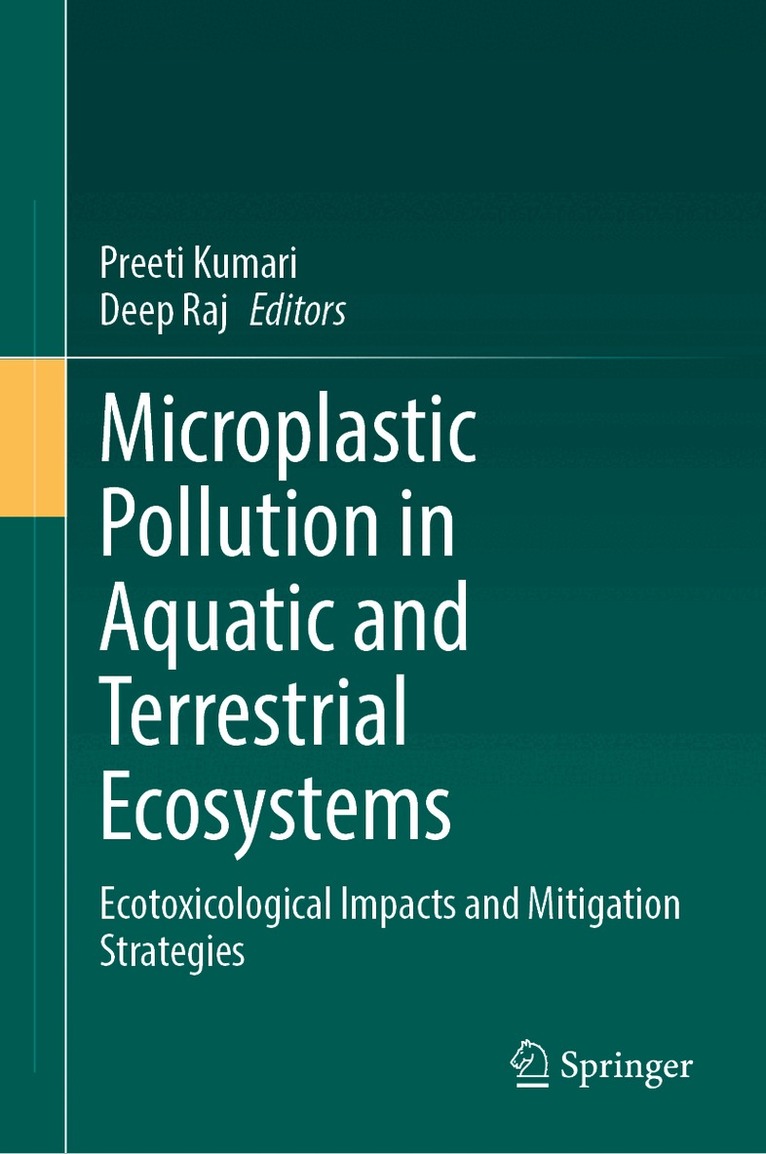
Microplastic Pollution in Aquatic and Terrestrial Ecosystems
Ecotoxicological Impacts and Mitigation Strategies
1 797 kr
Kommande
Beskrivning
Produktinformation
- Utgivningsdatum:2026-07-05
- Mått:155 x 235 x undefined mm
- Format:Inbunden
- Språk:Engelska
- Antal sidor:505
- Förlag:Springer Nature Switzerland AG
- ISBN:9783032176578
Utforska kategorier
Mer om författaren
Dr. Preeti Kumari is an Assistant Professor at the Amity Institute of Applied Sciences, Amity University Jharkhand, Ranchi, India. She holds expertise in Environmental Science, Ecology, and Zoology, with a strong research focus on ecotoxicology, metal and metalloid pollution, microplastics, and environmental risk assessment. Her research primarily addresses the sources, fate, bioaccumulation, and toxicological effects of contaminants such as mercury, arsenic, cadmium, chromium, copper, and lead in aquatic and terrestrial ecosystems, with special emphasis on fish toxicity and human health risks. Dr. Kumari has published extensively in high-impact international journals and edited volumes, including Human and Ecological Risk Assessment, Ecological Indicators, Environmental Science and Pollution Research, Environmental Monitoring and Assessment, and Chemistry and Ecology. She has also contributed book chapters published by Springer and has interdisciplinary research experience extending to biomonitoring, biotic indices, and microplastic assessment. Her work is indexed in Scopus, Google Scholar, and ResearchGate. She has actively participated in several national and international conferences, receiving recognition for her research presentations. Dr. Kumari continues to contribute to environmental monitoring, pollution mitigation research, and sustainability-focused academic initiatives. Dr. Deep Raj is an Assistant Professor in the Department of Environmental Science and Engineering at SRM University–AP, Andhra Pradesh, India. He holds a Ph.D. and has strong academic training in Environmental Chemistry, Analytical Chemistry, and Inorganic Chemistry. His research focuses on environmental monitoring and assessment, heavy metal and metalloid contamination (mercury, arsenic, cadmium, chromium, and lead), phytoremediation, coal and fly ash pollution, soil contamination, microplastics estimation, and environmental risk assessment. Dr. Raj has made significant contributions to the field through publications in reputed international journals such as Environmental Monitoring and Assessment, Human and Ecological Risk Assessment, Chemosphere, International Journal of Phytoremediation, Metals, Land Degradation & Development, Scientific Reports, and Water, Air, & Soil Pollution. His work emphasizes contaminant source identification, bioaccumulation, human and ecological health risks, and sustainable remediation strategies, particularly using plant-based approaches. He is actively involved in interdisciplinary research on environmental pollution, remediation, and sustainability and collaborates with national and international researchers. Dr. Raj’s scholarly work is indexed in Scopus, Web of Science, and Google Scholar, reflecting his consistent contributions to environmental science and engineering research.
Innehållsförteckning
- Part 1: Transport and Detection of Microplastics in Terrestrial & Aquatic.- Chapter 1: Transport and Detection of Microplastics In Terrestrial and Aquatic.- Chapter 2: Research Progress In Analytical Methods For Sampling And Identification of Microplastic Particles.- Chapter 3: Fate And Distribution of Microplastics.- Part 2: An Overview of Microplastics In Global Ecosystems.- Chapter 4: Microplastics and Their Global Impact.- Chapter 5: Abundance of Microplastics In Lentic and Lotic Ecosystems.- Chapter 6: Transport and Fate of Microplastics In Ecosystems.- Chapter 7: Microplastics In Grazing Areas.- Chapter 8: Atmospheric Pathways of Microplastic Pollution.- Part 3: Ecotoxicological Effects of Microplastics.- Chapter 9: The Ecotoxicological Footprint of Microplastics: Strategies For Mitigation.- Chapter 10: Microplastic: A Threat To Food Security.- Chapter 11: Microplastics In Agricultural and Food Systems: Emerging Threats To Global Food Security and Solutions For A Sustainable Future.- Chapter 12: Mechanism of Toxicity: Cellular and Molecular Responses To Microplastic Exposure.- Chapter 13: Nanoplastics In The Environment: Unique Hazards, Biological Interactions, and Emerging Risks.- Part 4: Current Research and Developments In Microplastic Removal Technologies.- Chapter 14: History, Evolution, and Processes To Mitigate Microplastic Pollution.- Chapter 15: Biological Methods of Remediation: A Sustainable Solution For Microplastic Pollution.- Chapter 16: Microplastic Control Strategies: Application of 3R’s and Emerging Technologies.- Part 5: Recent Trends and Future Challenges In Microplastic Ecotoxicology.- Chapter 17: Unanswered Questions and Uncertainties In Microplastic Ecotoxicology: Guiding Future Research Directions.- Chapter 18: Feeding On Plastic Soup: A Comprehensive Review On Microplastic Contamination In Marine Bivalves.- Chapter 19: Future Challenges and Opportunities In Mitigating Microplastic Pollution: A Global Perspective.- Chapter 20: Microplastic Pollution and Sustainability: Challenges, Innovations, and Integrated Approaches For Global Mitigation.- Chapter 21: Role of Remote Sensing and Machine Learning In Estimation of Microplastics.- Chapter 22: Scientific, Technological, and Methodological Hurdles In Microplastic Pollution Mitigation.- Chapter 23: Concluding Remarks.
Du kanske också är intresserad av
Multiplication in vitro du bananier (Musa spp.) cv. Grand Naine
Shahnawaz Ahmed, Preeti Kumari
525 kr
Fundamental, Practical and Disruptive Applications of Powder Metals
Raúl Pérez-Bustamante
2 449 kr