• Fri frakt över 249 kr
  • •
  • Snabba leveranser
  • •
  • Billiga böcker
Kundservice

Du är på sajten för privatpersoner.

Företag, bibliotek eller offentlig verksamhet?

Du handlar på classic.bokus.com, där alla dina funktioner finns intakta.
Till classic.bokus.com
Bokus logotyp. Gå till startsidan.
  • Erbjudanden
  • Nyheter
  • Student
  • Topplistor
  • Barn & ungdom
  • Bokus Play
  • E-böcker
  • Pocketböcker
  • Spel & pussel

10% rabatt på allt med kod: NYSTART10 →

Sidfot

Mina sidor

    Hjälp

    • Kundservice
    • Vanliga frågor och svar
    • Frakt och leverans
    • Retur vid ångerrätt
    • Reklamera vara
    • Betalning
    • Köpvillkor
    • Allmänna villkor
    • Information om webbplatsens tillgänglighet

    Om Bokus

    • Om oss
    • Pressrum
    • För studenter
    • För företag
    • För bibliotek och offentlig verksamhet
    • För leverantörer
    • Hållbarhet

    Populärt

    • Aktuella erbjudanden
    • Presentkort
    • Studentlitteratur
    • Nya böcker
    • Topplistor
    • Signerade böcker
    • Engelska böcker

    Inspiration

    • Boktips
    • BookTok
    • Populära bokserier
    • Barnbokskaraktärer
    • Populära författare
    Logotyp för Bokus
    Följ oss på Facebook (extern länk)Följ oss på Instagram (extern länk)Följ oss på YouTube (extern länk)Följ oss på TikTok (extern länk)
    bokus @ CookiesAnpassa cookiesIntegritetspolicyKöpvillkor
    Till Citymail hemsida (extern länk)Till Budbee hemsida (extern länk)Till Postnord hemsida (extern länk)Till Schenker hemsida (extern länk)Till Early Bird hemsida (extern länk)Till Walleys hemsida (extern länk)
    1. Naturvetenskap och teknik
    2. Matematik och naturvetenskap
    3. Matematik
    4. Beräkning och matematisk analys

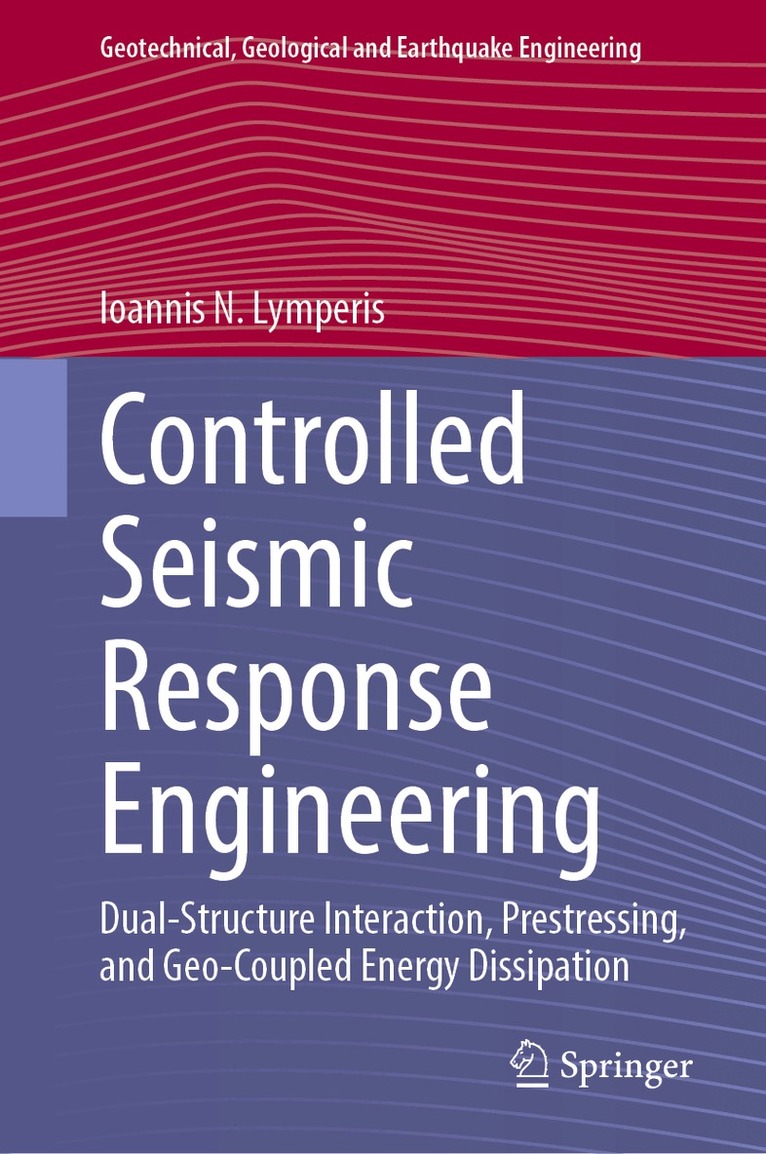
    Controlled Seismic Response Engineering

    Dual-Structure Interaction, Prestressing, and Geo-Coupled Energy Dissipation

    AvIoannis N. Lymperis

    Inbunden, Engelska, 2026

    Del i serien Geotechnical, Geological and Earthquake Engineering

    1 932 kr

    Kommande

    Beskrivning

    This book presents an alternative framework for seismic response control based on geo-coupled structural interaction and controlled seismic energy redistribution. The proposed system combines a prestressed, ground-anchored inner core with an elastic external frame, enabling controlled energy dissipation, reduction of relative displacement, and transfer of inertial demand into the surrounding geomass. The approach integrates theoretical mechanics, numerical simulation, and experimental investigation to formulate a coherent design philosophy aimed at reducing seismic damage while maintaining structural integrity. Emphasis is placed on physical transparency, reproducibility of simulations, and practical relevance for contemporary seismic engineering.

    Produktinformation

    • Utgivningsdatum:2026-10-31
    • Mått:155 x 235 x undefined mm
    • Format:Inbunden
    • Språk:Engelska
    • Serie:Geotechnical, Geological and Earthquake Engineering
    • Antal sidor:293
    • Förlag:Springer Nature Switzerland AG
    • ISBN:9783032297259

    Utforska kategorier

    • Beräkning och matematisk analys inom Naturvetenskap och teknik
    • Geovetenskap inom Naturvetenskap och teknik
    • Byggnadsteknik inom Naturvetenskap och teknik

    Mer om författaren

    Ioannis N. Lymperis is an independent researcher in structural and earthquake engineering based in Ios, Greece. His work focuses on alternative approaches to seismic response control through prestressing and soil–structure interaction. He is the inventor of multiple patented systems related to structural anchoring and hydraulic tensioning mechanisms. His research integrates analytical modeling, numerical simulation, and experimental investigation, aiming to develop physically consistent and practically applicable solutions for seismic design.

    Innehållsförteckning

    • Chapter 1. Introduction.- Chapter 2. The Fundamental Theoretical Framework of SHIELD.- Chapter 3. The Theoretical Foundation of the SHIELD System: From Damage Observation to the Transformation of the Equilibrium Mechanism.- Chapter 4. Mathematical Formulation of the Mechanical Elimination of Deformational Response.- Chapter 5. Clarifications on the Dynamic Behavior of the Coupled System.- Chapter 6. Energy Redistribution Mechanism.- Chapter 7. Interpretation of Results: The Nature of Dynamic Kinematic Coupling.- Chapter 8. Numerical Case Study of the SHIELD Geo-Coupled Structural System.- Chapter 9. Discussion and Design Implications.- Chapter 10. Conclusions.- Chapter 11. The Fundamental Theoretical Statement.- Chapter 12. Implications for Future Research and Practice.- Chapter 13. A Hybrid Dual-System Seismic Protection Concept Based on Prestressed Geo-Structural Coupling and Elastic Peripheral Framing.- Chapter 14. Numerical Simulation Framework.- Chapter 15. Rationale and Engineering Merit of the Hybrid Dual-System.- Chapter 16. Constraint-Governed Seismic Mechanics Energy, Stability, Regime Transition and Multi-Degree Dynamic Interpretation.- Chapter 17. Hierarchy of Kinematic Coupling Mechanisms and Outcome: Dynamic Soil–Structure Coupling.- Chapter 18. The Role of Tendons in the Transformation of Seismic Response.- Chapter 19. Broader Implications for Seismic Design Philosophy.- Chapter 20. Redefining Seismic Force.- Chapter 21. Technological Implementation.- Chapter 22. Fundamental Advantages and Implications of the Method.- Chapter 23. A New Seismic Paradigm: Non-Symmetric Response Theory (NSRT).- Chapter 24. Mechanism of Preemptive Reduction of Effective Elasticity and Critical Prestressing Force.- Chapter 25. Analysis of Three-Dimensional Seismic Excitation on a 1:7 Scale Specimen.- Chapter 26. Similarity Coefficients.- Chapter 27. Test Specimen Dimensions and Properties.- Chapter 28. Numerical Validation through IDA Analysis and Theoretical Paradigm Challenges.- Chapter 29. Sensitivity Analysis of the SHIELD System Response Using FEA and IDA.- Chapter 30. Discussion and Theoretical Interpretation.- Chapter 31. The Secret of SHIELD: Geo-Fusion and the Nature of Inertia (Revised).- Chapter 32. Conclusions – Foundational Interpretation.- Chapter 33. SHIELD and the Reconsideration of the Seismic Safety Paradigm.- Chapter 34. Geo-Anchoring Mechanism and Expansion–Compression Activation Method for Structure–Ground Coupling.- Chapter 35. Synthetic Dynamic Framework of the SHIELD Method and Hybrid Mechanism of Controlled Interaction.