• Fri frakt över 249 kr
  • •
  • Snabba leveranser
  • •
  • Billiga böcker
Kundservice

Du är på sajten för privatpersoner.

Företag, bibliotek eller offentlig verksamhet?

Du handlar på classic.bokus.com, där alla dina funktioner finns intakta.
Till classic.bokus.com
Bokus logotyp. Gå till startsidan.
  • Erbjudanden
  • Nyheter
  • Student
  • Topplistor
  • Barn & ungdom
  • Bokus Play
  • E-böcker
  • Pocketböcker
  • Spel & pussel

Må bättre, för mindre! Upp till 50% rabatt på hälsoböcker

Sidfot

Mina sidor

    Hjälp

    • Kundservice
    • Vanliga frågor och svar
    • Frakt och leverans
    • Retur vid ångerrätt
    • Reklamera vara
    • Betalning
    • Köpvillkor
    • Allmänna villkor
    • Information om webbplatsens tillgänglighet

    Om Bokus

    • Om oss
    • Pressrum
    • För studenter
    • För företag
    • För bibliotek och offentlig verksamhet
    • För leverantörer
    • Hållbarhet

    Populärt

    • Aktuella erbjudanden
    • Presentkort
    • Studentlitteratur
    • Nya böcker
    • Topplistor
    • Signerade böcker
    • Engelska böcker

    Inspiration

    • Boktips
    • BookTok
    • Populära bokserier
    • Barnbokskaraktärer
    • Populära författare
    Logotyp för Bokus
    Följ oss på Facebook (extern länk)Följ oss på Instagram (extern länk)Följ oss på YouTube (extern länk)Följ oss på TikTok (extern länk)
    bokus @ CookiesAnpassa cookiesIntegritetspolicyKöpvillkor
    Till Citymail hemsida (extern länk)Till Budbee hemsida (extern länk)Till Postnord hemsida (extern länk)Till Schenker hemsida (extern länk)Till Early Bird hemsida (extern länk)Till Walleys hemsida (extern länk)
    1. Naturvetenskap och teknik
    2. Teknik och industri
    3. Maskinteknik och material

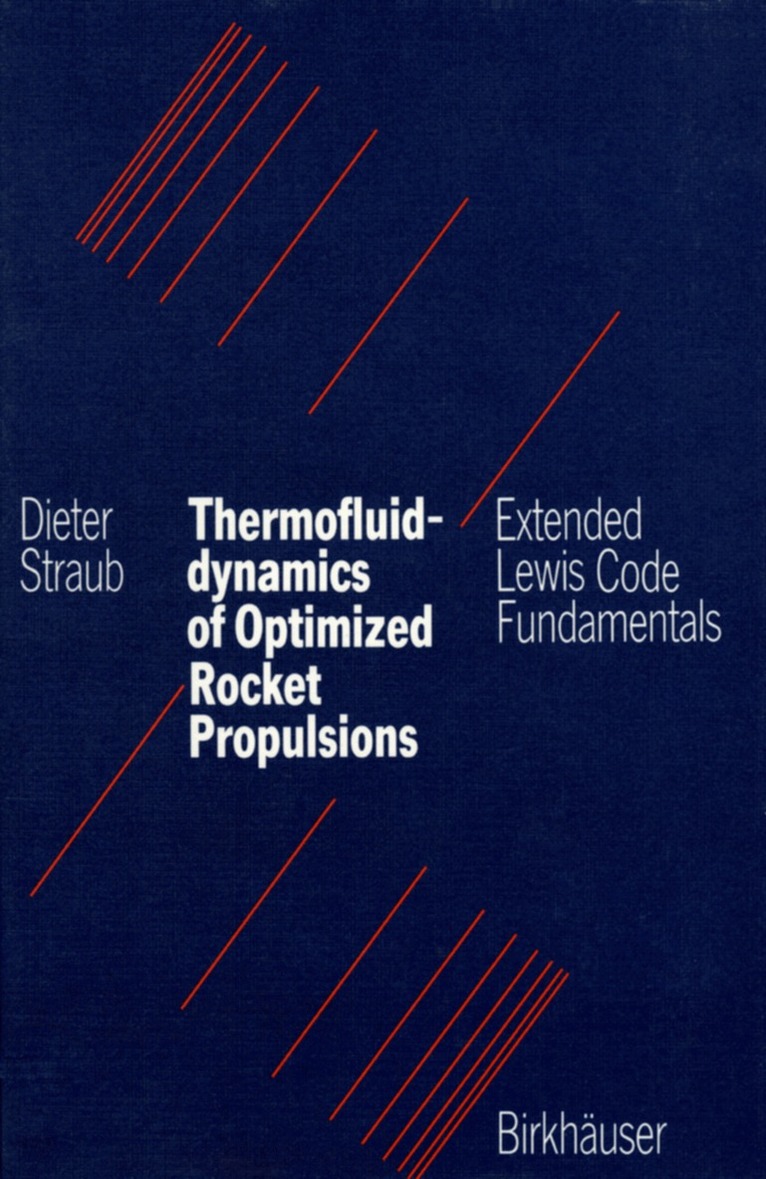
    Thermofluiddynamics of Optimized Rocket Propulsions

    Extended Lewis Code Fundamentals

    AvSTRAUB

    Häftad, Engelska, 2011

    502 kr

    Beställningsvara. Skickas inom 10-15 vardagar. Fri frakt över 249 kr.

    Fler format och utgåvor

    E-bok

    710 kr

    Beskrivning

    This study has two declared aims: it presents the theoretical basis for a provably ideal comparative process for relaxing flows (ICP) and jus­ tifies its application to jet and, in particular, rocket engines. This will be treated in two parts. Part I offers a status quo report on current calculation methods, and compiles and explains briefly the most important data on selected pro­ minent rocket engines. Starting from the phenomenology of the dynamical and physico-chemical conversion processes in the fuel-oxidizer fluid mixture and in the burned gases, the ideal thermodynamic comparative process is then derived - as a defined sequential change of states in the system. In order to render this comparative process readily under­ standable, it is first applied to an appropriate model gas using alge­ braic equations for all relevant parameters. This model gas undergoes energy conversion processes without forfeiting the simplicity of pre­ sentation typical of classical gas dynamics. Above all, examination of this model offers proof that it is generally impermissible to use, as is done in practice, the familiar isentropic equation for flow changes of state continuously propagated in flow tube theory. Elementary calculations immediately indicate essential attributes which are also typical for relaxing, multicomponent, one-phase systems, such as the significant 'pressure drop phenomenon' or the establishment of the steady mass flow rate as an 'eigenvalue' of the comparative pro­ cess. Their relevance to the RE theory is stressed.

    Produktinformation

    • Utgivningsdatum:2011-09-23
    • Mått:152 x 229 x 15 mm
    • Vikt:399 g
    • Format:Häftad
    • Språk:Engelska
    • Antal sidor:266
    • Förlag:Springer Basel
    • ISBN:9783034899277

    Utforska kategorier

    • Maskinteknik och material inom Naturvetenskap och teknik

    Innehållsförteckning

    • Synopsis.- One (I): Optimal Comparative Process for Rocket Engines.- 1. Description of the Problem.- 2. Definition of an Ideal Comparative Process.- 3. Classical Gas Dynamics of the ICP.- 4. Design Criteria for Rocket Engines.- 5. Summary I.- Two (II): Thermofluiddynamics of Rocket Propulsion.- 1. Problems with the NASA-Methods.- 2. Basic Principles of the Alternative Theory.- 3. The Munich Method.- 4. Test of the MM with Data from LH-LOX Rocket Engines.- 5. Summary Part II.- List of Relevant Symbols.- Appendix 1: Thermodynamic Analysis of the Simplified Model Gas.- Appendix 2: Properties of State of Polynary Fluid Mixtures.- Notes.- Index of Names.