• Fri frakt över 249 kr
  • •
  • Snabba leveranser
  • •
  • Billiga böcker
Kundservice

Du är på sajten för privatpersoner.

Företag, bibliotek eller offentlig verksamhet?

Du handlar på classic.bokus.com, där alla dina funktioner finns intakta.
Till classic.bokus.com
Bokus logotyp. Gå till startsidan.
  • Erbjudanden
  • Nyheter
  • Student
  • Topplistor
  • Barn & ungdom
  • Bokus Play
  • E-böcker
  • Pocketböcker
  • Spel & pussel

10% studentrabatt med kod TERM26

Sidfot

Mina sidor

    Hjälp

    • Kundservice
    • Vanliga frågor och svar
    • Frakt och leverans
    • Retur vid ångerrätt
    • Reklamera vara
    • Betalning
    • Köpvillkor
    • Allmänna villkor
    • Information om webbplatsens tillgänglighet

    Om Bokus

    • Om oss
    • Pressrum
    • För studenter
    • För företag
    • För bibliotek och offentlig verksamhet
    • För leverantörer
    • Hållbarhet

    Populärt

    • Aktuella erbjudanden
    • Presentkort
    • Studentlitteratur
    • Nya böcker
    • Topplistor
    • Signerade böcker
    • Engelska böcker

    Inspiration

    • Boktips
    • BookTok
    • Populära bokserier
    • Barnbokskaraktärer
    • Populära författare
    Logotyp för Bokus
    Följ oss på Facebook (extern länk)Följ oss på Instagram (extern länk)Följ oss på YouTube (extern länk)Följ oss på TikTok (extern länk)
    bokus @ CookiesAnpassa cookiesIntegritetspolicyKöpvillkor
    Till Citymail hemsida (extern länk)Till Budbee hemsida (extern länk)Till Postnord hemsida (extern länk)Till Schenker hemsida (extern länk)Till Early Bird hemsida (extern länk)Till Walleys hemsida (extern länk)
    1. Skönlitteratur
    2. Litteraturvetenskap
    3. Litteraturvetenskap

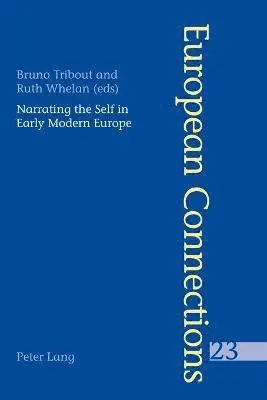
    Narrating the Self in Early Modern Europe- L’écriture de soi dans l’Europe moderne

    AvBruno Tribout,Ruth Whelan

    Häftad, Engelska, 2007

    Del 23 i serien European Connections

    1 070 kr

    Beställningsvara. Skickas inom 5-8 vardagar. Fri frakt över 249 kr.

    Beskrivning

    What does it mean to narrate the self? Is there a ‘self’ to be narrated? What form should such narratives or writings take? The authors of the sixteen essays collected in this volume use a variety of approaches to study a broad range of what are now called ‘ego-documents’ from the Renaissance to the beginning of the nineteenth century. From them it emerges that ‘the self’ is not an acknowledged fact, but rather a historical process, which is neither linear nor stable.Que peut bien signifier l’écriture de soi à l’époque moderne ? Y a-t-il même un « moi » à décrire et raconter ? Quelles formes peuvent prendre de tels récits ? Les seize contributions rassemblées dans ce volume cherchent à répondre à ces questions en interrogeant, suivant diverses approches, une grande variété de textes de la Renaissance à la Révolution, relevant de ce que l’historiographie tend à nommer des « ego-documents ». A travers l’étude de ces textes, il apparaît que le « moi », loin d’être un donné universel, est le fruit d’un processus historique qui n’est ni linéaire ni stable.

    Produktinformation

    • Utgivningsdatum:2007-07-16
    • Mått:220 x 150 x 21 mm
    • Vikt:480 g
    • Format:Häftad
    • Språk:Engelska, Franska
    • Serie:European Connections
    • Antal sidor:333
    • Förlag:Verlag Peter Lang
    • ISBN:9783039107407

    Utforska kategorier

    • Litteraturvetenskap inom Skönlitteratur
    • Europas historia inom Historia och arkeologi

    Mer om författaren

    The Editors: Bruno Tribout is a Lecturer in French at the National University of Ireland, Maynooth. His research interests are in early modern civil and political ethics as inscribed in seventeenth-century French historiography, memoirs and tragedy. He has published articles on related issues in XVIIe siècle and Littératures classiques.Ruth Whelan is the Professor of French and Head of the Department of French at the National University of Ireland, Maynooth and a Member of the Royal Irish Academy. She is a specialist in early modern France and has published extensively on the intellectual and religious culture of the period, particularly on Huguenot refugees from 1680 to 1730.Les responsables de la publication : Bruno Tribout est professeur adjoint au Département d’Études françaises de la National University of Ireland, Maynooth. Il s’intéresse à la morale civile et politique de l’âge classique, notamment à travers l’historiographie, les Mémoires et la tragédie.Membre de la Royal Irish Academy, Ruth Whelan est professeur et chef du Département d’Études française de la National University of Ireland, Maynooth. Spécialiste de la France moderne, elle a consacré de nombreuses publications à la culture intellectuelle et religieuse de cette période, plus particulièrement aux réfugiés huguenots de 1680 à 1730.

    Innehållsförteckning

    • Contents/Contenu : Bruno Tribout/Ruth Whelan: Introduction. Seeing through a glass darkly – Katherine M. MacDonald: Diplomacy and biography in the wars of religion: Charles Paschal’s life of Guy du Faur de Pibrac (1584) – Marie-Clarté Lagrée : Les avatars du discours sur soi : l’exemple de François Le Poulchre (ca.1546-1597) – Bruno Forand : La figure de l’historien au travail : les fonctions paradigmatiques du moi dans l’historiographie renaissante – Matthieu Lemoine : Un mémorialiste face à l’événement : le maréchal de Bassompierre et la journée des Dupes – Carol Baxter: Writing the self and community identity: the personal records of Port-Royal nuns – Bruno Tribout : Mémoires et imagination : sur les fonctions d’une ‘reine du monde’ chez Retz – Carolyn Lougee Chappell: Paper memories and identity papers: why Huguenot refugees wrote memoirs – Ruth Whelan: From the other side of silence: Huguenot life-writing, a dialogic art of narrating the self – Séverine Genieys-Kirk: Narrating the self in Mme de Murat’s Mémoires de Madame la Comtesse de M*** avant sa retraite. Servant de réponse aux Mémoires de Mr. Evremond (1697) – Nicholas Hammond: Remembering Port-Royal: memoir-writing in the eighteenth century – Frédéric Charbonneau : L’être à l’écart : situation du sujet dans les Mémoires de Saint-Simon – Síofra Pierse: Voltaire and the reconstruction of the self in the Mémoires and later correspondence – Darach Sanfey : La ‘petite histoire’ de Jean-Jacques Rousseau – Richard A. Francis: Self-description in Beaumarchais and the disintegration of personality – Anne Régent : Du Dieu de Pascal au Dieu de Jean-Jacques, itinéraire d’une âme féminine à la veille de la Révolution : Madame Roland par elle-même, dans ses Mémoires et dans ses Lettres – Jacqueline Hill: Making sense of mixed descent: English and Irish genealogy in the memoirs (1815) of an Irish loyalist, Ambrose Hardinge Giffard (1771-1827).