• Fri frakt över 249 kr
  • •
  • Snabba leveranser
  • •
  • Billiga böcker
Kundservice

Du är på sajten för privatpersoner.

Företag, bibliotek eller offentlig verksamhet?

Du handlar på classic.bokus.com, där alla dina funktioner finns intakta.
Till classic.bokus.com
Bokus logotyp. Gå till startsidan.
  • Erbjudanden
  • Nyheter
  • Student
  • Topplistor
  • Barn & ungdom
  • Bokus Play
  • E-böcker
  • Pocketböcker
  • Spel & pussel

10% rabatt på allt med kod: NYSTART10 →

Sidfot

Mina sidor

    Hjälp

    • Kundservice
    • Vanliga frågor och svar
    • Frakt och leverans
    • Retur vid ångerrätt
    • Reklamera vara
    • Betalning
    • Köpvillkor
    • Allmänna villkor
    • Information om webbplatsens tillgänglighet

    Om Bokus

    • Om oss
    • Pressrum
    • För studenter
    • För företag
    • För bibliotek och offentlig verksamhet
    • För leverantörer
    • Hållbarhet

    Populärt

    • Aktuella erbjudanden
    • Presentkort
    • Studentlitteratur
    • Nya böcker
    • Topplistor
    • Signerade böcker
    • Engelska böcker

    Inspiration

    • Boktips
    • BookTok
    • Populära bokserier
    • Barnbokskaraktärer
    • Populära författare
    Logotyp för Bokus
    Följ oss på Facebook (extern länk)Följ oss på Instagram (extern länk)Följ oss på YouTube (extern länk)Följ oss på TikTok (extern länk)
    bokus @ CookiesAnpassa cookiesIntegritetspolicyKöpvillkor
    Till Citymail hemsida (extern länk)Till Budbee hemsida (extern länk)Till Postnord hemsida (extern länk)Till Schenker hemsida (extern länk)Till Early Bird hemsida (extern länk)Till Walleys hemsida (extern länk)
    1. Medicin
    2. Andra medicinska specialiteter
    3. Klinisk psykologi

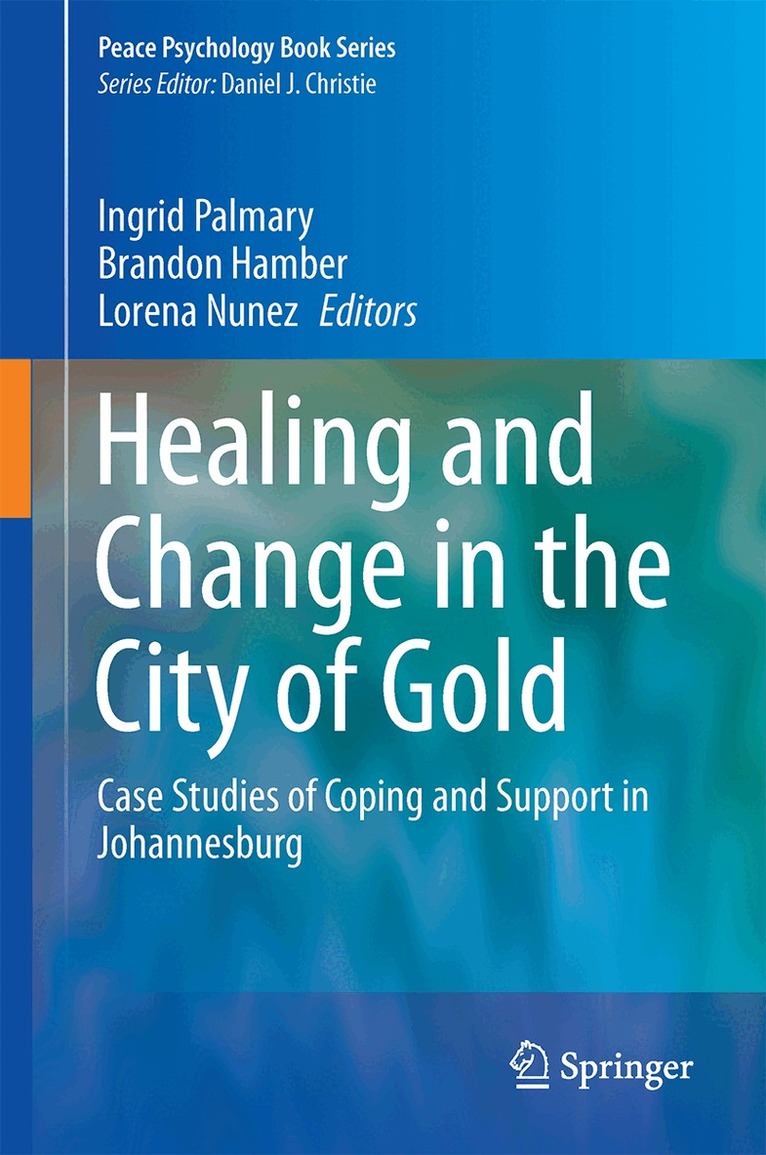
    Healing and Change in the City of Gold

    Case Studies of Coping and Support in Johannesburg

    AvIngrid Palmary,Brandon Hamber

    Inbunden, Engelska, 2014

    Del 24 i serien Peace Psychology Book Series

    563 kr

    Beställningsvara. Skickas inom 10-15 vardagar. Fri frakt över 249 kr.

    Beskrivning

    This volume collects case studies on the lives of people living in post-apartheid Johannesburg, South Africa. In doing so, it considers how people manage, respond to, narrate and/or silence their experiences of past and present violence, multiple insecurities and precarity in contexts where these experiences take on an everyday continuous character. Taking seriously how context shapes the meaning of violence, the forms of response, and the consequences thereof, the contributing chapter authors use participatory and ethnographic techniques to understand people’s everyday responses to the violence and insecurity they face in contemporary Johannesburg. Each case study documents an example of a strategy of coping and healing and reflects on how this strategy shapes the theory and practice of violence prevention and response. The case studies cover a diversity of groups of people in Johannesburg including migrants, refugees, homeless people, sex workers and former soldiers from across the African continent. Read together, the case studies give us new insights into what it means for these residents to seek support, to cope and to heal challenging the boundaries of what psychologists traditionally consider support mechanisms or interventions for those in distress. They develop a notion of healing that sees it as a process and an outcome that is rooted in the world-view of those who live in the city. Alongside the people’s sense of insecurity is an equally strong sense of optimism, care and a striving for change. It is perhaps not surprising, then, that this book deals very centrally with themes of the struggle for progress, mobility (geographic, material and spiritual), and a sense of possibility and change associated with Johannesburg. Ultimately, the volume argues that coping and healing is both a collective and individual achievement as well as an economic, psychological and material phenomenon. Overall this volume challenges the notion that people can andshould seek support primarily from professional, medicalized psychological services and rather demonstrates how the particular support needed is shaped by an understanding of the cause of precarity.

    Produktinformation

    • Utgivningsdatum:2014-11-05
    • Mått:155 x 235 x 17 mm
    • Vikt:465 g
    • Format:Inbunden
    • Språk:Engelska
    • Serie:Peace Psychology Book Series
    • Antal sidor:187
    • Upplaga:2015
    • Förlag:Springer International Publishing AG
    • ISBN:9783319087672

    Utforska kategorier

    • Klinisk psykologi inom Medicin
    • Socialpsykologi och gruppsykologi inom Psykologi och pedagogik
    • Statsvetenskap och politisk teori inom Samhälle och politik

    Mer om författaren

    Ingrid Palmary is an associate professor at the in the African Centre for Migration and Society at the University of the Witwatersrand. Ingrid joined Wits in 2005 after completing her PhD (psychology) at Manchester Metropolitan University, UK. Prior to joining Wits she worked at the Centre for the Study of Violence and Reconciliation as a senior researcher. Her research has been in the field of gender, violence and displacement. Professor Brandon Hamber is Director of the International Conflict Research Institute (INCORE), an associate site of the United Nations University based at the University of Ulster. He is a Mellon Distinguished Visiting Scholar in the School of Human and Community Development at the University of the Witwatersrand in Johannesburg. He was born in South Africa and currently lives in Belfast. In South Africa he trained as a Clinical Psychologist at the University of the Witwatersrand and holds a Ph.D. from the University of Ulster. Lorena Nunez (Ph.D) is a social anthropologist with specialization in Medical Anthropology. Her earlier work experience was in the field of gender and development as researcher and activist in the women’s movement in Chile in the 1990’s.

    Innehållsförteckning

    • Chapter 1: Case studies of precarious life in Johannesburg.- Chapter 2: The Suitcase Project: Working with unaccompanied child refugees in new ways.- Chapter 3: Shaping New Spaces: An alternative approach to healing in current “shelter” interventions for vulnerable women in Johannesburg.- Chapter 4.Violence and Memory in Breaking the Silence of Gukurahundi: A case study of the ZAM in Johannesburg, South Africa.- Chapter 5: Between remorse and nostalgia: Haunting memories of war and the search for healing among former Zimbabwean soldiers in exile in South Africa.- Chapter 6: Violence, suffering and support: Congolese forced migrants’ experiences of psychosocial services in Johannesburg.- Chapter 7:Watching each others’ back, coping with precarity in sex work.-  Chapter 8:Tormented by Umnyama: An urban cosmology of migration and misfortune in inner-city Johannesburg.- Chapter 9: Faith healing, migration and gendered conversions in Pentecostal churches in Johannesburg.- Chapter 10: Healing and deliverance in the city of gold.