• Fri frakt över 249 kr
  • •
  • Snabba leveranser
  • •
  • Billiga böcker
Kundservice

Du är på sajten för privatpersoner.

Företag, bibliotek eller offentlig verksamhet?

Du handlar på classic.bokus.com, där alla dina funktioner finns intakta.
Till classic.bokus.com
Bokus logotyp. Gå till startsidan.
  • Erbjudanden
  • Student
  • Topplistor
  • Barn & ungdom
  • Bokus Play
  • E-böcker
  • Ljudböcker
  • Pocketböcker
  • Spel och pussel

Pocketfynda! Hundratals böcker för 49 kr/st →

Sidfot

Mina sidor

    Hjälp

    • Kundservice
    • Vanliga frågor och svar
    • Frakt och leverans
    • Retur vid ångerrätt
    • Reklamera vara
    • Betalning
    • Köpvillkor
    • Allmänna villkor
    • Information om webbplatsens tillgänglighet

    Om Bokus

    • Om oss
    • Pressrum
    • För studenter
    • För företag
    • För bibliotek och offentlig verksamhet
    • För leverantörer
    • Hållbarhet

    Populärt

    • Aktuella erbjudanden
    • Presentkort
    • Studentlitteratur
    • Nya böcker
    • Topplistor
    • Signerade böcker
    • Engelska böcker

    Inspiration

    • Boktips
    • BookTok
    • Barnbokskaraktärer
    • Populära författare
    Logotyp för Bokus
    Följ oss på Facebook (extern länk)Följ oss på Instagram (extern länk)Följ oss på YouTube (extern länk)Följ oss på TikTok (extern länk)
    bokus @ CookiesAnpassa cookiesIntegritetspolicyKöpvillkor
    Till Citymail hemsida (extern länk)Till Budbee hemsida (extern länk)Till Postnord hemsida (extern länk)Till Schenker hemsida (extern länk)Till Early Bird hemsida (extern länk)Till Walleys hemsida (extern länk)
    1. Naturvetenskap och teknik
    2. Teknik och industri
    3. Energiteknik

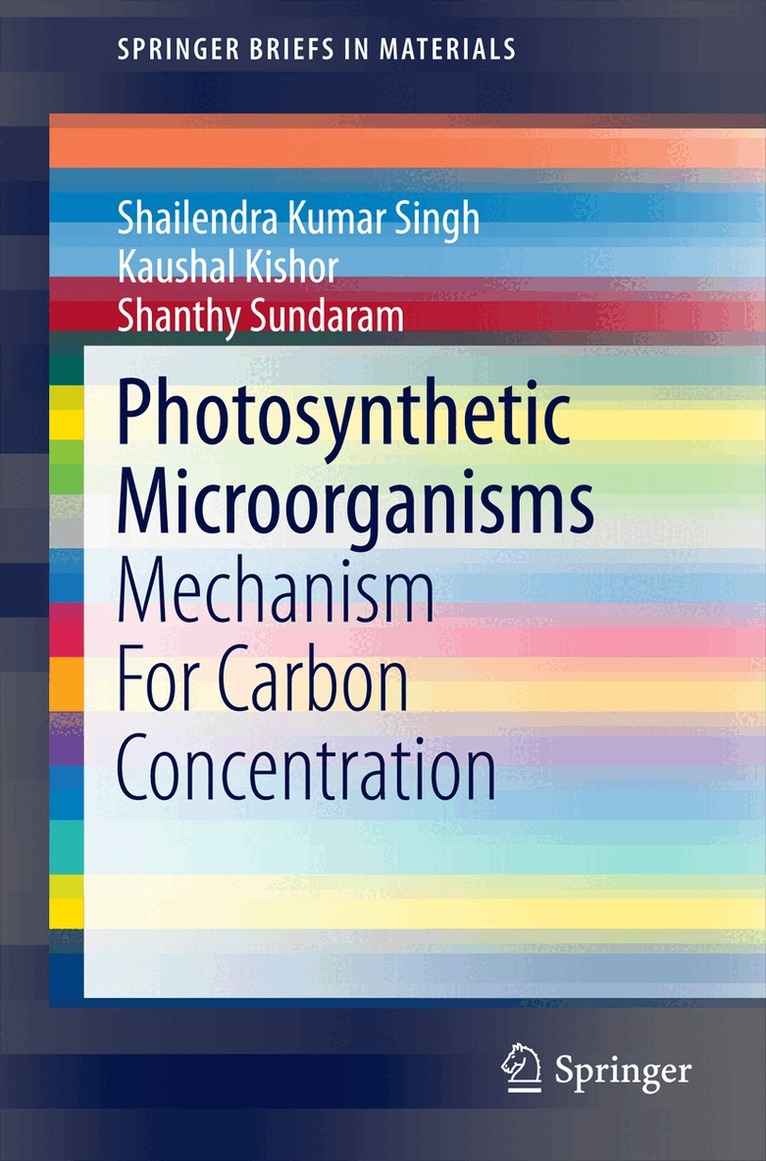
    Photosynthetic Microorganisms

    Mechanism For Carbon Concentration

    AvShailendra Kumar Singh,Shanthy Sundaram

    Häftad, Engelska, 2014

    Del i serien SpringerBriefs in Materials

    542 kr

    Beställningsvara. Skickas inom 10-15 vardagar. Fri frakt över 249 kr.

    Beskrivning

    This book provides a cohesive overview of carbon concentrating mechanism (CCM) of photosynthetic microorganisms such as cyanobacteria and microalgae. This unique mechanism is by far the most spectacular physiological process in algal growth and productivity. Due to this fact, the study of CCM has captivated phycologists, algal molecular and cellular biologists, botanists, agriculturalists, crop growers, and most recently algal biofuel researchers, around the world. In the brief, the authors draw a contextual in-depth overview, on the basis of the latest findings, to develop an account of the core concepts regarding state-of-the-art of CCM. Subsequent chapters use this account to explore carbon concentrating mechanism of cyanobacteria and microalgae. They highlight the concise summaries of cutting-edge research and integrated industrial applications of photosynthetic microorganism based CO2 mitigation system, across a wide spectrum of energy and environment. The brief also presents sustainable perspectives of carbon concentrating mechanism in the context of current global energy and environmental challenges.

    Produktinformation

    • Utgivningsdatum:2014-09-08
    • Mått:155 x 235 x 8 mm
    • Vikt:219 g
    • Format:Häftad
    • Språk:Engelska
    • Serie:SpringerBriefs in Materials
    • Antal sidor:123
    • Upplaga:2014
    • Förlag:Springer International Publishing AG
    • ISBN:9783319091228

    Utforska kategorier

    • Energiteknik inom Naturvetenskap och teknik
    • Maskinteknik och material inom Naturvetenskap och teknik

    Mer om författaren

    Dr. Singh is an Associate Researcher at the Centre of Biotechnology, University of Allahabad, India. He graduated in Biochemistry at Allahabad Agricultural Institute, Allahabad, India, in 2004 and worked as a fellow researcher at Birla Institute of Technology and Sciences, Pilani, Rajasthan, India for 3 Years. He received a PhD in Chemical and Bio-Engineering from National Institute of Technology, Jalandhar, India, in 2013. He also worked as a Visiting Researcher at Nano-solution Research Laboratory, Tokyo Institute of Technology, Japan as a part of DST-JSPS project. He is the author of more than 20 National and International publications in the area of sustainable energy and environment and reviewer of many international scientific journals. He has substantial knowledge in molecular biology, biochemistry and phycology, including more than seven years of experience in algal techniques during doctoral and post doctoral research work. His research particularly focuses on developing sustainable & integrated algal technologies in the area of energy and environmental biotechnology.Dr. Kishor is a researcher at Department of Chemical Engineering, Motilal Nehru National Institute of Technology, Allahabad, India. He took his B. Tech. in Biotechnology and M. Tech. in Chemical Engineering from National Institute of Technology, Jalandhar, India. He received his Doctorate in Chemical Engineering from Motilal Nehru National Institute of Technology, Allahabad, India in 2014. His area of research is Modeling and Simulation of reactors, Microfluidics and their applications. Prof. Sundaram is a Professor and Coordinator at the Centre of Biotechnology, University of Allahabad, India. She graduated with gold medal in M.Sc. Microbiology at Bombay University, India in 1986. She received Doctorate Degree in Microbiology from Barkatullah University, Bhopal, India in 1992. Dr Sundaram has been received many reputed awards and post-doctoral fellowships, includes The Jawaharlal Nehru Memorial Trust UK Scholarship and Commonwealth Academic Staff Fellowship at University of Warwick, United Kingdom. She has been working in the field of Algae Biotechnology for more than 20 years and published more than 100 papers in National and International reputed journals and conferences.  Her research activities are related to the development of advanced biotechnological tools in energy and environment area as biosensor, sustainable biofuel, cleaner technologies etc.

    Innehållsförteckning

    • Introduction.- Carbon concentrating mechanism.- Carbon concentrating mechanism of cyanobacteria.- Carbon concentrating mechanism of microalgae.- Photosynthetic microorganisms based mitigation system: Integrated approaches for global sustainability.