• Fri frakt över 249 kr
  • •
  • Snabba leveranser
  • •
  • Billiga böcker
Kundservice

Du är på sajten för privatpersoner.

Företag, bibliotek eller offentlig verksamhet?

Du handlar på classic.bokus.com, där alla dina funktioner finns intakta.
Till classic.bokus.com
Bokus logotyp. Gå till startsidan.
  • Erbjudanden
  • Nyheter
  • Student
  • Topplistor
  • Barn & ungdom
  • Bokus Play
  • E-böcker
  • Pocketböcker
  • Spel & pussel

10% rabatt på allt med kod NYSTART10 →

Sidfot

Mina sidor

    Hjälp

    • Kundservice
    • Vanliga frågor och svar
    • Frakt och leverans
    • Retur vid ångerrätt
    • Reklamera vara
    • Betalning
    • Köpvillkor
    • Allmänna villkor
    • Information om webbplatsens tillgänglighet

    Om Bokus

    • Om oss
    • Pressrum
    • För studenter
    • För företag
    • För bibliotek och offentlig verksamhet
    • För leverantörer
    • Hållbarhet

    Populärt

    • Aktuella erbjudanden
    • Presentkort
    • Studentlitteratur
    • Nya böcker
    • Topplistor
    • Signerade böcker
    • Engelska böcker

    Inspiration

    • Boktips
    • BookTok
    • Populära bokserier
    • Barnbokskaraktärer
    • Populära författare
    Logotyp för Bokus
    Följ oss på Facebook (extern länk)Följ oss på Instagram (extern länk)Följ oss på YouTube (extern länk)Följ oss på TikTok (extern länk)
    bokus @ CookiesAnpassa cookiesIntegritetspolicyKöpvillkor
    Till Citymail hemsida (extern länk)Till Budbee hemsida (extern länk)Till Postnord hemsida (extern länk)Till Schenker hemsida (extern länk)Till Early Bird hemsida (extern länk)Till Walleys hemsida (extern länk)
    1. Naturvetenskap och teknik
    2. Geovetenskap
    3. Geografi

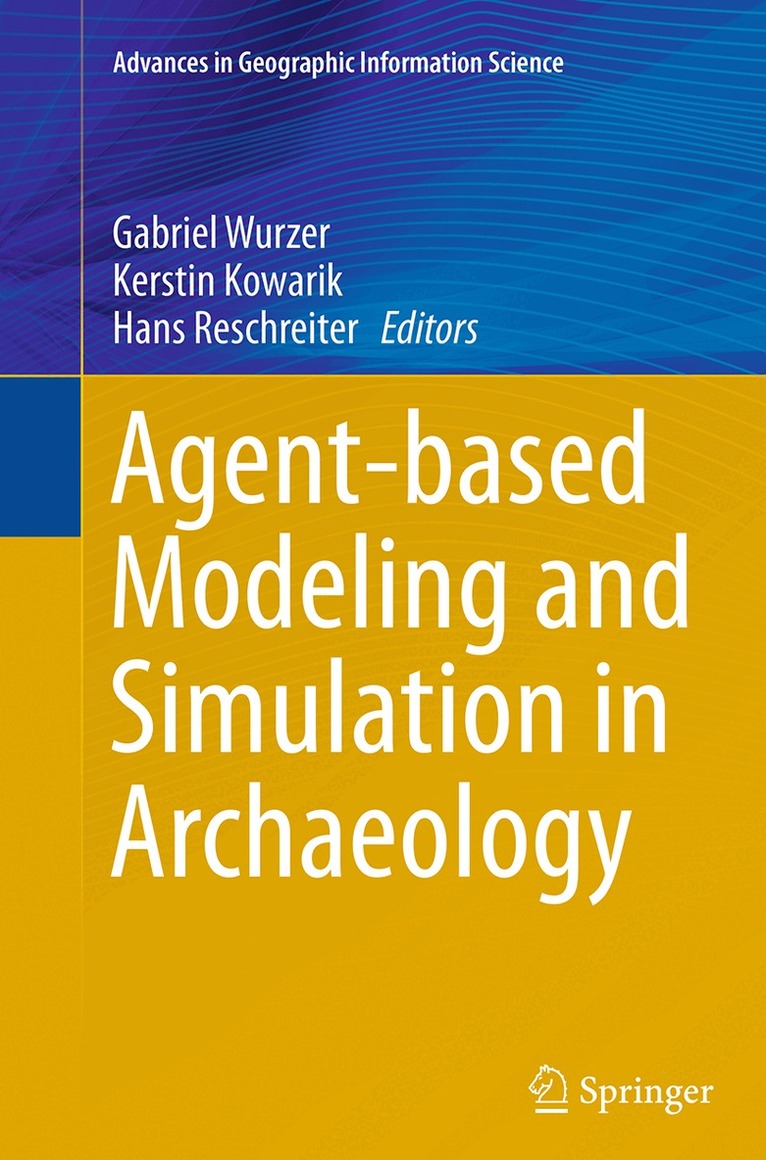
    Agent-based Modeling and Simulation in Archaeology

    AvGabriel Wurzer,Kerstin Kowarik

    Häftad, Engelska, 2016

    Del i serien Advances in Geographic Information Science

    1 086 kr

    Beställningsvara. Skickas inom 10-15 vardagar. Fri frakt över 249 kr.

    Beskrivning

    Archaeology has been historically reluctant to embrace the subject of agent-based simulation, since it was seen as being used to "re-enact" and "visualize" possible scenarios for a wider (generally non-scientific) audience, based on scarce and fuzzy data. Furthermore, modeling "in exact terms" and programming as a means for producing agent-based simulations were simply beyond the field of the social sciences. This situation has changed quite drastically with the advent of the internet age: Data, it seems, is now ubiquitous. Researchers have switched from simply collecting data to filtering, selecting and deriving insights in a cybernetic manner. Agent-based simulation is one of the tools used to glean information from highly complex excavation sites according to formalized models, capturing essential properties in a highly abstract and yet spatial manner. As such, the goal of this book is to present an overview of techniques used and work conducted in that field, drawing on the experience of practitioners.

    Produktinformation

    • Utgivningsdatum:2016-08-23
    • Mått:155 x 235 x 16 mm
    • Vikt:435 g
    • Format:Häftad
    • Språk:Engelska
    • Serie:Advances in Geographic Information Science
    • Antal sidor:269
    • Förlag:Springer International Publishing AG
    • ISBN:9783319342825

    Utforska kategorier

    • Geografi inom Naturvetenskap och teknik

    Mer om författaren

    Gabriel Wurzer is a computer scientist working on Agent-Based Simulation at Vienna University of Technology, in which field he is publishing, organizing workshops and holding lectures. Through cooperation with the Natural History Museum Vienna, he developed multiple models on prehistoric salt mining in the prehistoric mines of Hallstatt. Apart from Archaeology, he is also active in the field of Architectural planning, especially Hospital Simulation in the context of early design.Kerstin Kowarik is an archaeologist working at the Natural History Museum Vienna specializing in the European Bronze Age and Early Iron Age. She is currently engaged with several research projects on the prehistoric salt mines of Hallstatt. Her research focuses on provisioning structures, organization of trade and human – environment interaction. She has a special interest in exploring the potential of computer based simulations for archaeological research, economic archaeology and environmental archaeology.Hans Reschreiter is an archaeologist working at the Natural History Museum Vienna specializing in prehistoric crafts and technology as well as prehistoric mining. He is head of the archaeological excavations in the prehistoric salt mines of Hallstatt (Austria). His research focuses on working processes and mining technology. He has a special interest in prehistoric wood working, experimental archaeology and ethnoarchaeology.

    Recensioner i media

    From the book reviews: "Agent-based Modeling and Simulation in Archaeology provides a much-needed update, in one solid volume, on the methods and practice of using agent-based modeling to understand the past. ... The most useful portion of this book to those new to agent-based modeling is probably the Methods section. ... this book will be a worthwhile addition to our bookshelves, and I can already imagine incorporating it into courses in agent-based modeling." (simulatingcomplexity, simulatingcomplexity.wordpress.com, February, 2015)

    Innehållsförteckning

    • Introduction.- Explaining the past with ABM: on modeling philosophy.- Modeling archaeology: origins of the artificial Anasazi Project and beyond.- Agent-based simulation in archaeology: a characterization.- Reproducibility.- Geosimulation: modeling spatial processes.- Large simulations and small societies: high performance computing for archaeological simulations.- Mining with agents: modeling prehistoric mining and prehistoric economy.- Modeling settlement rank-size fluctuations.- Understanding the iron age economy: sustainability of agricultural practices under stable population growth.- Simulating Patagonian territoriality in prehistory: space, frontiers and networks among hunter-gatherers.- How did sugarscape become a whole society model?.