• Fri frakt över 249 kr
  • •
  • Snabba leveranser
  • •
  • Billiga böcker
Kundservice

Du är på sajten för privatpersoner.

Företag, bibliotek eller offentlig verksamhet?

Du handlar på classic.bokus.com, där alla dina funktioner finns intakta.
Till classic.bokus.com
Bokus logotyp. Gå till startsidan.
  • Erbjudanden
  • Nyheter
  • Student
  • Topplistor
  • Barn & ungdom
  • Bokus Play
  • E-böcker
  • Pocketböcker
  • Spel & pussel

10% studentrabatt med kod TERM26

Sidfot

Mina sidor

    Hjälp

    • Kundservice
    • Vanliga frågor och svar
    • Frakt och leverans
    • Retur vid ångerrätt
    • Reklamera vara
    • Betalning
    • Köpvillkor
    • Allmänna villkor
    • Information om webbplatsens tillgänglighet

    Om Bokus

    • Om oss
    • Pressrum
    • För studenter
    • För företag
    • För bibliotek och offentlig verksamhet
    • För leverantörer
    • Hållbarhet

    Populärt

    • Aktuella erbjudanden
    • Presentkort
    • Studentlitteratur
    • Nya böcker
    • Topplistor
    • Signerade böcker
    • Engelska böcker

    Inspiration

    • Boktips
    • BookTok
    • Populära bokserier
    • Barnbokskaraktärer
    • Populära författare
    Logotyp för Bokus
    Följ oss på Facebook (extern länk)Följ oss på Instagram (extern länk)Följ oss på YouTube (extern länk)Följ oss på TikTok (extern länk)
    bokus @ CookiesAnpassa cookiesIntegritetspolicyKöpvillkor
    Till Citymail hemsida (extern länk)Till Budbee hemsida (extern länk)Till Postnord hemsida (extern länk)Till Schenker hemsida (extern länk)Till Early Bird hemsida (extern länk)Till Walleys hemsida (extern länk)
    1. Ekonomi och Ledarskap
    2. Nationalekonomi
    3. Internationell ekonomi

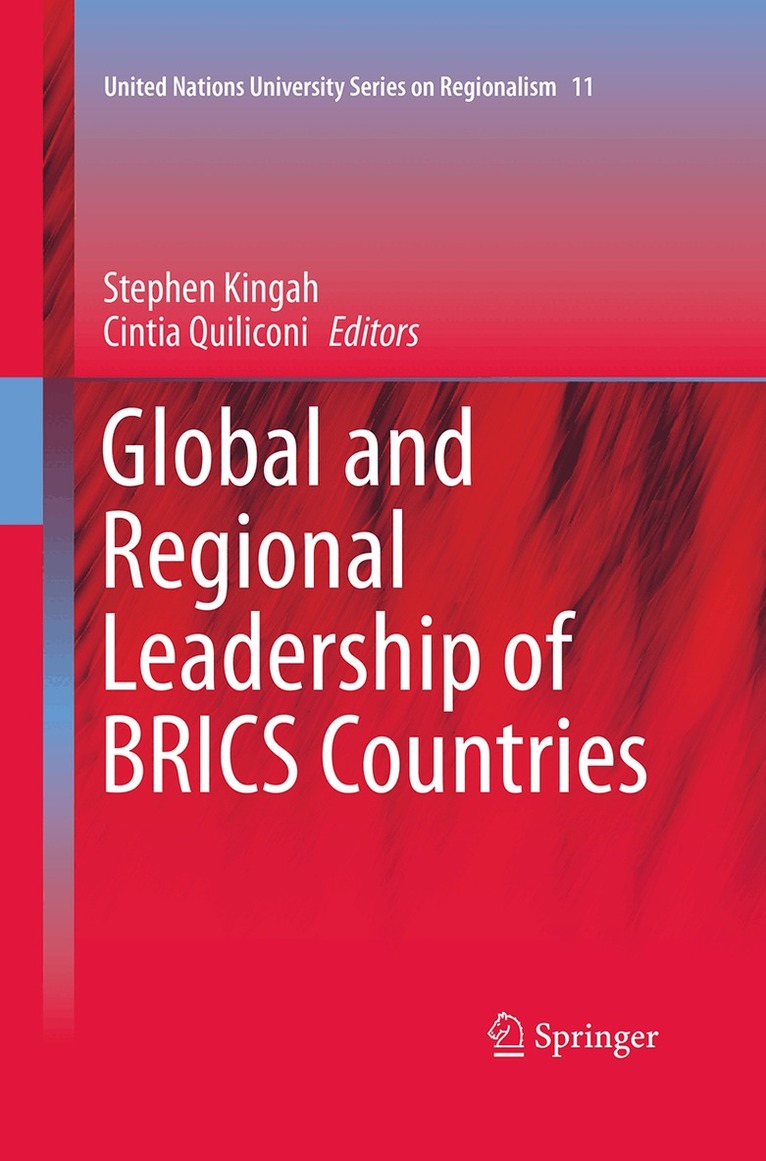
    Global and Regional Leadership of BRICS Countries

    AvStephen Kingah,Cintia Quiliconi

    Häftad, Engelska, 2016

    Del 11 i serien United Nations University Series on Regionalism

    549 kr

    Beställningsvara. Skickas inom 10-15 vardagar. Fri frakt över 249 kr.

    Beskrivning

    This book presents a systematic collation of the regional and global dimensions of the leadership role of BRICS countries (Brazil, Russia, India, China and South Africa). It analyses the rising regional and global leadership of BRICS, using specific benchmarks to gauge the nature of this leadership. The elements examined include willingness to lead, the capacity to do as much, and the degree to which the given actor is accepted as a leader both within and beyond its region. The chapters in the book capture the nature of trends in regional and global leadership within the contexts of a changing international order.It is taken for granted that Brazil, Russia, India, China and South Africa are now engineering a unique pool of governance that is seeking alternatives to the current order of global economic and political affairs. The fact that these countries have jointly decided to forge ahead with the BRICS constellation of states that is now taking consequential decisions such as the creation of the BRICS’ New Development Bank, is not to be treated lightly. In this book the majority of papers take a step back and systematically analyse the real state of the leadership that is provided by the BRICS on a litany of regionally and globally relevant issues. While no one doubts the fact that these countries have the capacity to provide leadership especially in their various regions on many issues, what remains moot is whether they are willing and capable to do so at the global level. Even in those cases where there is the willingness and capacity, the book argues that the acceptance of such leadership by potential followers is not always a given.

    Produktinformation

    • Utgivningsdatum:2016-08-23
    • Mått:155 x 235 x 16 mm
    • Vikt:441 g
    • Format:Häftad
    • Språk:Engelska
    • Serie:United Nations University Series on Regionalism
    • Antal sidor:281
    • Förlag:Springer International Publishing AG
    • ISBN:9783319370217

    Utforska kategorier

    • Internationell ekonomi inom Ekonomi och Ledarskap
    • Ekonomisk politik inom Ekonomi och Ledarskap
    • Internationella relationer inom Samhälle och politik

    Mer om författaren

    Stephen Kingah is research fellow at the United Nations University (Institute on Comparative Regional Integration Studies, UNU-CRIS), in Bruges. He holds a PhD in law from the Free University of Brussels (VUB). Following his PhD studies he worked as ad hoc administrator in the European Commission charged with the European Union’s relations par rapport international financial institutions, with emphasis on the World Bank and the African Development Bank. He lectures in the governance program at the University of Maastricht. Stephen has published in many periodicals including the International and Comparative Law Quarterly, International Organizations Law Review, European Foreign Affairs Review, Proceedings of the American Society of International Law, South African Journal of International Affairs, European Law Journal, World Bank Legal Review, amongst others.Cintia Quiliconi. PhD in Politics and International Relations, University of Southern California (USC), she holds a M.A. in Politics from New York University, and a B.A. in Political Science from the University of Buenos Aires. She is a professor at the International Studies Department at FLACSO-Ecuador and a research fellow at the Department of International Relations at FLACSO-Argentina. She has been a Fulbright scholar and consultant to various international organizations such as the World Bank, the Inter-American Development Bank and the United Nations Development Program. She is also member of the Latin American trade Network (LATN). She has served as advisor to the Secretariat of Industry and the Secretariat of Agriculture in Argentina. Her publications and research interests focus on international political economy and development, regionalism in Latin America, trade negotiations and EU and U.S.- Latin American economic relations.

    Recensioner i media

    “Kingah and Quiliconi sum up the leadership potential of each BRICS member in a precise and informative manner. … This book would also appeal to scholars of international relations and political science; economists, international finance experts and international lawyers; diplomats and other practitioners; civil society and international/regional NGOs; industry and potential trading partners and interested members of the public. This is the value of accessible and informative writing. If you want to know more about BRICS, read this book.” (Narnia Bohler-Muller, South African Journal of International Affairs, Vol. 23 (3), September, 2016)

    Innehållsförteckning

    • Chapter 1. Introduction: The BRICS in Regional and Global Governance; Stephen Kingah and Cintia Quiliconi.- Chapter 2. Conceptualising Regional Leadership: the Positioning Theory Angle; Luk Van Langenhove, Marieke Zwartjes and Giorgios Papanagnou.- Chapter 3. BRICS: Leadership in the Making; Cintia Quiliconi, Marcelo Saguier and Diana Tussie.- Chapter 4. Brazil's Leadership through Global Channels: Autonomy, Diversification and Acceptance; Melisa Deciancio.- Chapter 5. Cooperation for Development, Brazilian Regional Leadership and Global Protagonism; Leticia Pinheiro and Gabrieli Gaio.- Chapter 6. Global Security and Economic Leadership of Russia; Andrei Korobkov, Stephen Kingah and Jovana Jovic.- Chapter 7. Russia's Leadership of Regional Integration in Eurasia; Mikhail A. Molchanov.- Chapter 8. India as a Global Power: Capability, Willingness and Acceptance; Golam Robbani.- Chapter 9. Indian Aspirations and South Asian Realities: Perceived Hegemon or Emerging Leader?; Dhananjay Tripathi.- Chapter 10. Leadership with Chinese Characteristics: What Role for Soft Power?; Mark Beeson and Shaomin Xu.- Chapter 11. Complexity of the Relations among Leading States and the Following States: The Case of East Asian Regional Integration; Yong Wang.- Chapter 12. Has south Africa the Spine for Global Leadership?; Stephen Kingah and Stefano degli Uberti.- Chapter 13. South Africa's Quest for Leadership in Africa: Achievements, Constraints and DileIntrommas; Mills Soko and Neil Balchin.- Chapter 14. Conclusions: Leadership of the BRICS and Implications for the European Union; Cintia Quiliconi and Stephen Kingah.