• Fri frakt över 249 kr
  • •
  • Snabba leveranser
  • •
  • Billiga böcker
Kundservice

Du är på sajten för privatpersoner.

Företag, bibliotek eller offentlig verksamhet?

Du handlar på classic.bokus.com, där alla dina funktioner finns intakta.
Till classic.bokus.com
Bokus logotyp. Gå till startsidan.
  • Erbjudanden
  • Nyheter
  • Student
  • Topplistor
  • Barn & ungdom
  • Bokus Play
  • E-böcker
  • Pocketböcker
  • Spel & pussel

10% rabatt på allt med kod NYSTART10 →

Sidfot

Mina sidor

    Hjälp

    • Kundservice
    • Vanliga frågor och svar
    • Frakt och leverans
    • Retur vid ångerrätt
    • Reklamera vara
    • Betalning
    • Köpvillkor
    • Allmänna villkor
    • Information om webbplatsens tillgänglighet

    Om Bokus

    • Om oss
    • Pressrum
    • För studenter
    • För företag
    • För bibliotek och offentlig verksamhet
    • För leverantörer
    • Hållbarhet

    Populärt

    • Aktuella erbjudanden
    • Presentkort
    • Studentlitteratur
    • Nya böcker
    • Topplistor
    • Signerade böcker
    • Engelska böcker

    Inspiration

    • Boktips
    • BookTok
    • Populära bokserier
    • Barnbokskaraktärer
    • Populära författare
    Logotyp för Bokus
    Följ oss på Facebook (extern länk)Följ oss på Instagram (extern länk)Följ oss på YouTube (extern länk)Följ oss på TikTok (extern länk)
    bokus @ CookiesAnpassa cookiesIntegritetspolicyKöpvillkor
    Till Citymail hemsida (extern länk)Till Budbee hemsida (extern länk)Till Postnord hemsida (extern länk)Till Schenker hemsida (extern länk)Till Early Bird hemsida (extern länk)Till Walleys hemsida (extern länk)
    1. Ekonomi och Ledarskap
    2. Nationalekonomi

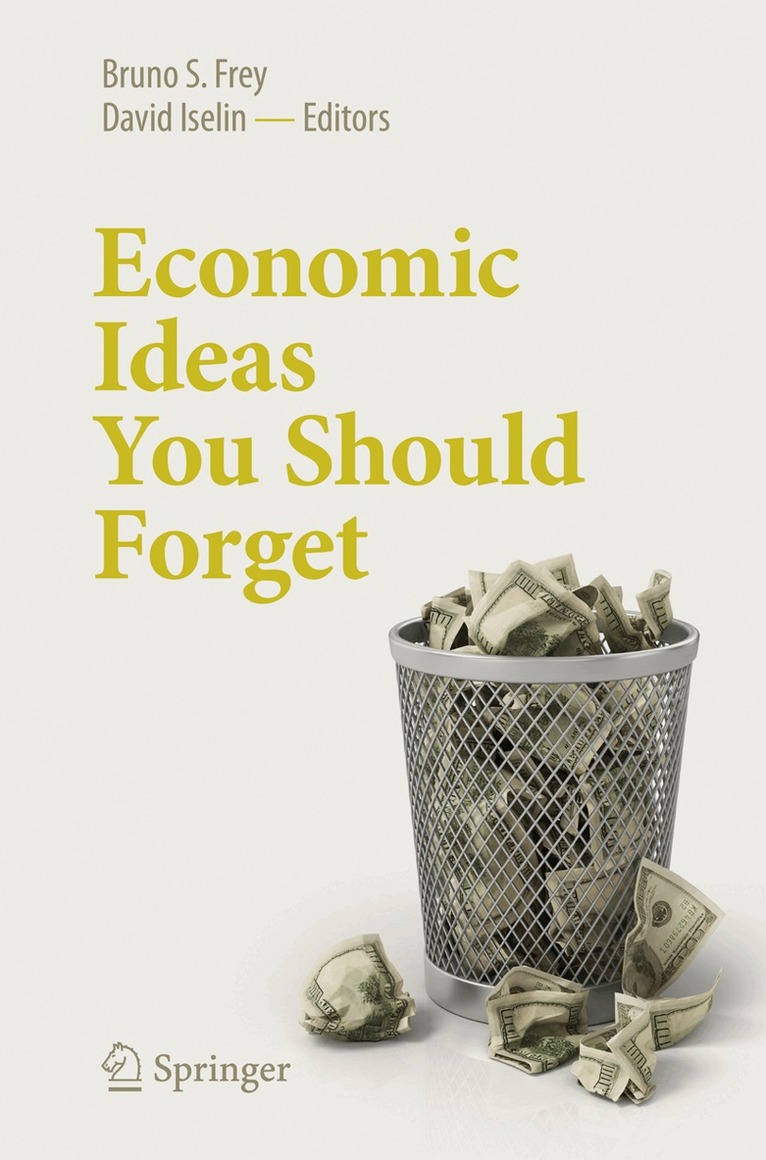
    Economic Ideas You Should Forget

    AvBruno S. Frey,David Iselin

    Häftad, Engelska, 2017

    415 kr

    Beställningsvara. Skickas inom 10-15 vardagar. Fri frakt över 249 kr.

    Beskrivning

    Reporting on cutting-edge advances in economics, this book presents a selection of commentaries that reveal the weaknesses of several core economics concepts. Economics is a vigorous and progressive science, which does not lose its force when particular parts of its theory are empirically invalidated; instead, they contribute to the accumulation of knowledge.By discussing problematic theoretical assumptions and drawing on the latest empirical research, the authors question specific hypotheses and reject major economic ideas from the “Coase Theorem” to “Say’s Law” and “Bayesianism.” Many of these ideas remain prominent among politicians, economists and the general public. Yet, in the light of the financial crisis, they have lost both their relevance and supporting empirical evidence.This fascinating and thought-provoking collection of 71 short essays written by respected economists and social scientists from all over the world will appeal to anyone interested in scientific progress and the further development of economics.

    Produktinformation

    • Utgivningsdatum:2017-03-17
    • Mått:155 x 235 x 10 mm
    • Vikt:288 g
    • Format:Häftad
    • Språk:Engelska
    • Antal sidor:166
    • Upplaga:17001
    • Förlag:Springer International Publishing AG
    • ISBN:9783319474571

    Utforska kategorier

    • Nationalekonomi inom Ekonomi och Ledarskap
    • Ekonomisk historia inom Ekonomi och Ledarskap

    Mer om författaren

    Bruno S. Frey is Permanent Visiting Professor at the University of Basel. He was Professor of Economics at the University of Zurich from 1977-2012, Distinguished Professor of Behavioural Science at the Warwick Business School, UK from 2010-2013 and Senior Professor of Economics at Zeppelin University Friedrichshafen, Germany from 2013-2015. Frey is Research Director of CREMA – Centre for Research in Economics, Management and the Arts, Switzerland and Co-Founder of CREW - Centre for Research in Economics and Well-being at the University of Basel. He was Managing Editor, from 1969-2015, and is now Honorary Editor of Kyklos. Bruno Frey seeks to extend economics beyond the standard neo-classics by including insights from other disciplines, including political science, psychology and sociology.David Iselin is an economist and member of the corporate communications team at KOF Swiss Economic Institute, ETH Zurich. He is editor of Ökonomenstimme,a policy platform for German-speaking economists. In November 2016, he finished his PhD at ETH Zurich, in which he analyses the relationship between news and the economy. As a freelance journalist, he is a regular contributor for the Swiss weekly DAS MAGAZIN, among others.

    Recensioner i media

    “The result was a potpourri of short essays that span economic science and economic policy.” (David Colander, Journal of Economic Literature, Vol. 55 (3), September, 2017)

    Innehållsförteckning

    • Introduction.- Capitalism.- Sola-Protestantism in Economics.-Economics Has Hothing to Do with Religion.- More Choice Is Always Better.-People Are Outcome-Oriented.- Deriving Peopls's Trade Policy Preferences from Macro-Economic Trade Theory.- Size (of Government) Doesn't Matter.- Byesianism.- The Return on Equity.- Peak Oil Theory.- More Choice Is Always Better.- (Un-)Productive Labor.- Volatility Is Risk.- Robots Will Take All Our Jobs.- Economic Growth Increase People's Well-Being.- Big Data Predictions Devoid of Theory.- Government Debts Are a Burden on Future Generations.- Public Spending Reduces Unemployment.- The Capital Asset Pricing Model.- Innovation Programs Lead to Innovation.- Factors of Production Are Homogenous Within Categories.- Individual Utility Depends Only on Absolut Consumption.- The Relative Price Effect Explains Behavior.- The Precedence of Exchange Over Production.- Inequality Reduces Growth.- Contingent Valuation, Willingness to Pay and Willingness to Accept.-Governments Must Reduce Budget Deficits.- Reach for Your Dream.- The EU's Competiveness Authority.- Say's Law.- Boundedness of Rationality.- Rational Expectations.- Letting Insolvent Banks Fail.- Pleasantville Politics - Selecting Politicians According to Ability.- The Axioms of Revealed Preference.- The Myth of Expansionary Consolidations.- Government Hurts the Economy More Than It Helps.- The Motivated Armchair Approach to Preferences.- Economics Is Based on Scientific Methods.- The Death of Distance.- Concept of Rationality.- Pay for Performance Raises Performance.- Home Ownership Is Good.- Coase Theorem.- Poverty Is Good for Development.- Markets Are Efficient.- CEOs Are Paid for Talent.- The Efficiency-Equity Tradeoff.- Deterministic Trend of Inequality.- Quantitative Easing.- Hosting the Olympic Games.- Abolishing Cash as Solution Against the Evil.- Receiving Money and Hot Having to work Raises Happiness.- Saints in Public Office.- Helicopter Money.- Decisions are Deterministic.-Politicians Systematically Converge to the Median Voter.- Artists Are Poor and Thus Unhappy.- Returns on Educational Investments Are Highest for Early Childhood Interventions.- EU Centralization.- The Alleged Asymmetry in Maintaining a Fixed Exchange Rate.- Governments Should Maximize the Happiness of the Population.- Okun's Equality-Efficiency Tradeoff.- A Rising Tide Raises all Boats.- Social Cost Analysis.- Natural Resources Make Rich.- The Natural Rate of Interest Is Positive.- Europe's "Skill Shortage".- Taxes are Paid Because of Expected Punishment.- Better safe than Sorry.- The End of Work.- Postscript