• Fri frakt över 249 kr
  • •
  • Snabba leveranser
  • •
  • Billiga böcker
Kundservice

Du är på sajten för privatpersoner.

Företag, bibliotek eller offentlig verksamhet?

Du handlar på classic.bokus.com, där alla dina funktioner finns intakta.
Till classic.bokus.com
Bokus logotyp. Gå till startsidan.
  • Erbjudanden
  • Student
  • Topplistor
  • Barn & ungdom
  • Bokus Play
  • E-böcker
  • Ljudböcker
  • Pocketböcker
  • Spel och pussel

Pocketfynda! Hundratals böcker för 49 kr/st →

Sidfot

Mina sidor

    Hjälp

    • Kundservice
    • Vanliga frågor och svar
    • Frakt och leverans
    • Retur vid ångerrätt
    • Reklamera vara
    • Betalning
    • Köpvillkor
    • Allmänna villkor
    • Information om webbplatsens tillgänglighet

    Om Bokus

    • Om oss
    • Pressrum
    • För studenter
    • För företag
    • För bibliotek och offentlig verksamhet
    • För leverantörer
    • Hållbarhet

    Populärt

    • Aktuella erbjudanden
    • Presentkort
    • Studentlitteratur
    • Nya böcker
    • Topplistor
    • Signerade böcker
    • Engelska böcker

    Inspiration

    • Boktips
    • BookTok
    • Barnbokskaraktärer
    • Populära författare
    Logotyp för Bokus
    Följ oss på Facebook (extern länk)Följ oss på Instagram (extern länk)Följ oss på YouTube (extern länk)Följ oss på TikTok (extern länk)
    bokus @ CookiesAnpassa cookiesIntegritetspolicyKöpvillkor
    Till Citymail hemsida (extern länk)Till Budbee hemsida (extern länk)Till Postnord hemsida (extern länk)Till Schenker hemsida (extern länk)Till Early Bird hemsida (extern länk)Till Walleys hemsida (extern länk)
    1. Data och IT
    2. Systemvetenskap och AI

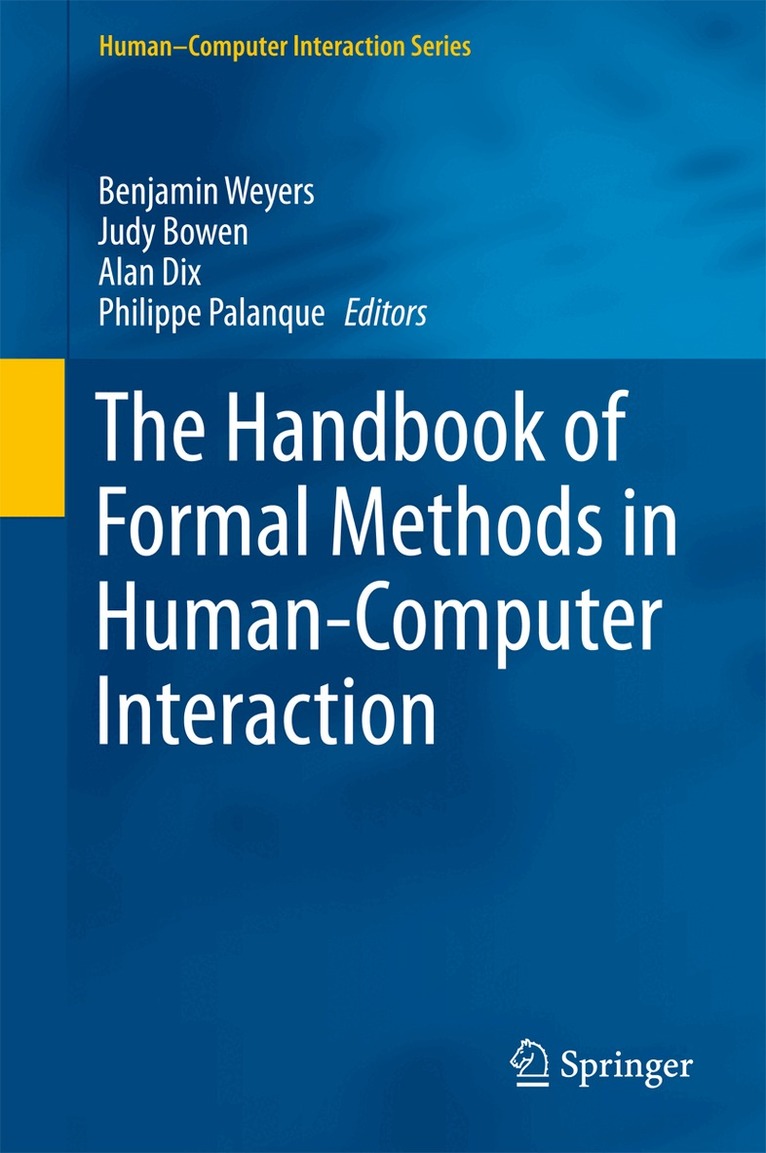
    Handbook of Formal Methods in Human-Computer Interaction

    AvBenjamin Weyers,Judy Bowen

    Inbunden, Engelska, 2017

    Del i serien Human–Computer Interaction Series

    3 648 kr

    Beställningsvara. Skickas inom 10-15 vardagar. Fri frakt över 249 kr.

    Beskrivning

    This book provides a comprehensive collection of methods and approaches for using formal methods within Human-Computer Interaction (HCI) research, the use of which is a prerequisite for usability and user-experience (UX) when engineering interactive systems.  World-leading researchers present methods, tools and techniques to design and develop reliable interactive systems, offering an extensive discussion of the current state-of-the-art with case studies which highlight relevant scenarios and topics in HCI as well as presenting current trends and gaps in research and future opportunities and developments within this emerging field.The Handbook of Formal Methods in Human-Computer Interaction is intended for HCI researchers and engineers of interactive systems interested in facilitating formal methods into their research or practical work.

    Produktinformation

    • Utgivningsdatum:2017-05-03
    • Mått:155 x 235 x 36 mm
    • Vikt:1 159 g
    • Format:Inbunden
    • Språk:Engelska
    • Serie:Human–Computer Interaction Series
    • Antal sidor:575
    • Förlag:Springer International Publishing AG
    • ISBN:9783319518374

    Utforska kategorier

    • Systemvetenskap och AI inom Data och IT
    • Programvaruutveckling inom Data och IT
    • Människa – datorinteraktion inom Data och IT

    Mer om författaren

    Benjamin Weyers is a Senior Researcher at the Virtual Reality and Immersive Visualization Group at RWTH Aachen University, Germany. Benjamin is strongly involved in the FET-flagship project “The Human Brain Project” and co-leads the work package on interactive visualization. He studied Computer Science at the University of Duisburg-Essen and received his doctorate with the Computer Graphics and Scientific Computing Group at the University of Duisburg-Essen.  His research interests include human-computer interaction (HCI), formal modelling, information visualization and virtual reality (VR). Judy Bowen is a Senior Lecturer at the University of Waikato in New Zealand. For the past ten years she has been working in the area of formal modelling for interactive systems, specifically safety-critical interactive systems. Her work includes projects that consider safety-properties of systems, contexts of use for non-context aware systems and the use of technologyin hazardous work-places and environments. Alan Dix is a Professor in the Human–Computer Interaction Centre at the University of Birmingham and a Senior Researcher at Talis. He has worked in HCI for over thirty years and his research has included foundational work on formal methods in HCI, some of the earliest work on privacy in HCI and the ethics of machine learning, and more recently has included learning analytics, IT and data issues for marginal communities as well as walking one thousand miles around Wales.  He runs the twice-yearly Tiree Tech Wave.  Philippe Palanque is a Professor of Computer Science at the University of Toulouse and leads the ICS Research Group. Since the late 80's, he has worked on the development and application of formal description techniques for interactive systems. The main aim of his research has been to address Usability, Safety and Dependability in order to build trustable safety-critical Interactive Systems.

    Recensioner i media

    “Human-computer interaction (HCI), as a discipline, is overwhelmingly experimental. One quick look at the proceedings ... the leading conference in the domain, will make this clear: almost all papers report on carefully crafted, well-designed experiments. … I enjoyed reading the book … .” (Jacques Carette, Computing Reviews, January, 22 , 2018)​

    Innehållsförteckning

    • Foreword.- Part I: Introduction.- State of the Art in Formal Methods in HCI.- Topics of formal methods in HCI.- Trends and Gaps.- Case Studies.- Part II: Modeling, Execution and Simulation.- Visual and Formal Modeling of Modularized and Executable User Interface Models.- Combining Models for Interactive System Modelling.- Activity Modelling for Low-Intention Interaction.- Modelling the User Physigrams – Modeling Physical Device Characteristics Interaction.- Formal Description of Adaptive Interactive Systems based on Executable User Interface Models.- Part II:Analysis, Validation and Verification.- Learning Safe Interactions and Full-Control.- Reasoning About Interactive Systems in Dynamic Situations of Use Enhanced Operator Function Model (EOFM): A Task Analytic Modeling Formalism for Including Human.- Behavior in the Verification of Complex Systems.- The Specification and Analysis of Use Properties of a Nuclear.- Control System.- Formal Analysis of MultipleCoordinated HMI Systems.- Part IV:  Future Opportunities and Developments.- Domain-Specific Modelling for Human-Computer Interaction.- Exploiting Action Theory as a Framework for Analysis and Design of Formal Methods Approaches: Application to the CIRCUS Integrated Development Environment .- A Public Tool Suite for Modelling Interactive Applications.- Formal Modeling of App-Ensembles.- Dealing with Faults during Operations: Beyond Classical Use of Formal Methods.