• Fri frakt över 249 kr
  • •
  • Snabba leveranser
  • •
  • Billiga böcker
Kundservice

Du är på sajten för privatpersoner.

Företag, bibliotek eller offentlig verksamhet?

Du handlar på classic.bokus.com, där alla dina funktioner finns intakta.
Till classic.bokus.com
Bokus logotyp. Gå till startsidan.
  • Erbjudanden
  • Nyheter
  • Student
  • Topplistor
  • Barn & ungdom
  • Bokus Play
  • E-böcker
  • Pocketböcker
  • Spel & pussel

10% rabatt på allt med kod: NYSTART10 →

Sidfot

Mina sidor

    Hjälp

    • Kundservice
    • Vanliga frågor och svar
    • Frakt och leverans
    • Retur vid ångerrätt
    • Reklamera vara
    • Betalning
    • Köpvillkor
    • Allmänna villkor
    • Information om webbplatsens tillgänglighet

    Om Bokus

    • Om oss
    • Pressrum
    • För studenter
    • För företag
    • För bibliotek och offentlig verksamhet
    • För leverantörer
    • Hållbarhet

    Populärt

    • Aktuella erbjudanden
    • Presentkort
    • Studentlitteratur
    • Nya böcker
    • Topplistor
    • Signerade böcker
    • Engelska böcker

    Inspiration

    • Boktips
    • BookTok
    • Populära bokserier
    • Barnbokskaraktärer
    • Populära författare
    Logotyp för Bokus
    Följ oss på Facebook (extern länk)Följ oss på Instagram (extern länk)Följ oss på YouTube (extern länk)Följ oss på TikTok (extern länk)
    bokus @ CookiesAnpassa cookiesIntegritetspolicyKöpvillkor
    Till Citymail hemsida (extern länk)Till Budbee hemsida (extern länk)Till Postnord hemsida (extern länk)Till Schenker hemsida (extern länk)Till Early Bird hemsida (extern länk)Till Walleys hemsida (extern länk)
    1. Naturvetenskap och teknik
    2. Teknik och industri
    3. Energiteknik

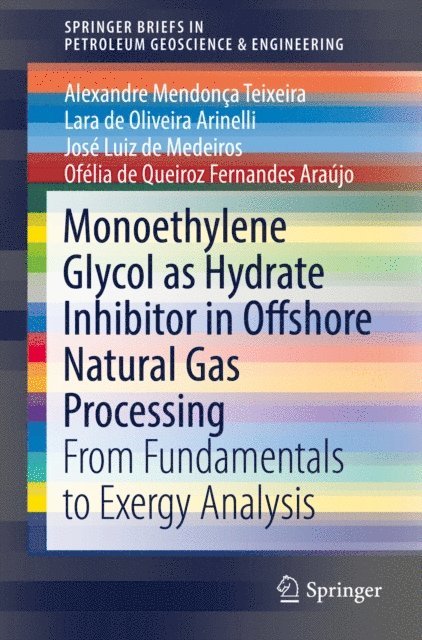
    Monoethylene Glycol as Hydrate Inhibitor in Offshore Natural Gas Processing

    From Fundamentals to Exergy Analysis

    AvAlexandre Mendonça Teixeira,Lara de Oliveira Arinelli

    Häftad, Engelska, 2017

    Del i serien SpringerBriefs in Petroleum Geoscience & Engineering

    547 kr

    Beställningsvara. Skickas inom 10-15 vardagar. Fri frakt över 249 kr.

    Beskrivning

    This book addresses several issues related to hydrate inhibition and monoethylene glycol (MEG) recovery units (MRUs) in offshore natural gas fields, from fundamentals to engineering aspects and from energy consumption assessment to advanced topics such as exergy analysis. The assessment of energy degradation in MRUs is critical in offshore rigs, and the topic of exergy theory has by no means been completely explored; it is still being developed. The book presents a comprehensive, yet concise, formulation for exergy flow and examines different approaches for the reference state of MEG and definition of the reference environment so as to obtain an effective exergy analysis with consistent results.It also provides new and useful information that has a great potential in the field of exergy analysis application by assessing energy degradation for three well-known MRU technologies on offshore rigs: the Traditional Atmospheric Distillation Process; the Full-Stream Process; and the Slip-Stream Process. The book then elucidates how the main design parameters impact the efficiency of MEG recovery units and offers insights into thermodynamic efficiency based on case studies of general distillation-based processes with sharp or not too sharp cut, providing ranges for expected values of efficiencies and enhancing a global comprehension of this subject. Since MEG recovery is an energy consuming process  that invariably has to be conducted in a limited space and with limited power supply, the book is a valuable resource for those involved in design, engineering, economic evaluation and environmental evaluation of topside processing on offshore platforms for natural gas production.

    Produktinformation

    • Utgivningsdatum:2017-09-22
    • Mått:155 x 235 x undefined mm
    • Format:Häftad
    • Språk:Engelska
    • Serie:SpringerBriefs in Petroleum Geoscience & Engineering
    • Antal sidor:114
    • Förlag:Springer International Publishing AG
    • ISBN:9783319660738

    Utforska kategorier

    • Energiteknik inom Naturvetenskap och teknik
    • Maskinteknik och material inom Naturvetenskap och teknik

    Mer om författaren

    Alexandre M. Teixeira: He is a chemical engineer, holds a M.Sc. degree with emphasis in oil and gas field, is currently a D.Sc. student and works in a project in a partnership with Petrobras. He has experience in the field of process engineering, focusing his research on flow assurance in offshore platforms, energy efficiency and natural gas processing. He gained an outstanding scholar award (undergraduate student) in 2012 due to his academic performance and B. Sc. with honors (cum laude), and in 2014 won the best M.Sc. thesis award from Escola de Química of the Federal University of Rio de Janeiro.Lara de O. Arinelli: She is graduated in Chemical Engineering by the Federal University of Rio de Janeiro, Brazil, and holds a M.Sc. degree with emphasis in process engineering, specifically in the oil and gas field. She is currently a D.Sc. student, while working in parallel in a research project with Petrobras. The main theme of her thesis is natural gas processing, focusing on the development of unit operation extensions of membranes and supersonic separation for simulation purposes. Lara gained an outstanding scholar award (undergraduate student) in 2012 due to her academic performance, B.Sc. degree with honors (cum laude) and in 2015 won the best M.Sc. thesis award from Escola de Química of the Federal University of Rio de Janeiro.Prof. Dr. José Luiz de Medeiros: He graduated in Chemical Engineering at Federal University of Rio de Janeiro (1980), Brazil. He earned MSc (1982) and DSc (1990) Chemical Engineering degrees from the same institution. He is currently an Assistant Professor in the Department of Chemical Engineering at Federal University of Rio de Janeiro since 1990. He has experience in several sectors of chemical engineering with emphasis in Petroleum, Natural Gas and Petrochemistry, with several published works in the following research lines: Applied Thermodynamics, Separation Processes, Process Identification & Optimization, Statistical & Mathematical Methods. His fields of study concentrate on Compositional Modeling, Hydro-treatment & Hydrocracking of Oil Fractions, Compressible & Incompressible Flows and Associate Separation Technologies, Flow Assurance in Natural Gas Systems, Pipeline Network Modeling for Natural Gas & Oil Transportation, Leak Detection in Compressible & Incompressible Pipeline Networks, Chemical Sequestration of CO2 , Capture of CO2 & H2S from Natural Gas via Membrane Permeation and Technologies of Contact with Aqueous Ethanolamines.Prof. Dr. Ofélia de Queiroz Fernandes Araújo: She holds a PhD (1987) and MSc (1984) degrees in Chemical Engineering from the University of Illinois at Urbana-Champaign (USA), and BSc in Chemical Engineering from the Federal University of Rio de Janeiro (1981), Brazil. Worked at NATRON SA (1987-198) and OXITENO SA (1989-1993) in process simulation and control engineering. Joined the Federal University of Rio de Janeiro, in 1993, in the Chemical Engineering Department, where she is currently Associate Professor. Her research interests are process and environmental engineering, with special focus in natural gas processing, and CO2 separation and utilization, and green engineering. She was head of two graduate programs - Technology of Chemical and Biochemical Processes (2007-2010) and Environmental Engineering (2014-2015).

    Innehållsförteckning

    • Chapter 1. Introduction.- Chapter 2. Hydrate Formation and Inhibition in Offshore Natural Gas Processing.- Chapter 3.MEG Loops in Offshore Natural Gas Fields.- Chapter 4.Thermodynamics of Glycol Systems.- Chapter 5.MRU Processes.- Chapter 6. Energy Consumption and CO2 Emission of MRU Processes.- Chapter 7.Thermodynamic Efficiency of Steady State Operations of MRUs.- Chapter 8.Exergy Analysis of Chemical Processes.- Chapter 9.Exergy Analysis of MRU Processes in Offshore Platforms.- Chapter 10.Influence of Design Parameters on Exergy Efficiencies of MRU Processes.- Chapter 11.Energy Performance versus Exergy Performance of MRU Processes.- Chapter 12.Concluding Remarks.