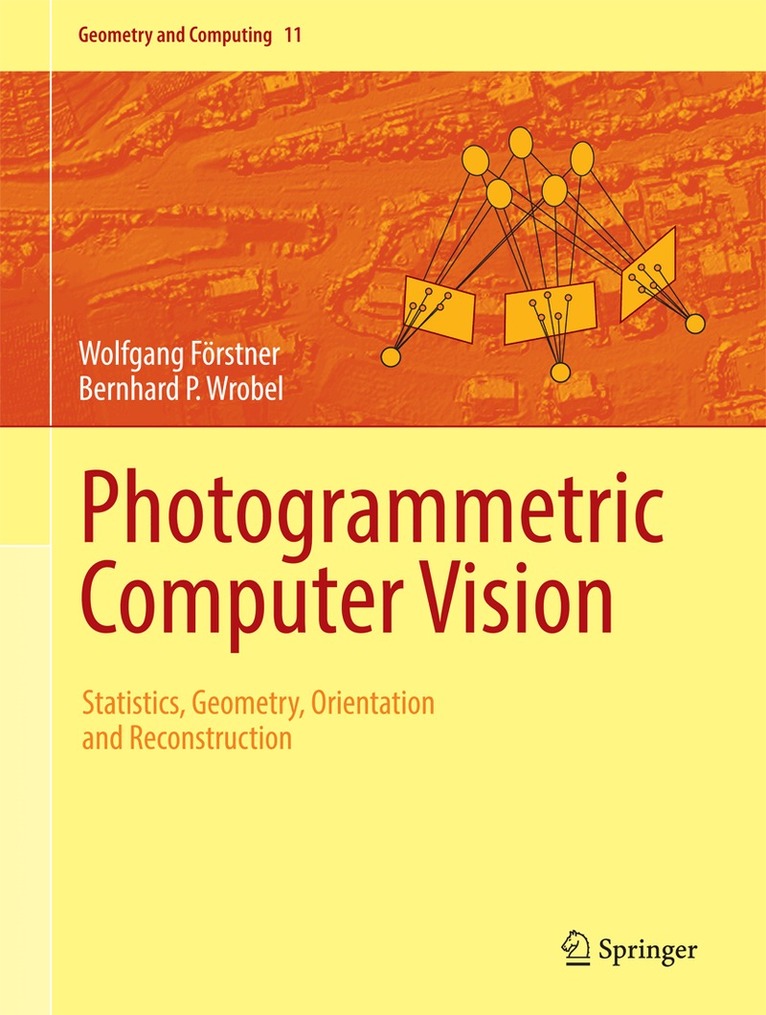
Photogrammetric Computer Vision
Statistics, Geometry, Orientation and Reconstruction
AvWolfgang Förstner,Bernhard P. Wrobel
Del 11 i serien Geometry and Computing
694 kr
Beställningsvara. Skickas inom 10-15 vardagar. Fri frakt över 249 kr.
Fler format och utgåvor
Beskrivning
Produktinformation
- Utgivningsdatum:2018-06-14
- Mått:210 x 279 x 45 mm
- Vikt:1 972 g
- Format:Häftad
- Språk:Engelska
- Serie:Geometry and Computing
- Antal sidor:816
- Förlag:Springer International Publishing AG
- ISBN:9783319791708
Utforska kategorier
Mer om författaren
Prof. Dr.-Ing. Wolfgang Förstner is an internationally leading expert in photogrammetry, computer vision, pattern recognition and machine learning. Throughout his exemplary career of nearly 40 years as a researcher, inventor, innovator and educator, he has made exceptionally significant scientific contributions in many areas of information from imagery and mentored generations of mapping scientists and engineers. Examples of his work include blunder detection for aerial triangulation, image matching, object recognition and statistical projective geometry. He developed the well-known Förstner Operator, for the detection of key points in images, in the 1980s. After studying geodesy and surveying, he first worked at the University of Stuttgart before moving to the University of Bonn as Professor for Photogrammetry where he led the Institute for Photogrammetry from 1990 to 2012. He published more than 100 academic papers, coauthored three book chapters for the ASPRS Manual of Photogrammetry, supervised more than 30 Ph.D. theses, and was closely involved with the International Society for Photogrammetry and Remote Sensing and the German Association for Pattern Recognition. Prof. Dr.-Ing. Bernhard P. Wrobel received his Ph.D. (Dr.-Ing) in theoretical geodesy from the University of Bonn. From 1975 to 1981 he was professor for close-range photogrammetry and from 1981 to 2001 for photogrammetry at Darmstadt University of Technology, and also head of the Institute for Photogrammetry and Cartography. He was closely involved with the International Society for Photogrammetry and Remote Sensing, and he coauthored three book chapters for the ASPRS Manual of Photogrammetry. Besides his work related to precise mensuration tasks in industry, his research interests cover the mathematical fundamentals of photogrammetry such as the digital inversion of image formation for reconstruction of 3D surfaces and reflectance from multiple images.Authors' website (code, lecture slides) at http://www.ipb.uni-bonn.de/book-pcv/)
Recensioner i media
“Photogrammetric Computer Vision represents a milestone publication in modern photogrammetry. … The excellence of the material in this book is undergirded by careful cross-referencing and the occasional use of a didactic manner whereby important concepts, when they are first introduced, are written in italics in the outer margins.” (Charles Toth, Photogrammetric Engineering & Remote Sensing, Vol. 83 (10), October, 2017)“This book is a great achievement. … it gives a comprehensive overview of the geometrical concepts of photogrammetry and computer vision. … it will be invaluable as a book of reference for graduate students, researchers, software engineers and practitioners aswell as for teachers involved in these subjects.” (Franz Rottensteiner, Journal of Photogrammetry, Remote Sensing and Geoinformation Science, Vol. 85 (3), August, 2017)“This book on Photogrammetric Computer Vision can thus be seen as a logical continuation of the authors’ academic work, dedicated to building bridges between photogrammetry and computer vision. … this book forms a rich body of state-of-the-art knowledge in image geometry and related problems.” (Markus Gerke, The Photogrammetric Record, June, 2017)“This book is one of two volumes on photogrammetric computer vision. This volume focuses on geometric image analysis based on statistics … . This is an excellent textbook. It can be used in higher education at BSc. and MSc. levels. The authors gives different education programs with different objectives to be achieved. This greatly helps to use the book.” (Attila Fazekas, zbMATH, 1372.68002, 2017)
Innehållsförteckning
- Introduction.- Tasks for Photogrammetric Computer Vision.- Modelling in Automated Photogrammetric Computer Vision.- Probability Theory and Random Variables.- Testing.- Estimation.- Homogeneous Representations of Points, Lines and Planes.- Transformations.- Geometric Operations.- Rotations.- Oriented Projective Geometry.- Reasoning with Uncertain Geometric Entities.- Orientation and Reconstruction.- Bundle Adjustment.- Surface Reconstruction from Point Clouds.- References.- Index.
Mer från samma författare
Semantic Modeling for the Acquisition of Topographic Information from Images and Maps
Wolfgang Förstner, Lutz Plümer
1 064 kr