• Fri frakt över 249 kr
  • •
  • Snabba leveranser
  • •
  • Billiga böcker
Kundservice

Du är på sajten för privatpersoner.

Företag, bibliotek eller offentlig verksamhet?

Du handlar på classic.bokus.com, där alla dina funktioner finns intakta.
Till classic.bokus.com
Bokus logotyp. Gå till startsidan.
  • Erbjudanden
  • Student
  • Topplistor
  • Barn & ungdom
  • Bokus Play
  • E-böcker
  • Ljudböcker
  • Pocketböcker
  • Spel och pussel

Pocketfynda! Hundratals böcker för 49 kr/st →

Sidfot

Mina sidor

    Hjälp

    • Kundservice
    • Vanliga frågor och svar
    • Frakt och leverans
    • Retur vid ångerrätt
    • Reklamera vara
    • Betalning
    • Köpvillkor
    • Allmänna villkor
    • Information om webbplatsens tillgänglighet

    Om Bokus

    • Om oss
    • Pressrum
    • För studenter
    • För företag
    • För bibliotek och offentlig verksamhet
    • För leverantörer
    • Hållbarhet

    Populärt

    • Aktuella erbjudanden
    • Presentkort
    • Studentlitteratur
    • Nya böcker
    • Topplistor
    • Signerade böcker
    • Engelska böcker

    Inspiration

    • Boktips
    • BookTok
    • Barnbokskaraktärer
    • Populära författare
    Logotyp för Bokus
    Följ oss på Facebook (extern länk)Följ oss på Instagram (extern länk)Följ oss på YouTube (extern länk)Följ oss på TikTok (extern länk)
    bokus @ CookiesAnpassa cookiesIntegritetspolicyKöpvillkor
    Till Citymail hemsida (extern länk)Till Budbee hemsida (extern länk)Till Postnord hemsida (extern länk)Till Schenker hemsida (extern länk)Till Early Bird hemsida (extern länk)Till Walleys hemsida (extern länk)
    1. Naturvetenskap och teknik
    2. Matematik och naturvetenskap
    3. Matematik
    4. Talteori

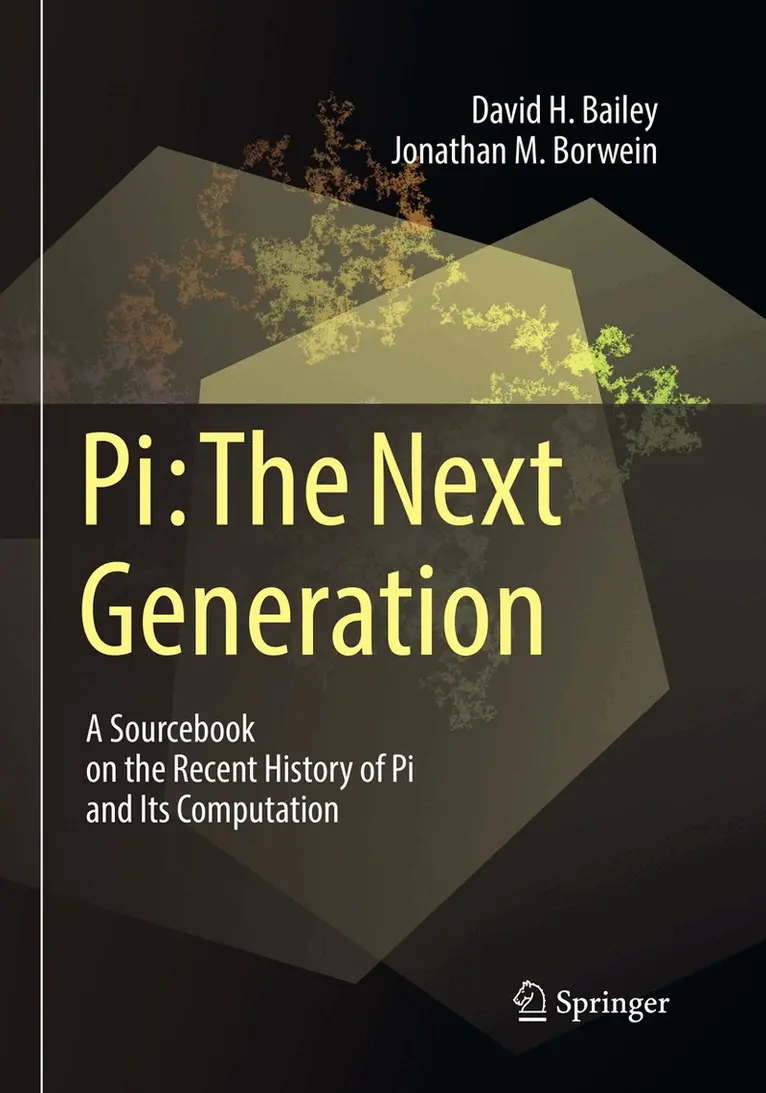
    Pi: The Next Generation

    A Sourcebook on the Recent History of Pi and Its Computation

    AvDavid H. Bailey,Jonathan M. Borwein

    Häftad, Engelska, 2018

    1 078 kr

    Beställningsvara. Skickas inom 10-15 vardagar. Fri frakt över 249 kr.

    Fler format och utgåvor

    Inbunden

    1 078 kr

    Beskrivning

    This book contains a compendium of 25 papers published since the 1970s dealing with pi and associated topics of mathematics and computer science.  The collection begins with a Foreword by Bruce Berndt. Each contribution is preceded by a brief summary of its content as well as a short key word list indicating how the content relates to others in the collection. The volume includes articles on actual computations of pi, articles on mathematical questions related to pi (e.g., “Is pi normal?”), articles presenting new and often amazing techniques for computing digits of pi (e.g., the “BBP” algorithm for pi, which permits one to compute an arbitrary binary digit of pi without needing to compute any of the digits that came before), papers presenting important fundamental mathematical results relating to pi, and papers presenting new, high-tech techniques for analyzing pi (i.e., new graphical techniques that permit one to visually see if pi and other numbers are “normal”).  This volume is a companion to Pi: A Source Book whose third edition released in 2004.  The present collection begins with 2 papers from 1976, published by Eugene Salamin and Richard Brent, which describe “quadratically convergent” algorithms for pi and other basic mathematical functions, derived from some mathematical work of Gauss. Bailey and Borwein hold that these two papers constitute the beginning of the modern era of computational mathematics.  This time period (1970s) also corresponds with the introduction of high-performance computer systems (supercomputers), which since that time have increased relentlessly in power, by approximately a factor of 100,000,000, advancing roughly at the same rate as Moore’s Law of semiconductor technology.  This book may be of interest to a wide range of mathematical readers; some articles cover more advanced research questions suitable for active researchers in the field, but several are highly accessible to undergraduate mathematics students.

    Produktinformation

    • Utgivningsdatum:2018-04-22
    • Mått:178 x 254 x 29 mm
    • Vikt:974 g
    • Format:Häftad
    • Språk:Engelska
    • Antal sidor:507
    • Förlag:Springer International Publishing AG
    • ISBN:9783319812700

    Utforska kategorier

    • Talteori inom Naturvetenskap och teknik
    • Matematikens grunder inom Naturvetenskap och teknik
    • Matematikens filosofi inom Naturvetenskap och teknik

    Mer om författaren

    David H. Bailey currently has two affiliations for his professional research work. Dr. Bailey is Senior Scientist, Computational Research Department, Lawrence Berkeley National Laboratory from which he officially retired in June 2013 but continues as an active researcher. Since February 2013, Bailey is also a Research Fellow, Department of Computer Science, University of California, Davis.Jonathan M. Borwein is currently Laureate Professor in the School of Mathematical and Physical Sciences at the University of Newcastle (NSW) with adjunct appointments at Dalhousie and at Simon Fraser. He received his Doctorate from Oxford in 1974, and has published extensively in optimization, analysis, and computational mathematics, and has received various prizes both for research and for exposition. He directs the University of Newcastle’s Priority Research Centre in Computer Assisted Research Mathematics and its Applications (CARMA).

    Recensioner i media

    “Pi: The Next Generation is compiled as a sourcebook on the recent history of π from 1975 on, and on computational issues. … Reading the papers in this book I found many aspects on the mathematics and history of π which I did not know before and I enjoyed reading it very much. As the older book on π this one will also soon become a standard reference tool for working mathematicians and historians of mathematics alike.” (Thomas Sonar, London Mathematical Society Newsletter, newsletter.lms.ac.uk, November, 2017)“Each reprinted paper is accompanied by a brief introduction explaining its significance. The papers range from historical surveys to popular expositions to research articles. Although I knew most of the papers already, I still found it delightful to browse at random. It would make a good selection for a high school or college library.” (Jeffrey O. Shallit, Mathematical Reviews, May, 2017)

    Innehållsförteckning

    • Foreword.- Preface.- Introduction.- Computation of pi using arithmetic-geometric mean.- Fast multiple-precision evaluation of elementary functions.- The arithmetic-geometric mean of Gauss.- The arithmetic-geometric mean and fast computation of elementary functions.- A simplified version of the fast algorithms of Brent and Salamin.- Is pi normal?.- The computation of pi to 29,360,000 decimal digits using Borweins' quartically convergent algorithm.- Gauss, Landen, Ramanujan, the arithmetic-geometric mean, ellipses, pi, and the ladies diary.- Vectorization of multiple-precision arithmetic program and 201,326,000 decimal digits of pi calculation.-Ramanujan and pi.- 11. Ramanujan, modular equations, and approximations to pi or how to compute one billion digits of pi.- Pi, Euler numbers, and asymptotic expansions.- A spigot algorithm for the digits of pi.- On the rapid computation of various polylogarithmic constants.- Similarities in irrationality proofs for pi, ln 2, ζ(2), and ζ(3).- Unbounded spigot algorithms for the digits of pi.- Mathematics by experiment: Plausible reasoning in the 21st century.- Approximations to pi derived from integrals with nonnegative integrands.- Ramanujan's series for 1/π: A survey.- The computation of previously inaccessible digits of π2 and Catalan's constant.- Walking on real numbers.- Birth, growth and computation of pi to ten trillion digits.- Pi day is upon us again and we still do not know if pi is normal.- The Life of pi.- I prefer pi: A brief mathematical history and anthology of articles in the American Mathematical Monthly.- Bibliography.- Index.