
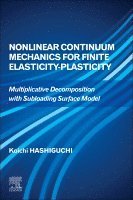
Foundations of Elastoplasticity: Subloading Surface Model
Häftad, Engelska, 2018
2 857 kr
Beställningsvara. Skickas inom 11-20 vardagar. Fri frakt över 249 kr.
Fler format och utgåvor
Beskrivning
This book is the standard text book of elastoplasticity in which the elastoplasticity theory is comprehensively described from the conventional theory for the monotonic loading to the unconventional theory for the cyclic loading behavior. Explanations of vector-tensor analysis and continuum mechanics are provided first as a foundation for elastoplasticity theory, covering various strain and stress measures and their rates with their objectivities.Elastoplasticity has been highly developed by the creation and formulation of the subloading surface model which is the unified fundamental law for irreversible mechanical phenomena in solids. The assumption that the interior of the yield surface is an elastic domain is excluded in order to describe the plastic strain rate due to the rate of stress inside the yield surface in this model aiming at the prediction of cyclic loading behavior, although the yield surface enclosing the elastic domain is assumed in allthe elastoplastic models other than the subloading surface model. Then, the plastic strain rate develops continuously as the stress approaches the yield surface, providing the advantages: 1) The tangent modulus changes continuously, 2) The yield judgment whether the stress reaches the yield surface is not required, 3) The stress is automatically attracted to the yield surface even when it goes out from the yield surface by large loading increments in numerical calculation and 4) The finite strain theory based on the multiplicative decomposition of deformation gradient tensor is formulated exactly. Consequently, the monotonic, the cyclic, the non-proportional loading behaviors for wide classes of materials including soils, rocks and concretes in addition to metals can be described rigorously by the subloading surface model. Further, the viscoplastic constitutive equations in a general rate from the quasi-static to the impact loadings are described, and constitutive equations of friction behavior and its application to the prediction of stick-slip phenomena, etc. are also described in detail. In addition, the return-mapping algorithm, the consistent tangent modulus, etc. are explained for the numerical analyses. Further, the damage, the phase-transformation and the crystal plasticity models are also described in brief. All of them are based on the subloading surface model. The elastoplasticity analysis will be advanced steadily based on the subloading surface model.
Produktinformation
Utforska kategorier
Recensioner i media
Innehållsförteckning
Hoppa över listan






Mer från samma författare
Introduction to Finite Strain Theory for Continuum Elasto-Plasticity
Yuki Yamakawa, Koichi Hashiguchi
E-bok
20121 851 kr
Introduction to Finite Strain Theory for Continuum Elasto-Plasticity
Yuki Yamakawa, Koichi Hashiguchi
E-bok
20121 865 kr
Introduction to Finite Strain Theory for Continuum Elasto-Plasticity
Koichi Hashiguchi, Yuki Yamakawa
Inbunden, 2012
1 632 kr
Hoppa över listan







Du kanske också är intresserad av
Exploring the Vertebrate Central Cholinergic Nervous System
Alexander G. Karczmar
Häftad, 2016
2 857 kr
Abnormal Child and Adolescent Psychology
Allen C. Israel, Jennifer Weil Malatras, Rita Wicks-Nelson
E-bok
20202 857 kr
Stability, Control and Differential Games
Alexander Tarasyev, Vyacheslav Maksimov, Tatiana Filippova
Häftad, 2021
2 857 kr
Deep Learning in Biomedical Signal and Medical Imaging
Sarada Prasad Gochhayat, Utku Kose, Ngangbam Herojit Singh
E-bok
20242 857 kr