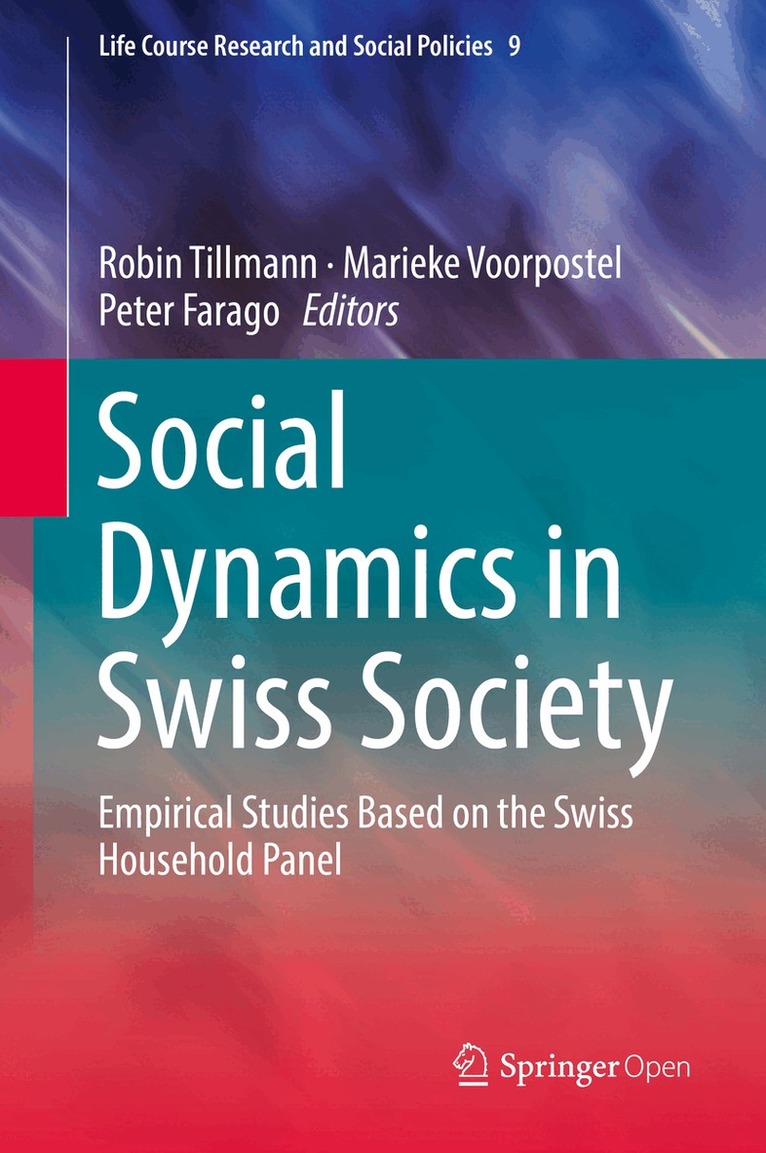
Social Dynamics in Swiss Society
Empirical Studies Based on the Swiss Household Panel
AvRobin Tillmann,Marieke Voorpostel
Del i serien Life Course Research and Social Policies
534 kr
Beställningsvara. Skickas inom 10-15 vardagar. Fri frakt över 249 kr.
Beskrivning
Produktinformation
- Utgivningsdatum:2018-06-25
- Mått:155 x 235 x 21 mm
- Vikt:582 g
- Format:Inbunden
- Språk:Engelska
- Serie:Life Course Research and Social Policies
- Antal sidor:253
- Upplaga:18001
- Förlag:Springer International Publishing AG
- ISBN:9783319895567
Utforska kategorier
Mer om författaren
Dr Robin Tillmann is the head of the Swiss Household Panel at the Swiss Centre of Expertise in the Social Sciences FORS. He has more than 20 years of experience in empirical social research. His research interests include social stratification, social inequality and social change, precariousness and poverty, and quality of life. He is co-editor of the special issue “Persistent Social Inequalities” of the Swiss Journal of Sociology (2012). He contributed to the Encyclopedia of Quality of Life and Well-Being Research (Springer, 2014) and to the book Poor Europe. The problem of poverty in chosen European countries (Wydawnictwo Uniwersytetu Śląskiego, 2015). Dr Marieke Voorpostel is a senior researcher for the Swiss Household Panel at the Swiss Centre of Expertise in the Social Sciences FORS. She received her PhD in sociology from Utrecht University in 2007. Her research focuses primarily on kinship, family diversity, the interplay between the family and the community, and survey methodology. She has published her research in various European and American scientific journals. She has also contributed to handbooks on aging and the family.
Innehållsförteckning
- Introduction.- Part 1 Family, health & quality of life.- Chapter 1.1 “Health and Inequality: Impact of the Deterioration of a Household Member’s Health on Household Mobility”, Monica Budowski & Maurizia Masia, University of Fribourg, Robin Tillmann, FORS.- Chapter 1.2 “Life-Course Smoking Behavior in Switzerland in the 20th Century”, Dean R. Lillard, Ohio State University, DIW-Berlin.- Chapter 1.3 “Obesity and subjective well-being in Switzerland”, Mario Lucchini, Università degli Studi di Milano-Bicocca, University of Applied Sciences and Arts of Southern Switzerland, Sara Della Bella, University of Applied Sciences and Arts of Southern Switzerland.- Chapter 1.4 “Exploring the cohabitation gap in relationship dissolution and mental wellbeing: A cross-national longitudinal analysis of transitions from cohabitation and marriage in Switzerland and Australia”, Belinda Hewitt, The University of Queensland, Marieke Voorpostel, FORS, Gavin Turrell, Queensland University of Technology.-Chapter 1.5 “The transition to marriage: a step in the gendered division of housework shaping subjective well-being”, Valérie-Anne Ryser, FORS, Jean-Marie Le Goff, University of Lausanne, NCCR LIVES.- Chapter 1.6 “Family trajectory and life satisfaction: the Swiss case”, Boris Wernli & Sara Zella, FORS.- Part 2 Resources, work & living conditions.- Chapter 2.1 “Analyzing Trends in Deprivation and Poverty”, Pascale Gazareth & Katia Iglesias, University of Neuchâtel, Eric Crettaz, University of Applied Sciences of Western Switzerland.- Chapter 2.2 “Trajectories of Vulnerability: A Sequence-Analytical Approach”, Felix Bühlmann, University of Lausanne, NCCR LIVES.- Chapter 2.3 “From School to Work: Old or New Routes to Employment”, Rolf Becker, David Glauser & Christoph Zangger, University of Bern.- Chapter 2.4 “The true richness: savings and children among Swiss, German and Australian families”, Laura Ravazzini, University of Neuchâtel, Ursina Kuhn, FORS.- Chapter 2.5 “Home ownership andwealth inequality in Germany and Switzerland”, Markus Grabka, DIW-Berlin, Ursina Kuhn, FORS.- Chapter 2.6 “Voluntary turnover: a means of reducing perceived job insecurity? A longitudinal analysis in Switzerland”, Florence Lebert, FORS.- Part 3 Politics, attitudes & migration.- Chapter 3.1 “Partisan Support in Context”, Jennifer Fitzgerald & Christopher Jorde, University of Colorado, Boulder.- Chapter 3.2 “Does it stand a chance? The decrease in support for joining the European Union in Switzerland”, Oriane Sarrasin, University of Lausanne, Bram Lancee, Utrecht University, Theresa Kuhn, University of Amsterdam.- Chapter 3.3 “Perceived Unemployment Risk and Preferences for Social Protection”, Nicolas Pekari & Flurina Schmid, FORS, Jan Rosset, University of Mannheim.- Chapter 3.4 “Where Do They End Up? Biographical Consequences of Political Activism”, Gian-Andrea Monsch, FORS, Florence Passy, University of Lausanne.- Chapter 3.5 “Is There a Swiss Immigrant Epidemiological Paradox? Findings from the Swiss Household Panel”, Gina Potarca, University of Lausanne, Laura Bernardi, University of Lausanne, NCCR LIVES. 3.6 “First and Second Child Among Immigrants and Their Descendants in Switzerland: Results and difficulties to find results in Switzerland”, Andrés Guarin, Laura Bernardi, University of Lausanne, NCCR LIVES, Flurina Schmid, FORS
Du kanske också är intresserad av
Ageing and Migration in a Global Context
Marion Repetti, Toni Calasanti, Chris Phillipson
836 kr
Situating Children of Migrants across Borders and Origins
Claudio Bolzman, Laura Bernardi, Jean-Marie Le Goff
534 kr
Older Workers and Labour Market Exclusion Processes
Nathalie Burnay, Jim Ogg, Clary Krekula, Patricia Vendramin
1 273 kr
Surveying Human Vulnerabilities across the Life Course
Michel Oris, Caroline Roberts, Dominique Joye, Michèle Ernst Stähli
519 kr