• Fri frakt över 249 kr
  • •
  • Snabba leveranser
  • •
  • Billiga böcker
Kundservice

Du är på sajten för privatpersoner.

Företag, bibliotek eller offentlig verksamhet?

Du handlar på classic.bokus.com, där alla dina funktioner finns intakta.
Till classic.bokus.com
Bokus logotyp. Gå till startsidan.
  • Erbjudanden
  • Nyheter
  • Student
  • Topplistor
  • Barn & ungdom
  • Bokus Play
  • E-böcker
  • Pocketböcker
  • Spel & pussel

10% studentrabatt med kod TERM26

Sidfot

Mina sidor

    Hjälp

    • Kundservice
    • Vanliga frågor och svar
    • Frakt och leverans
    • Retur vid ångerrätt
    • Reklamera vara
    • Betalning
    • Köpvillkor
    • Allmänna villkor
    • Information om webbplatsens tillgänglighet

    Om Bokus

    • Om oss
    • Pressrum
    • För studenter
    • För företag
    • För bibliotek och offentlig verksamhet
    • För leverantörer
    • Hållbarhet

    Populärt

    • Aktuella erbjudanden
    • Presentkort
    • Studentlitteratur
    • Nya böcker
    • Topplistor
    • Signerade böcker
    • Engelska böcker

    Inspiration

    • Boktips
    • BookTok
    • Populära bokserier
    • Barnbokskaraktärer
    • Populära författare
    Logotyp för Bokus
    Följ oss på Facebook (extern länk)Följ oss på Instagram (extern länk)Följ oss på YouTube (extern länk)Följ oss på TikTok (extern länk)
    bokus @ CookiesAnpassa cookiesIntegritetspolicyKöpvillkor
    Till Citymail hemsida (extern länk)Till Budbee hemsida (extern länk)Till Postnord hemsida (extern länk)Till Schenker hemsida (extern länk)Till Early Bird hemsida (extern länk)Till Walleys hemsida (extern länk)
    1. Naturvetenskap och teknik
    2. Teknik och industri
    3. Byggnadsteknik

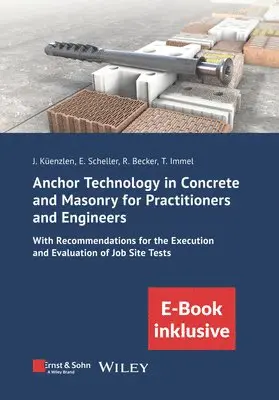
    Anchor Technology in Concrete and Masonry for Practitioners and Engineers: With Recommendations for the Execution and Evaluation of Job Site Tests (incl. eBook as PDF)

    AvJürgen Küenzlen,Eckehard Scheller

    Häftad, Engelska, 2024

    Del i serien Bauingenieur-Praxis

    1 643 kr

    Beställningsvara. Skickas inom 3-6 vardagar. Fri frakt över 249 kr.

    Beskrivning

    Anchors are everyday items in construction. However, the ever more complex world of building has led to anchor technology being investigated in more and more scientific detail during the course of product development. New anchor systems take into account the increasing diversity of base materials and the required economic efficiency. The scientific studies result in sometimes highly complex engineering design methods that are specified in numerous codes of practice, e.g. EN 1992-4 ?Eurocode 2 ? Design of concrete structures ? Part 4: Design of fastenings for use in concrete?. As a result, it is no longer possible to design an anchor with a simple, quick and easily grasped manual calculation.However, the experience of the authors over the past 20 years shows that in order to gain the acceptance of users, there is an urgent need to translate academic anchor theory into manageable anchor practice for real building sites.It is exactly that gap that this book intends to fill. The focus is on the practical use of anchors and answering practical questions such as: "Which anchor do I need for my fastening task and what do I have to consider?" To answer this question, the authors guide the reader through the seemingly vast number of anchor systems and provide advice for everyday building situations. The theory regarding the structural behaviour is only explained, and then only briefly, when it helps to solve the fastening task and understand the solution to that task. For clarity, the reader is merely referred to the existing codes of practice and other specialist publications that provide summaries.(Package: Print Book + ePDF)

    Produktinformation

    • Utgivningsdatum:2024-12-30
    • Mått:170 x 244 x 15 mm
    • Vikt:680 g
    • Format:Häftad
    • Språk:Engelska, Tyska
    • Serie:Bauingenieur-Praxis
    • Antal sidor:320
    • Förlag:Wiley-VCH Verlag GmbH
    • ISBN:9783433033036

    Utforska kategorier

    • Byggnadsteknik inom Naturvetenskap och teknik

    Mer om författaren

    Dr.-Ing. Dipl.-Wirt.-Ing. (FH) Jürgen H. R. Küenzlen LL.M. M.A. M.A.1993-1998 Studies in Civil Engineering at the University of Stuttgart, majoring in Hydraulic Engineering; 1998-1999 Studies in Business Engineering at the University of Applied Sciences Pforzheim.1999-2004 Scientific assistant and deputy laboratory manager at the Institute of Construction Materials at the University of Stuttgart, Department of Fastening Technology; 2004 doctorate (Dr.-Ing.) on the load-bearing behaviour of screw anchors.2004-2007 product manager for window fasteners at Adolf Würth GmbH & Co. KG in Künzelsau/Germany; since 2008 project manager in product management with a focus on approval of anchors in the masonry sector and in the window fastening sector at Adolf Würth GmbH & Co. KG.Collaboration in various working groups and committees on the subject of fall protection, burglary protection, window fixings, masonry; collaboration in the DIBt working group "Tests in Construction". Author and co-author of over 100 technical papers and reference books in the fields of fastening technology and flood protection.Dipl.-Ing. (FH) Eckehard Scheller1987 Apprenticeship as a wood mechanic (carpenter) followed by 2 years as a journeyman; then 1992-1995 civil engineering studies at the Technical University of Applied Sciences Berlin (TFH).1996-2000 structural engineer at Pichler Ingenieure GmbH Berlin.2001-2012 German Institute for Building Technology (DIBt), Department I2 "Anchorages and fixings, stairs".2012-2017 Project Manager Technical Marketing Fastening Technology at Adolf Würth GmbH & Co. KG, Künzelsau/Germany.Since 2017, member of the DIBt working group "Tests in Construction".2018-2020 Head of Technology and Standardisation at the Deutsche Gesellschaft für Mauerwerks- und Wohnungsbau e. V. DGfM (German Society for Masonry and Housing Construction) and head of the office of the Deutscher Ausschuss für Mauerwerk e.V. DAfM (German Masonry Committee).Since 2019 ISB Block und Becker Consulting Engineers PartGmbB.Dipl.-Ing. Rainer Becker1993 University studies in civil engineering, specialising in structural engineering.2000-2013 Research assistant at the Institute for Building Research and research in the area of fastening technology and ETICS; 2001-2012 deputy test centre manager "post-installed reinforcement connections" at the Technical University of Dortmund.Since 2013 managing director of fobatec GmbH with a focus on anchoring and fastening technology, and since 2017 test centre manager "post-installed reinforcement connections" of fobatec GmbH.Since 2018 founding partner of ISB Block und Becker Beratende Ingenieure PartGmbB.Since 2022 managing director of OPUS Engineering GmbH with focus on anchorage and fastening technology.Since 2007, collaboration in various working groups of the DIBt expert committee SVA 21; 2013 appointment to the DIBt SVA 21 "Anchorages and Fastenings"; since 2015 collaboration in the DIBt working group "Tests in Construction"; 2020 appointment to the DIBt SVA "A - ETICS" and "B1 - ETICS on Mineral Substrates".Dipl.-Ing. Thomas Kuhn2005 Diploma in civil engineering at the Technical University of Kaiserslautern.2005-2006 Product development and application consulting at Metall-Kunststoff-Technik GmbH & Co. KG (MKT).Since 2006, sales manager at Adolf Würth GmbH & Co. KG, and customer training for anchor users;2008-2009 Deputy Head and 2010-2022 Head of the DIN EN ISO/IEC 17025:2018 accredited Würth anchor testing laboratory.2022 Key Account Manager Anchor Technology in construction site project management; Since 2023 OPUS Engineering GmbH.Member of TG2.9 Fastenings to structural concrete and masonry of the fib International Federation for Structural Concrete since 2011.Thorsten Immel1995-1998 Apprenticeship as a wholesale and foreign trade merchant at Adolf Würth GmbH & Co. KG;1998-2001 Sales manager at Adolf Würth GmbH & Co. KG;2002-2004 Further training as a technical business administrator at the Chamber of Industry and Commerce, and 2002 specialised training as a "Certified Fastening Technician" trainer (Institut für Werkstoffe im Bauwesen IWB Stuttgart);2002-2010 Product and application consulting, fastening technology division, Adolf Würth GmbH & Co. KG.Since 2010 Würth anchor testing laboratory (DIN EN ISO/IEC 17025:2018 accredited): Performance and documentation of tests as part of approval and assessment procedures for anchors, creation of corresponding approval systems, performance of external and internal, theoretical and practical anchor training courses.

    Innehållsförteckning

    • 1 Introduction1.1 General1.2 By way of an introduction: a real conversation about anchors in a private situation1.3 Anchor technology for professionals2 European regulations2.1 General2.2 European Technical Assessment (ETA)2.3 CE marking2.4 Overview of important regulations3 Base material ? In what material do I want to fasten my anchors?3.1 General3.2 Identifying the base material on the building site3.2.1 Identifying the base material by means of construction documents3.2.2 Identifying the base material without construction documents4 Base materials in detail4.1 Concrete4.1.1 General4.1.2 Cracked (reinforced) concrete4.1.3 Uncracked concrete4.1.4 Types of concrete4.1.5 Compressive strength classes4.2 Masonry4.2.1 General4.2.2 Solid and vertically perforated clay bricks4.2.3 Solid and perforated calcium silicate units4.2.4 Solid and hollow lightweight concrete blocks4.2.5 Aerated concrete blocks4.2.6 Autoclaved aerated concrete: wall, floor and roof panels4.2.7 Solid and hollow masonry units made from normal-weight concrete4.2.8 Stone4.2.9 Base materials subsequently insulated5 Environment -What are the external influences?5.1 General5.2 Temperature5.3 Freezing Temperatures5.4 Fire5.5 Corrosion5.5.1 Advice in the approvals for anchors5.5.2 Advice for anchoring fastenings in concrete according to EN 1992-45.5.3 Additional helpful information6 Member dimensions -Where can I install my anchor?6.1 Definitions of important terms and dimensions in anchor technology6.2 (Minimum) member thickness6.2.1 Concrete6.2.2 Masonry6.3 Edge distance c6.3.1 Concrete6.3.2 Masonry6.4 Spacing s6.4.1 Concrete6.4.2 Masonry6.5 Regulations for approved plastic anchors7 Fixtures and anchor plates -What do I want to fasten?7.1 General7.2 The theory behind fixtures and anchor plates7.3 The support of the fixture7.3.1 General7.3.2 Fixture with statically determinate supports - single fastening7.3.3 Fixture with statically indeterminate supports - multiple fastenings7.3.4 Summary with one example7.4 Clearance holes in fixtures7.5 Types of installation7.5.1 General7.5.2 Fixture mounted afterwards7.5.3 Anchor installed through fixture7.6 Hole patterns in fixtures (arrangement of fastenings)7.7 Fixtures and anchor plates in practice8 Actions -What loads act on my fastening?8.1 General8.2 Loading directions (nature of the loading)8.3 Action effects (types of load)8.4 Design is the job of the planning team!8.5 An example to illustrate action effects8.5.1 General8.5.2 Structural system8.5.3 Self-weight - dead load8.5.4 Imposed loads8.5.5 Actions on the anchors due to dead and imposed loads8.5.6 Dynamic loads8.5.7 Summary9 Anchor systems9.1 Introduction9.2 Anchor systems for anchorages in concrete9.2.1 Metal anchors9.2.2 Bonded anchors9.3 Anchor systems for anchorage in concrete and masonry -Plastic anchors9.4 Anchor systems for anchorage in masonry -Injection systems10 Design11 Installation11.1 Installation technicians - trained personnel11.2 Drill -Drilling - cleaning out drilled holes11.2.1 General11.2.2 Position of the hole11.2.3 Drilling methods11.2.5 Aborted holes11.3 Temperature - working life -Curing time12 Typical mistakes and what we can do differently or better12.1 General12.2 Environment - corrosion12.3 Member dimensions - edge distances and spacings12.4 Anchor systems12.5 Dowel installation13 Summary -How do I solve my fastening task?14 Determining the resistances of plastic anchors and metal injection anchors by means of job sites tests14.1 Introduction14.2 Principles for job site tests involving masonry base materials14.3 Responsibilities14.4 Technical Rule Execution and evaluation of job site tests of plastic anchors for use in concrete and masonry with ETA14.5 Practical example 1: Tension tests on plastic anchors (tests to failure) - fastening of a façade support structure14.6 Technical Rule Execution and evaluation of job site tests of injection anchor systems for use in masonry with ETA14.7 Practical example 2: Tension tests for injection anchors (tests to failure) - fastening a balustrade for a French balcony14.8 Summary14.9 ReferencesAppendix 1 Execution and evaluation of job site tests of plastic anchors for use in concrete and masonry with ETA in accordance with EAD 330284-00-0604 or ETAG 020Appendix 2 Execution and evaluation of job site tests of injection anchor systems for use in masonry with ETA in accordance with EAD 330076-00-0604 or ETAG 029