• Fri frakt över 249 kr
  • •
  • Snabba leveranser
  • •
  • Billiga böcker
Kundservice

Du är på sajten för privatpersoner.

Företag, bibliotek eller offentlig verksamhet?

Du handlar på classic.bokus.com, där alla dina funktioner finns intakta.
Till classic.bokus.com
Bokus logotyp. Gå till startsidan.
  • Erbjudanden
  • Nyheter
  • Student
  • Topplistor
  • Barn & ungdom
  • Bokus Play
  • E-böcker
  • Pocketböcker
  • Spel & pussel

10% rabatt på allt med kod NYSTART10 →

Sidfot

Mina sidor

    Hjälp

    • Kundservice
    • Vanliga frågor och svar
    • Frakt och leverans
    • Retur vid ångerrätt
    • Reklamera vara
    • Betalning
    • Köpvillkor
    • Allmänna villkor
    • Information om webbplatsens tillgänglighet

    Om Bokus

    • Om oss
    • Pressrum
    • För studenter
    • För företag
    • För bibliotek och offentlig verksamhet
    • För leverantörer
    • Hållbarhet

    Populärt

    • Aktuella erbjudanden
    • Presentkort
    • Studentlitteratur
    • Nya böcker
    • Topplistor
    • Signerade böcker
    • Engelska böcker

    Inspiration

    • Boktips
    • BookTok
    • Populära bokserier
    • Barnbokskaraktärer
    • Populära författare
    Logotyp för Bokus
    Följ oss på Facebook (extern länk)Följ oss på Instagram (extern länk)Följ oss på YouTube (extern länk)Följ oss på TikTok (extern länk)
    bokus @ CookiesAnpassa cookiesIntegritetspolicyKöpvillkor
    Till Citymail hemsida (extern länk)Till Budbee hemsida (extern länk)Till Postnord hemsida (extern länk)Till Schenker hemsida (extern länk)Till Early Bird hemsida (extern länk)Till Walleys hemsida (extern länk)
    1. Naturvetenskap och teknik
    2. Teknik och industri
    3. Tillverkningsteknik

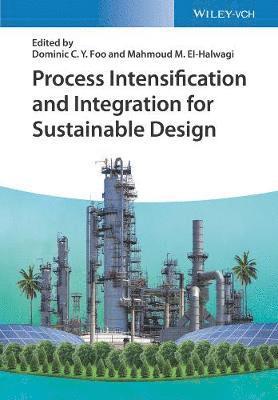
    Process Intensification and Integration for Sustainable Design

    AvDominic C. Y. Foo,Mahmoud M. El-Halwagi

    Inbunden, Engelska, 2021

    1 462 kr

    Beställningsvara. Skickas inom 11-20 vardagar. Fri frakt över 249 kr.

    Beskrivning

    Presents comprehensive coverage of process intensification and integration for sustainable design, along with fundamental techniques and experiences from the industryDrawing from fundamental techniques and recent industrial experiences, this book discusses the many developments in process intensification and integration and focuses on increasing sustainability via several overarching topics such as Sustainable Manufacturing, Energy Saving Technologies, and Resource Conservation and Pollution Prevention Techniques.Process Intensification and Integration for Sustainable Design starts discussions on: shale gas as an option for the production of chemicals and challenges for process intensification; the design and techno-economic analysis of separation units to handle feedstock variability in shale gas treatment; RO-PRO desalination; and techno-economic and environmental assessment of ultrathin polysulfone membranes for oxygen-enriched combustion. Next, it looks at process intensification of membrane-based systems for water, energy, and environment applications; the design of internally heat-integrated distillation column (HIDiC); and graphical analysis and integration of heat exchanger networks with heat pumps. Decomposition and implementation of large-scale interplant heat integration is covered, as is the synthesis of combined heat and mass exchange networks (CHAMENs) with renewables. The book also covers optimization strategies for integrating and intensifying housing complexes; a sustainable biomass conversion process assessment; and more. Covers the many advances and changes in process intensification and integrationProvides side-by-side discussions of fundamental techniques and recent industrial experiences to guide practitioners in their own processesPresents comprehensive coverage of topics relevant, among others, to the process industry, biorefineries, and plant energy managementOffers insightful analysis and integration of reactor and heat exchanger networkLooks at optimization of integrated water and multi-regenerator membrane systems involving multi-contaminantsProcess Intensification and Integration for Sustainable Design is an ideal book for process engineers, chemical engineers, engineering scientists, engineering consultants, and chemists.

    Produktinformation

    • Utgivningsdatum:2021-02-10
    • Mått:178 x 252 x 20 mm
    • Vikt:794 g
    • Format:Inbunden
    • Språk:Engelska
    • Antal sidor:344
    • Förlag:Wiley-VCH Verlag GmbH
    • ISBN:9783527345472

    Utforska kategorier

    • Tillverkningsteknik inom Naturvetenskap och teknik

    Mer om författaren

    Dominic Foo, PhD, is a Professor of Process Design and Integration at the University of Nottingham Malaysia Campus, and is the Founding Director for the Centre of Excellence for Green Technologies. He is also a Fellow of the Institution of Chemical Engineers (IChemE), a Chartered Engineer with the UK Engineering Council, and a Professional Engineer with the Board of Engineer Malaysia (BEM).Mahmoud El-Halwagi, PhD, is the McFerrin Professor at Artie McFerrin Department of Chemical Engineering, Texas A&M University and the Managing Director of the Texas A&M Engineering Experiment Station’s Gas and Fuel Research Center.

    Innehållsförteckning

    • Preface xv1 Shale Gas as an Option for the Production of Chemicals and Challenges for Process Intensification 1Andrea P. Ortiz-Espinoza and Arturo Jiménez-Gutiérrez1.1 Introduction 11.2 Where Is It Found? 11.3 Shale Gas Composition 31.4 Shale Gas Effect on Natural Gas Prices 31.5 Alternatives to Produce Chemicals from Shale Gas 41.6 Synthesis Gas 41.7 Methanol 51.8 Ethylene 61.9 Benzene 71.10 Propylene 71.11 Process Intensification Opportunities 81.12 Potential Benefits and Tradeoffs Associated with Process Intensification 101.13 Conclusions 11References 112 Design and Techno-Economic Analysis of Separation Units to Handle Feedstock Variability in Shale Gas Treatment 15Eric Bohac, Debalina Sengupta, andMahmoud M. El-Halwagi2.1 Introduction 152.2 Problem Statement 162.3 Methodology 172.4 Case Study 172.4.1 Data 182.4.2 Process Simulations and Economic Evaluation 192.4.2.1 Changes in Fixed and Variable Costs 202.4.2.2 Revenue 212.4.2.3 Economic Calculations 212.4.3 Safety Index Calculations 222.5 Discussion 232.5.1 Process Simulations 232.5.1.1 Dehydration Process 232.5.1.2 NGL Recovery Process 232.5.1.3 Fractionation Train 262.5.1.4 Acid Gas Removal 262.5.2 Profitability Assessment 262.5.3 High Acid Gas Case Economics 302.5.4 Safety Index Results 302.5.5 Sensitivity Analysis 322.5.5.1 Heating Value Cases 332.5.5.2 NGL Price Cases 342.6 Conclusions 35Appendices 352.A Appendix A: Key Parameters for the Dehydration Process 362.B Appendix B: Key Parameters for the Turboexpander Process 362.C Appendix C: Key Parameters for the Fractionation Train 372.D Appendix D: Key Parameters for the Acid Gas Removal System 37References 393 Sustainable Design and Model-Based Optimization of Hybrid RO–PRO Desalination Process 43Zhibin Lu, Chang He, Bingjian Zhang, Qinglin Chen, and Ming Pan3.1 Introduction 433.2 Unit Model Description and Hybrid Process Design 473.2.1 The Process Description 473.2.2 Unit Model and Performance Metrics 493.2.2.1 RO Unit Model 493.2.2.2 PRO Unit Model 523.2.3 The RO–PRO Hybrid Processes 543.2.3.1 Open-Loop Configuration 543.2.3.2 Closed-Loop Configuration 553.3 Unified Model-Based Analysis and Optimization 563.3.1 Dimensionless Mathematical Modeling 563.3.2 Mathematical Model and Objectives 583.3.3 Optimization Results and Comparative Analysis 593.4 Conclusion 62Nomenclature 63References 654 Techno-economic and Environmental Assessment of Ultrathin Polysulfone Membranes for Oxygen-Enriched Combustion 69Serene Sow Mun Lock, Kok Keong Lau, Azmi Mohd Shariff, Yin Fong Yeong, and Norwahyu Jusoh4.1 Introduction 694.2 Numerical Methodology for Membrane Gas Separation Design 704.3 Methodology 734.3.1 Simulation and Elucidation of Mixed Gas Transport Properties of Ultrathin PSF Membranes (Molecular Scale) 734.3.2 Simulation of Mathematical Model Interfaced in Aspen HYSYS for Mass and Heat Balance (Mesoscale) 754.3.3 Design of Oxygen-Enriched Combustion Using Ultrathin PSF Membranes 754.4 Results and Discussion 774.4.1 Simulation and Elucidation of Mixed Gas Transport Properties of Ultrathin PSF Membranes (Molecular) 774.4.2 Simulation of Mathematical Model Interfaced in Aspen HYSYS for Mass and Heat Balance (Mesoscale) 794.4.3 Design of Oxygen-Enriched Combustion Using Ultrathin PSF Membranes 824.4.3.1 Membrane Area Requirement 824.4.3.2 Compressor Power Requirement 834.4.3.3 Turbine Power Requirement 854.4.3.4 Economic Parameter 884.5 Conclusion 90Acknowledgment 91References 915 Process Intensification of Membrane-Based Systems for Water, Energy, and Environment Applications 97Nik A. H.M. Nordin, Zulfan A. Putra, Muhammad R. Bilad, Mohd D. H.Wirzal, Lila Balasubramaniam, Anis S. Ishak, and Sawin Kaur Ranjit Singh5.1 Introduction 975.2 Membrane Electrocoagulation Flocculation for Dye Removal 995.3 Carbonation Bioreactor for Microalgae Cultivation 1025.4 Forward Osmosis and Electrolysis for Energy Storage and Treatment of Emerging Pollutant 1075.5 Conclusions and Future Perspective 111References 1136 Design of Internally Heat-Integrated Distillation Column (HIDiC) 117Vasu Harvindran and Dominic C. Y. Foo6.1 Introduction 1176.2 Example and Conceptual Design of Conventional Column 1196.3 Basic Design of HIDiC 1206.4 Complete Design of HIDiC 1226.4.1 Top-Integrated Column 1226.4.2 Bottom-Integrated Column 1236.4.3 Geometrical Analysis for Heat Panels 1246.5 Energy Savings and Economic Evaluation 1266.6 Concluding Thoughts 128References 1287 Graphical Analysis and Integration of Heat Exchanger Networks with Heat Pumps 131Minbo Yang and Xiao Feng7.1 Introduction 1317.2 Influences of Heat Pumps on HENs 1327.2.1 Case 1 1337.2.2 Case 2 1347.2.3 Case 3 1347.2.4 Case 4 1357.2.5 Case 5 1367.2.6 Case 6 1367.2.7 Case 7 1367.3 Integration of Heat Pump Assisted Distillation in the Overall Process 1387.3.1 Increase of Pinch Temperature 1387.3.2 Decrease of Pinch Temperature 1407.3.3 No Change in Pinch Temperature 1417.3.4 Heat Pump Placement 1427.4 Case Study 1457.5 Conclusion 148References 1488 Insightful Analysis and Integration of Reactor and Heat Exchanger Network 151Di Zhang, Guilian Liu, and Xiao Feng8.1 Introduction 1518.2 Influence of Temperature Variation on HEN 1528.2.1 Location of Cold and Hot Streams 1528.2.2 Effect of Temperature Variation 1538.3 Relation Among Reactor Parameters 1568.3.1 Relation Among Temperatures, Selectivity, and Conversion of Reactor 1578.3.1.1 CSTR 1598.3.1.2 PFR 1598.3.2 Reactor Characteristic Diagram 1608.4 Coupling Optimization of HEN and Reactor 1618.5 Case Study 1638.6 Conclusions 165References 1669 Fouling Mitigation in Heat Exchanger Network Through Process Optimization 167Yufei Wang and Xiao Feng9.1 Introduction 1679.2 Operation Parameter Optimization for Fouling Mitigation in HENs 1699.2.1 Description on Velocity Optimization 1699.2.2 Fouling Threshold Model 1719.2.3 Heat Transfer Related Models 1729.2.4 Pressure Drop Related Models 1749.3 Optimization of Cleaning Schedule 1759.4 Application of Backup Heat Exchangers 1759.5 Optimization Constraints and Objective Function 1769.5.1 Optimization Constraints 1769.5.2 Objective Function 1779.5.3 Optimization Algorithm 1789.6 Case Studies 1789.6.1 Case Study 1: Consideration of Velocity Optimization Alone 1789.6.1.1 Optimization Results 1809.6.2 Case Study 2: Simultaneous Consideration of Velocity and Cleaning Schedule Optimization 1869.6.2.1 Constraints for Case Study 1889.6.2.2 Results and Discussion 1899.6.2.3 Considering Backup Heat Exchanger 1949.7 Conclusion 194Acknowledgments 196References 19810 Decomposition and Implementation of Large-Scale Interplant Heat Integration 201Runrun Song, Xiao Feng, Mahmoud M. El-Halwagi, and Yufei Wang10.1 Introduction 20110.1.1 Reviews and Discussions for Stream Selection 20210.1.2 Reviews and Discussions for Plant Selection 20410.1.3 Reviews and Discussions for Plant Integration 20410.2 Methodology 20510.2.1 Strategy 1 – Overview 20510.2.2 Identification of Heat Sources/Sinks for IPHI from Individual Plants 20610.2.3 Decomposition of a Large-Scale IPHI Problem into Small-Scale Subsections 20710.2.4 Strategy 2 for Indirect IPHI 20910.3 Case Study 21210.3.1 Example 1 21210.3.2 Example 2 21510.4 Conclusion 217References 21811 Multi-objective Optimisation of Integrated Heat, Mass and Regeneration Networks with Renewables Considering Economics and Environmental Impact 221So-Mang Kim, Adeniyi J. Isafiade, and Michael Short11.1 Introduction 22111.2 Literature Review 22211.2.1 Regeneration in Process Synthesis 22211.2.2 The Analogy of MEN and REN 22211.2.3 Combined Heat and Mass Exchange Networks (CHAMENs) 22411.3 Environmental Impact in Process Synthesis 22511.3.1 Life Cycle Assessment 22511.4 The Synthesis Method and Model Formulation 22611.4.1 Synthesis Approach 22711.4.2 Assumptions 22911.4.3 MINLP Model Formulation 23011.4.3.1 HENS Model Equations 23011.4.3.2 MEN and REN Model Equations 23311.4.3.3 The Combined Economic Objective Function 23611.4.3.4 Initializations and Convergence 23911.5 Case Study 24011.5.1 H2S Removal 24011.5.1.1 Synthesis of MEN (The First Step) 24211.5.1.2 Simultaneous Synthesis of MEN and REN (The Second Step) 24311.5.1.3 Simultaneous Synthesis of MEN, REN, and HEN (The Third Step) 24411.5.1.4 Absorption and Regeneration Temperature Optimization 24711.5.1.5 The Synthesis of Combined Model Using MOO 25211.6 Conclusions and Future Works 254References 25612 Optimization of Integrated Water and Multi-regenerator Membrane Systems Involving Multi-contaminants: A Water-Energy Nexus Aspect 261Musah Abass and Thokozani Majozi12.1 Introduction 26112.2 Problem Statement 26312.3 Model Formulation 26312.3.1 Material Balances for Sources 26412.3.2 Mass and Contaminants Balances for Regeneration Units 26512.3.3 Mass and Contaminant Balances for Permeate and Reject Streams 26512.3.4 Mass and Contaminant Balances for Sinks 26612.3.5 Modeling of the Regeneration Units 26612.3.5.1 Performance of Regeneration Units 26612.3.6 Logical Constraints 26712.3.7 The Objective Function 26712.4 Illustrative Example 26812.5 Conclusion 272Acknowledgments 27212.A Appendix: Detailed Models for the ED and RO Modules 273Nomenclature 280References 28213 Optimization Strategies for Integrating and Intensifying Housing Complexes 285Jesús M. Núñez-López, and JoséM. Ponce-Ortega13.1 Introduction 28513.2 Methods 28813.2.1 Total Annual Cost for the Integrated System 28913.2.2 FreshWater Consumption 28913.2.3 GHGE Emissions 29013.2.4 Environmental Impact 29013.2.5 Sustainability Return of Investment 29313.2.6 Process Route Healthiness Index 29313.2.7 Multistakeholder Approach 29513.3 Case Study 29513.4 Results 29613.5 Conclusions 296References 29914 Sustainable Biomass Conversion Process Assessment 301Eric C. D. Tan14.1 Introduction 30114.2 Methodology and Assumptions 30214.3 Results and Discussion 30514.3.1 Environmental Indicators 30514.3.2 Energy Indicators 31014.3.3 Efficiency Indicators 31214.3.4 Economic Indicators 31314.4 Conclusions 314Acknowledgments 316References 317Index 319